The Bridge Experts Called Impossible
Before 1937, San Francisco was the largest American city still served mainly by ferry boats. Getting to Marin County meant a boat ride of about 20 minutes. Many experts said a bridge here could not be built. The strait had strong, swirling tides, water 372 feet deep in the middle, fierce winds and blinding fog.
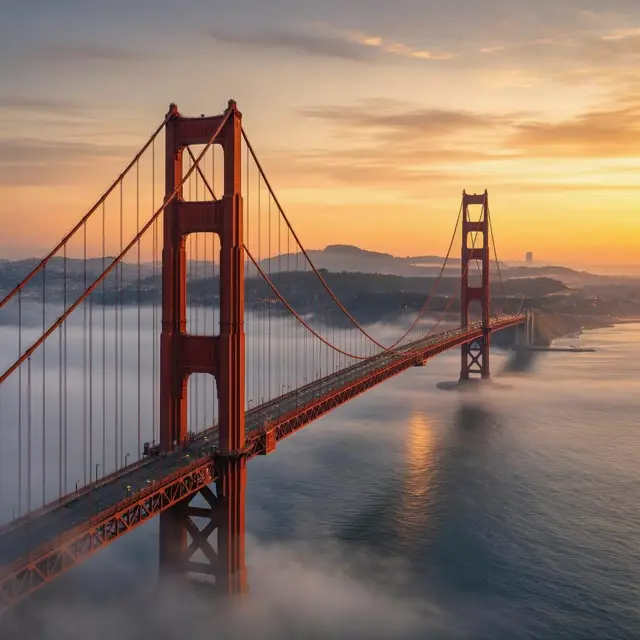
They were wrong. The Golden Gate Bridge opened on May 27, 1937. At the time it was both the longest and the tallest suspension bridge in the world. Its main span stretches 4,200 feet, and it stands 746 feet tall.
Today Frommer's travel guide calls it "possibly the most beautiful, certainly the most photographed, bridge in the world." The American Society of Civil Engineers lists it as one of the Wonders of the Modern World.
The Quiet Genius Who Got Fired
Joseph Strauss was the chief engineer, and he took most of the credit. But Strauss had little experience with suspension designs. His first plan, a huge cantilever on each side joined by a short hanging section in the middle, was rejected mainly because of how it looked. The graceful final design came largely from others.
Leon Moisseiff produced the basic structure. Charles Ellis did much of the technical work. Then, in 1931, Strauss fired Ellis, supposedly for spending too much money on telegrams. Ellis kept going anyway. He worked 70 hours a week without pay and turned in ten volumes of hand calculations.
Ellis got none of the credit in his lifetime. Only in 2007 did the bridge district decide to give him major credit for the design. Ellis also designed a clever "bridge within a bridge," a steel arch that carries the road over Fort Point, an old fort, so it would not have to be torn down.
Why It Is Orange, Not Striped
The famous color was chosen by Irving Morrow, a little-known architect of homes. He also shaped the towers and added the Art Deco touches, from the streetlights to the railings. The US Navy had a very different idea. It wanted the bridge painted with black and yellow stripes, so passing ships could see it.
Morrow's color won. Officially it is international orange, an orange vermilion. He picked it because it suits the natural surroundings and makes the bridge easier to see in fog.
Keeping it that way is a job that never ends. A crew of 38 painters touches up the spots where the steel has badly corroded. The paint has changed over time too. The original lead-based coats began to be stripped in the mid-1960s, and since 1990 acrylic topcoats have been used for air-quality reasons.
Safety Nets, an Old Brick and Roller Skates
Construction began on January 5, 1933. Money had been hard to raise after the 1929 stock market crash, until Amadeo Giannini, the founder of Bank of America, agreed that his bank would buy the entire bond issue. The bridge was finished ahead of schedule and $1.3 million under budget.
Strauss did bring one lasting idea: movable safety nets under the workers. Nineteen men were saved by those nets during the project. He also placed a brick from a demolished building at his old university in the south anchorage before the concrete was poured.
The opening was a party that lasted a week. The day before cars were allowed, 200,000 people crossed on foot or on roller skates. A student sprinter named Donald Bryan was the first to make it across from one end to the other. The next day, President Franklin D. Roosevelt pushed a button in Washington, D.C., to start car traffic at noon.
Foghorns, Wind and a Singing Railing
Summer fog can hide the whole bridge, so it has five foghorns, set up in 1937 and still working. Two deep horns on the south tower blast for 2 seconds every 18 seconds. Three higher horns at the middle of the span answer after every two of those blasts. Ships follow their sound to stay on the right side of the channel.
The bridge was built to handle winds of up to 68 mph, and an anemometer between the towers keeps track of them. In 2019 new, more flexible railing slats went in to help it cope with winds of up to 100 mph. Then, in June 2020, people across San Francisco and Marin began hearing an eerie hum. When strong wind blew through the slats, they whistled.
One engineering analysis found the tones matched the musical notes F, G, A and B. A fix of 12,000 clips with rubber dampers was approved in 2021. Even so, the bridge is expected to keep up its high whistle for about 70 hours a year.