Seven Alarm Clocks and One Backward Clock
At age seven, Grace Murray wanted to know how an alarm clock worked. She took one apart. Then another. She had dismantled seven of them before her mother noticed and limited her to just one clock. That curiosity stayed with her for life.
Later she kept a clock on her wall that ran counterclockwise. Her reason: "Humans are allergic to change. They love to say, 'We've always done it this way.' I try to fight that."
Her path was not smooth at first. Vassar College turned her down for early admission at 16 because her Latin scores were too low. She got in the next year and graduated in 1928 with a degree in mathematics and physics. She went on to earn a master's degree and then, in 1934, a Ph.D. in mathematics from Yale. By 1941 she was an associate professor of mathematics back at Vassar.
Too Light for the Navy, Then First in Her Class
When World War II began, Hopper tried to join the Navy. She was turned down. At 34 she was considered too old, and her weight was too low for her height. The Navy also felt her teaching job was valuable to the war effort.
She did not give up. In 1943 she took leave from Vassar and joined the Navy Reserve. She needed a special exemption because she weighed 15 pounds less than the Navy's 120-pound minimum. She then graduated first in her class in 1944.
The Navy sent her to Harvard University to work on the Mark I, one of the earliest computers. She became one of its first programmers. She is also credited with writing the first computer manual, "A Manual of Operation for the Automatic Sequence Controlled Calculator". She liked the work so much that she later turned down a full professorship at Vassar to stay at Harvard.
The Moth in the Machine
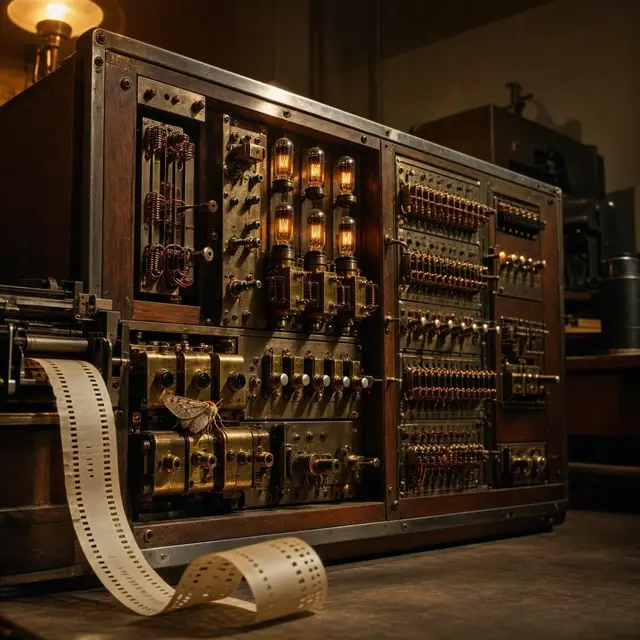
In 1947, Hopper's team at Harvard was working on the Mark II computer when it started acting up. The cause was a moth stuck in a relay. They pulled it out and taped it into the day's log with the note: "First actual case of bug being found". The word "bug" for a fault had been used in other fields for decades. But this moment became a famous early example of debugging a computer, and Hopper is credited with making the term popular. The moth is still taped in that log book at the Smithsonian's National Museum of American History.
She also had a gift for making tiny things visible. When generals and admirals asked why satellite messages took so long, she handed them pieces of wire 11.8 inches long. That is how far light travels in one nanosecond. A coil 984 feet long stood for a microsecond. Later, she handed out packets of ground pepper and called each grain a picosecond.
Teaching Computers to Read English
In 1949, Hopper joined the company building the UNIVAC I, the first known large-scale electronic computer sold on the market. She had a bold idea. People should write programs in plain English words, and the computer should translate them into machine code. She was quickly told this was impossible because computers didn't understand English.
She kept going. By 1952 she had a working compiler called A-0. "Nobody believed that," she said later. "I had a running compiler and nobody would touch it. They told me computers could only do arithmetic." Her idea took three years to be accepted. Her team went on to release some of the first compiler-based languages, including FLOW-MATIC.
In 1959, experts met to design a new business language called COBOL. It built on FLOW-MATIC and captured Hopper's belief in English-like code. Instead of symbols, you could write something like "Subtract income tax from pay". COBOL became hugely popular, and Hopper earned the nickname "Grandma COBOL".
The Navy Could Not Let Her Go
Hopper retired from the Navy Reserve in 1966, at age 60. Less than a year later, the Navy called her back for six months. Those six months turned into an open-ended assignment. She retired again in 1971 and was asked to return in 1972. She became a captain in 1973 and later a rear admiral, one of the Navy's few female admirals.
When she finally retired in 1986, she was the oldest active-duty commissioned officer in the U.S. Navy, at 79 years, eight months and five days. Her ceremony took place aboard the USS Constitution, the Navy's oldest commissioned ship.
Even then she kept working, as a consultant for Digital Equipment Corporation until her death in 1992. Her honors piled up: 40 honorary degrees, a Navy destroyer named USS Hopper, and the Presidential Medal of Freedom in 2016. Nvidia even named a GPU generation Hopper and a CPU generation Grace after her.