The Bored Student Who Was Not Officially an Eiffel
Gustave Eiffel was not a keen student. He found his classes in Dijon boring and a waste of time, until his history and literature teachers got him to study seriously in his last two years. His uncle, who had invented a way of distilling vinegar, and a chemist friend of his, taught him about everything from chemistry to mining.
Officially, he was not even Eiffel at first. His family took the name from the Eifel mountains in the German region they came from. But Gustave was registered at birth as Bonickhausen dit Eiffel, and the name was not formally changed until 1880.
His big break was a 500 m iron railway bridge over the river Garonne at Bordeaux. He started out assembling the metalwork and ended up running the entire project. Much later, a plan to demolish that bridge sparked a public campaign, and in 2010 it was listed as a French Historical Monument.
Bridges That Broke Records and a Floating Dome
In 1875, Eiffel's company won the job of bridging the river Douro in Portugal. The river was fast, up to 20 m deep, and its bed was deep gravel, so no piers could stand in it. The bridge needed a central span of 160 m, longer than any arch span built at the time. Eiffel's price was far below his nearest rival, and the bridge opened in November 1877.
That success won him the Garabit viaduct in France with no competing bids. He also created prefabricated bridges from a few standard parts, small enough to carry where roads were poor or missing. They were joined with bolts instead of rivets, so fewer skilled workers were needed on site.
His cleverest trick may be in Nice. The observatory dome he designed there was 22.4 m wide, the largest in the world when built. It did not run on wheels. It floated on a ring-shaped hollow girder sitting in a trough of water mixed with magnesium chloride.
The Hidden Frame Inside the Statue of Liberty
In 1881, the sculptor Auguste Bartholdi needed an engineer to help make the Statue of Liberty a reality. Some work had already been done by Eugène Viollet-le-Duc, who died in 1879. Eiffel was chosen because of his experience with the stress that wind puts on structures.
His answer is hidden inside. He designed a four-legged pylon that supports the copper sheets forming the statue's body. The entire statue was first put up at the Eiffel works in Paris, then taken apart and shipped to the United States.
Eiffel liked to show metal rather than hide it. Most railway stations of his time hid their iron frames behind fancy fronts. His design for the Nyugati station in Budapest put the metal structure right at the center, with ordinary stone and brick buildings on each side. He believed every engineering choice should rest on a careful calculation of the forces involved.
A Tower Drawn to a Tenth of a Millimetre
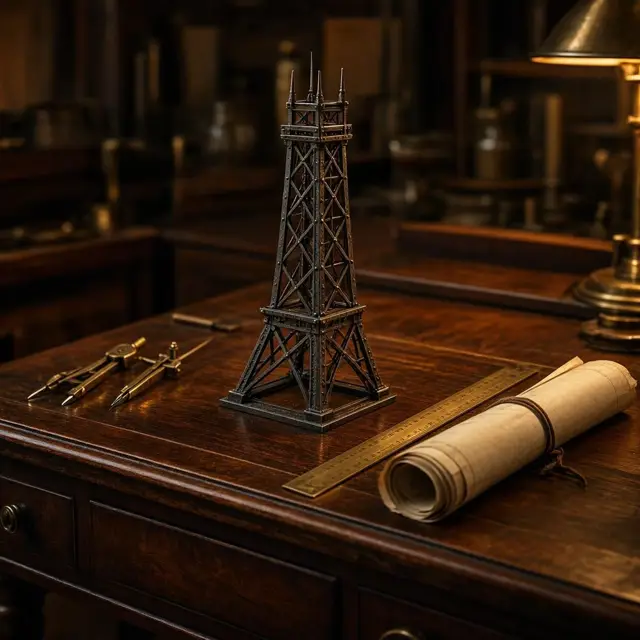
Here is the surprise: the Eiffel Tower was not Eiffel's idea. Two of his engineers, Maurice Koechlin and Émile Nouguier, sketched it in 1884. Eiffel was not keen at first. Once the architect Stephen Sauvestre added decorative arches, a glass pavilion and a cupola, he backed it and bought the patent. Many famous artists hated it. A group called the Committee of Three Hundred, one member for each metre of the tower's height, published a petition calling it a hateful column of bolted sheet metal.
The build was astonishingly precise. The drawing office made 1,700 general drawings and 3,629 detail drawings for 18,038 different parts. Rivet holes were placed to within 0.1 mm, and nothing was drilled or shaped on site. If a part did not fit, it went back to the factory.
On 31 March 1889, Eiffel led officials to the top on foot, since the lifts were not working yet. The climb took over an hour.
Testing the Air From His Own Tower
After a financial scandal linked to the Panama Canal, Eiffel left his company in 1893 and turned to science. Wind had always been a problem for his structures, so he set out to understand it.
His first tests used his own tower. He dropped surfaces with measuring equipment down a cable stretched from the second level to the ground, and showed that air resistance is closely tied to the square of the airspeed. In 1909 he built a wind tunnel at the foot of the tower and tested the airfoil shapes used by aviation pioneers like the Wright Brothers and Louis Blériot. He found that a wing's lift comes from lower air pressure above it, rather than higher pressure below. When neighbours complained about the noise, he moved to a bigger site at Auteuil in 1912.
In 1913, the Smithsonian Institution gave him the Samuel P. Langley Medal. Alexander Graham Bell said his writings on air resistance had already become classical.