A Curved Wall in the Black Canyon
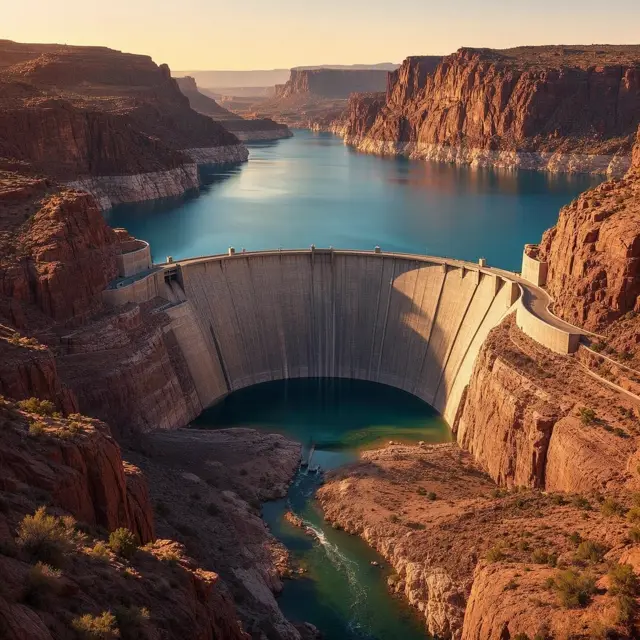
Hoover Dam stands in the Black Canyon of the Colorado River, right on the border between Nevada and Arizona. Workers built it between 1931 and 1936, during the Great Depression. Nothing this large had ever been made from concrete, and some of the methods were untested. Even so, the dam was handed to the federal government on March 1, 1936, more than two years ahead of schedule.
It is an arch-gravity dam. Its wall is 660 feet thick at the bottom and only 45 feet thick at the top, leaving room for a highway. The curve bulges toward the water, so the push of the lake is passed into the rock walls of the canyon.
Behind it sits Lake Mead. Water flows from the lake into intake towers and down four narrowing penstocks to the turbines, reaching about 85 mph. By 1939 the dam's power plant was the largest hydroelectric facility in the world. Today, water from Lake Mead serves 18 million people in Arizona, Nevada and California.
Moving a River Out of the Way
Before building could start, the Colorado River had to be moved. Crews drove four huge tunnels through the canyon walls, two on each side. Each was 56 feet across, and together they ran more than 3 miles. The contract set a fine of $3,000 a day for any delay, and the river could only be safely diverted in late fall and winter, when its water was low. On November 13, 1932, the river was sent into the two Arizona tunnels.
Next came two cofferdams to keep the river off the work site. The upper one was 96 feet high and 750 feet thick at its base, thicker than the dam itself. Then crews dug down to solid bedrock, removing about 1,500,000 cubic yards of material.
The canyon walls also had to be cleared of loose rock. That job went to the "high scalers," who hung from ropes with jackhammers and dynamite. They became a tourist attraction, and one was nicknamed the "Human Pendulum." Some dipped cloth hats in tar to guard against falling objects, and the company ordered thousands of "hard boiled hats," later called hard hats.
The 125-Year Cooling Problem
Concrete heats up and shrinks as it hardens. At this size, that was a serious problem. Engineers calculated that if the dam were poured in one continuous block, the concrete would take 125 years to cool. The uneven stresses would make the dam crack and crumble.
So they built it like a giant set of building blocks. The ground was marked into rectangles, and the concrete was poured in columns, some blocks as large as 50 feet square and 5 feet high. Inside each block ran 1-inch steel pipes. Cool river water flowed through them first, then ice-cold water from a refrigeration plant. Once a block stopped shrinking, the pipes were filled with grout. More than 582 miles of cooling pipe ended up inside.
The numbers are wild. The dam holds 3,250,000 cubic yards of concrete, enough to pave a two-lane highway from San Francisco to New York. It arrived in steel buckets that weighed 20 short tons when full, and each bucket raised the concrete in a form by just 1 inch. Tests in 1995 found that the concrete is still slowly getting stronger.
Art Deco in the Desert
The first plans for the dam's look were plain, with a Gothic-inspired railing and eagle statues. Critics said that was too dull for such a huge project. So architect Gordon B. Kaufmann was brought in. He streamlined everything and gave the whole site an elegant Art Deco style, with sculpted turrets rising smoothly from the dam face.
The intake towers carry two clocks, one set to Nevada time and one to Arizona time. The states sit in different time zones, but Arizona skips daylight saving time, so the clocks show the same time for more than half the year. Artist Allen Tupper True designed the floors and walls, and also created a colour code for pipes and machinery that was then used across all Bureau of Reclamation projects.
Sculptor Oskar J. W. Hansen added two 30-foot bronze statues called the Winged Figures of the Republic. To set them down without scratching their polished surface, workers placed them on ice and guided them into position as it melted. Around their base, a terrazzo floor holds a star map showing the sky at the moment of the dedication, so future astronomers could work out the exact date.
Hoover, Then Boulder, Then Hoover Again
The dam's name has its own story. In 1930, Interior Secretary Ray Wilbur named it Hoover Dam after President Herbert Hoover, even though no dam had ever been named for a president while in office. After the Roosevelt administration took over, Interior Secretary Harold Ickes ordered in 1933 that it be called Boulder Dam. Congress had already used the name Hoover Dam in five funding bills, but Ickes ignored that.
At the dedication on September 30, 1935, Ickes said "Boulder Dam" five times within thirty seconds. Hoover was not invited, and President Franklin D. Roosevelt avoided mentioning his name in his speech. The ceremony took place in 102 °F heat in front of 10,000 people. It was moved three hours earlier that morning, because officials had not realised that the President's radio slot was booked in Eastern Time.
Still, the name Boulder Dam never fully stuck. Americans used both names, and mapmakers were divided over which to print. In 1947, Congress voted unanimously to bring back the name Hoover Dam. Today about 7 million tourists visit each year.