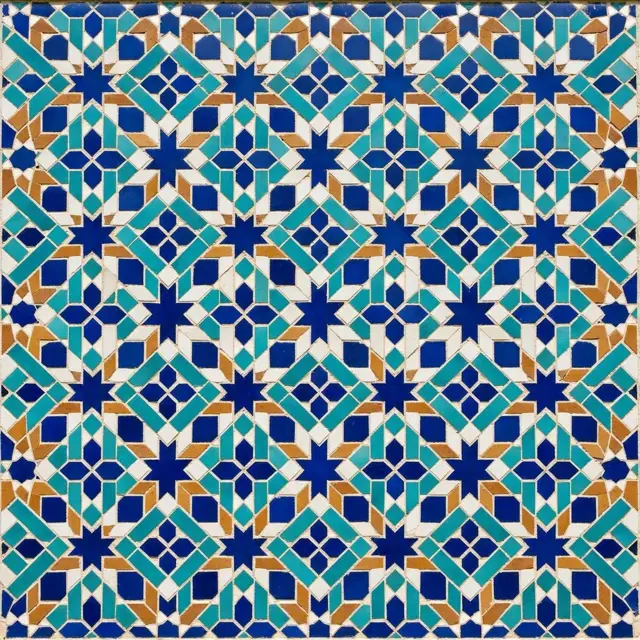
Built From Squares and Circles
Islamic geometric patterns are one of the main forms of Islamic ornament, alongside the arabesque of curving plant forms and calligraphy. The tradition tends to avoid figurative images, and the geometry took their place.
Most designs start from a small set of shapes: squares, circles and polygons such as pentagons and octagons, repeated, overlapped and interlaced. A recurring motif is the eight-pointed star, which is simply two squares with one rotated 45 degrees against the other.
The drawing method is strikingly plain. The patterns sit on grids that need only a ruler and compass to construct, and each result can be read as a mathematical tessellation that would extend forever if the wall did. One artist and educator has argued that these step by step constructions are effectively algorithms, making the tradition an ancestor of modern algorithmic art.
The circle usually comes first. A 15th century mosque in Yazd is built on one circle divided by six more drawn around it, producing a hexagon and then a six-pointed star pattern that fills the wall.
Five Hundred Years of Getting Harder
The patterns did not arrive fully formed. They grew more complex over centuries, and the dates are surprisingly specific.
The earliest are isolated shapes, eight-pointed stars and lozenges, at the Great Mosque of Kairouan in Tunisia in 836. Six- and eight-point stars appear at the Ibn Tulun Mosque in Cairo in 879 and spread from there.
From the 11th century the variety opens up. Seven- and ten-point girih patterns appear at the Jameh Mosque of Isfahan in 1086, and ten-point girih became common across the Islamic world, though not in Spain. Sweeping nine, eleven and thirteen-point patterns followed at the Barsian Mosque in 1098, and these stayed largely within Persia and central Asia. Eight and twelve-point rosettes reached Konya in Turkey in 1220 and Baghdad in 1230.
The late stage pushes higher still. Sixteen-point patterns appear in Cairo in 1321 and at the Alhambra between 1338 and 1390, while fourteen-point patterns turn up at Fatehpur Sikri in India in the late 16th century.
Tile, Plaster, Wood and Ceiling
The same geometry appears across completely different crafts. Moroccan zellij is tilework of glazed terracotta pieces set into plaster to make mosaics of regular and semi-regular tessellations, used on mosques, public buildings and the houses of the wealthy.
The carved ceilings of semi-domes, called muqarnas, are built as tiers of small niches that shrink as they rise. They are usually made of stucco and carry no structural load, and they run across Islamic architecture from Spain and Morocco to Persia.
Girih patterns were made in cut brickwork, stucco and mosaic tilework, and in woodwork they became lattice frames, sometimes filled with coloured glass, or mosaic panels for walls and ceilings. Most rest on a partly hidden grid, with the visible strapwork weaving over and under itself and deliberately not lining up with the construction lines beneath.
One Western belief about this work is that craftsmen introduced deliberate mistakes out of humility. That explanation is not supported.
Mathematics Catching Up
The Alhambra in Granada has been studied intensely by mathematicians looking for symmetry types. Moroccan geometric woodwork from the 14th to 19th centuries uses only five of the wallpaper symmetry groups, though one traditional construction method is claimed to be able to generate all seventeen.
The Dutch artist M. C. Escher visited the Alhambra and it redirected his career. He called its decoration the richest source of inspiration he had ever tapped, and went off to study the mathematics of tessellation.
The most striking case came in 2007. Two physicists, Peter Lu and Paul Steinhardt, showed that girih designs such as those on the Darb-e Imam shrine in Isfahan produce quasi-periodic tilings, patterns that never quite repeat, resembling those Roger Penrose described in 1973. They argued these were built not with ruler and compass but from a set of five decorated tiles.
In 2016 a researcher used patterns from Iranian tomb towers to design rubber sheets that expand sideways when pulled, a property useful for surgical stents.