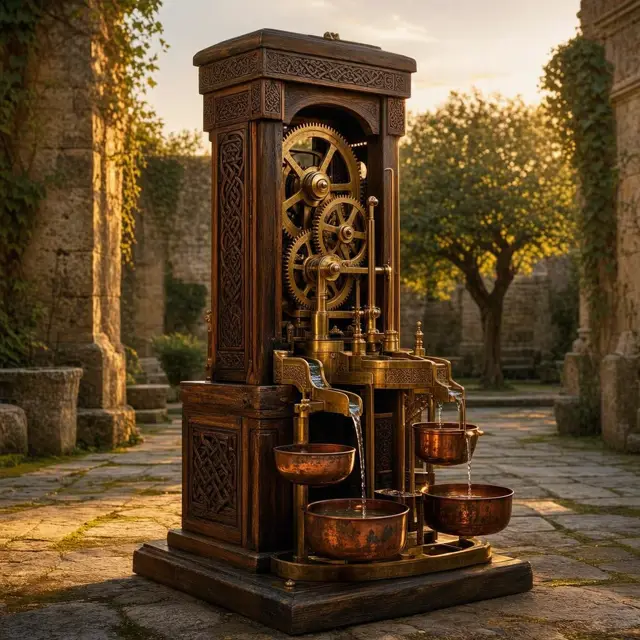
The Engineer Who Only Wrote What He Built
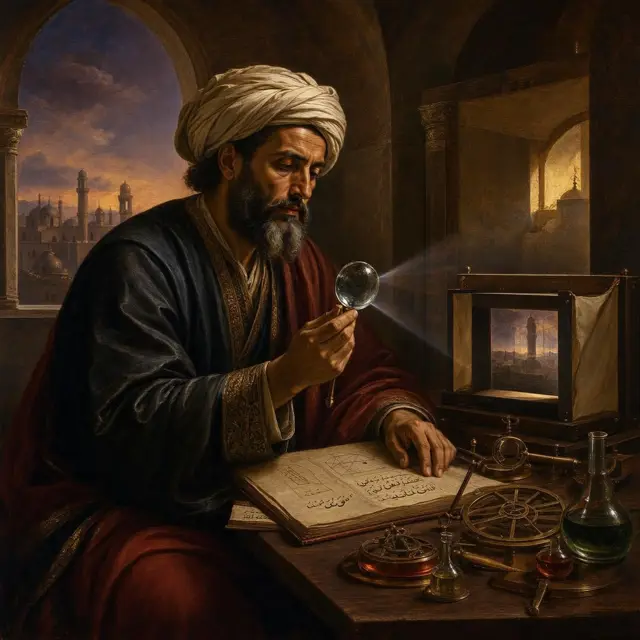
Ismail al-Jazari was born in 1136 in Upper Mesopotamia. Like his father before him, he worked as chief engineer at the Artuklu Palace, home of the Artuqid rulers. Almost everything we know about his life comes from a single book.
In 1206 he finished The Book of Knowledge of Ingenious Mechanical Devices. It describes 50 machines and explains how to build each one. Al-Jazari stresses again and again that he only describes devices he built himself. One historian says it reads like a modern do-it-yourself book. It was clearly popular, because many handmade copies survive.
He was a hands-on maker more than a theory person. His machines were usually put together by trial and error, not worked out with calculations. He was also a skilled artist who illustrated his inventions with miniature paintings. Today some call him the father of robotics.
Clocks That Put On a Show
Al-Jazari's clocks did much more than tell time. His famous elephant clock was the first clock in which an automaton reacted after set periods of time. A figure struck a cymbal and a mechanical bird chirped. It was also the first water clock to track temporal hours accurately, matching the way day length changes through the year.
His largest was the castle clock, about 3.4 metres tall. A pointer shaped like a crescent moon travelled across the top of a gateway, moved by a hidden cart. Every hour, a door opened to reveal a figure. Five musician figures played music, worked by a hidden camshaft on a water wheel.
He also built candle clocks, the most advanced ones known, and one used a bayonet fitting still found today. His water-powered scribe clock, about a metre high, was rebuilt successfully at the Science Museum in London in 1976.
Robot Servants and a Drum Machine
Al-Jazari loved machines that seemed alive. One was a waitress figure that could serve water. The drink dripped from a tank into a bucket and, after seven minutes, into a cup. Then the waitress appeared through an automatic door, serving it.
Another was a hand-washing machine shaped like a person made of jointed copper. A servant turned a knob, and water poured from a peacock-shaped jug in its right hand. When the water was nearly gone, the left hand reached out with a towel, comb and mirror. His peacock fountain went further. As the basin filled, a float made a servant figure appear with soap. More water triggered a second figure with a towel.
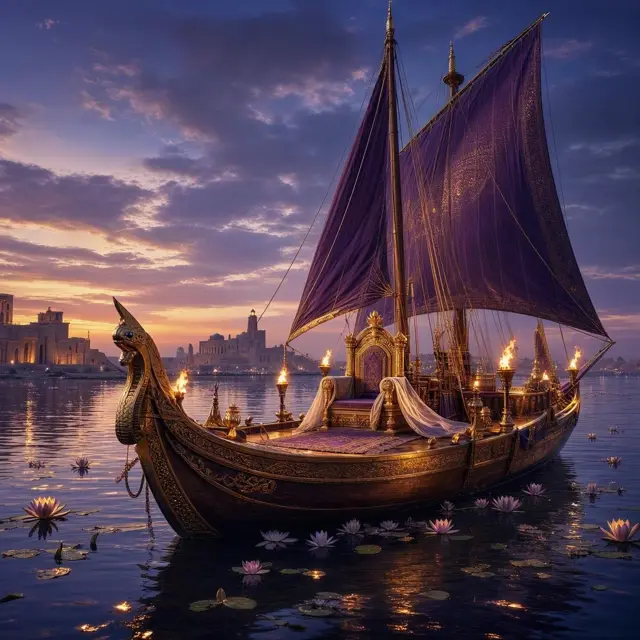
He also built a boat with four mechanical musicians that floated on a lake to entertain royal guests. Professor Noel Sharkey argues it was likely an early programmable machine. Moving its pegs around changed the drum rhythms.
Pumps That Point to the Steam Engine
Al-Jazari designed five machines for raising water, and here he showed his most important ideas. One was a twin-cylinder pump driven by a water wheel. It used an early crankshaft to turn spinning motion into back-and-forth motion, the same job crankshafts do in modern engines.
That pump had several firsts. It was the first known pump with a true suction pipe, and the first to use the double-acting principle. It could lift water 13.6 metres. The historian Joseph Needham counted it among the two medieval machines most directly in the family line of the steam engine and the locomotive.
His chain pumps lasted too. Machines like the ones he described supplied water in Damascus from the 13th century into modern times. In a curious twist, the chain in one of his drawings seems to form a Möbius strip, long before mathematicians studied that shape.
Tricks Engineers Still Use
The historian Donald Hill found several building methods that first appear in al-Jazari's work. He built up timber in layers to stop it warping. He balanced wheels, used wooden templates, and made paper models to test designs. He ground valve parts together with emery powder for a watertight fit, and cast metal in closed boxes of sand.
He also described early mechanical controls, including a large metal door, a combination lock and a lock with four bolts. Western scholars once thought conical valves first appeared in Leonardo's drawings, but al-Jazari's pictures show them much earlier. The same goes for the segmental gear, which first clearly appears in his work.
According to Encyclopaedia Britannica, Leonardo da Vinci may have been influenced by al-Jazari's automata. The earliest known copy of his book was made in April 1206, ordered by the Artuqid ruler Nasr al-Din Mahmud. It is kept today in the Topkapi Palace Library.