A Ship Rented for One Franc
In 1950, Jacques Cousteau leased a ship called Calypso from Thomas Loel Guinness. The rent was a symbolic one franc a year. Cousteau turned her into a floating laboratory and his main boat for diving and filming. For decades, Calypso carried him and his crew on expeditions as far as Antarctica.
Cousteau was born in France in 1910 and entered the French naval academy in 1930. He planned to become a naval pilot, but a car accident ended that dream. So he turned to his other passion: the ocean. In 1936, a friend lent him a pair of underwater goggles, early versions of modern swimming goggles, and his first underwater experiments began.
He went on to become a naval officer, oceanographer, filmmaker and author. His legacy includes more than 120 television documentaries, more than 50 books and an environmental foundation with 300,000 members. Yet he liked to call himself simply an "oceanographic technician". In truth, he was also a showman, a teacher and a lover of nature.
The Gear That Opened the Sea
In 1939, Cousteau began using a breathing device invented in 1926 by Commander Yves le Prieur. It let a diver carry air underwater, but Cousteau was not happy with how little time it gave him below the surface. His fix was to add a demand regulator, invented in 1942 by engineer Émile Gagnan.
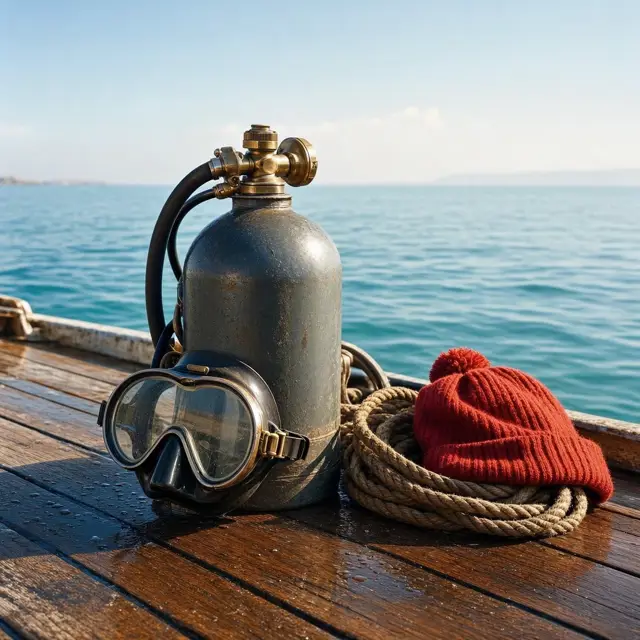
The result was the Aqua-Lung, first tried out as a prototype in 1943. It was the first successful open-circuit scuba set, and it finally made long underwater exploration possible. The prototypes were made in Boulogne-Billancourt by the Air Liquide company, following instructions from Cousteau and Gagnan.
Cousteau is credited with improving the design in the 1940s into the open-circuit scuba technology still used today. In 1943, he and his friends made the film Shipwrecks using two of the very first Aqua-Lung prototypes. The year before, their first French underwater film, 18 Meters Deep, had been shot with no breathing gear at all.
Movies From the Deep
Cousteau's first book, The Silent World, came out in 1953. It became a documentary co-directed with Louis Malle, one of the first films to show the ocean depths in color. In 1956, it won the Palme d'Or at the Cannes Film Festival. It stayed the only documentary to win that prize until 2004, and it also took home an Academy Award in 1957.
Then came television. The Undersea World of Jacques Cousteau ran for 10 years, from 1966 to 1976. On screen, Cousteau wore a red bonnet borrowed from old diving dress, which gave the shows a personal adventure feel. A second series, The Cousteau Odyssey, followed from 1977 to 1982.
His fame reached pop music too. In 1975, John Denver released a tribute song called "Calypso". It first appeared as a B-side, but it became a hit on its own and reached No. 2 on the charts. In 1990, the composer Jean Michel Jarre named a new album Waiting for Cousteau.
Porpoise Sonar and Homes Under the Sea
Cousteau had a sharp eye for animals. Once, as his ship headed for the Strait of Gibraltar, a group of porpoises followed it. When Cousteau steered a few degrees off the best route through the strait, the porpoises followed for a few minutes, then turned back toward mid-channel. They clearly knew the best course, even if the humans did not.
He concluded that they must have something like sonar, which was then a fairly new feature on submarines. He was right. His 1953 book, The Silent World, correctly predicted the echolocation abilities of porpoises.
He also dreamed of people living under the sea. In the 1960s, his Conshelf projects built underwater "villages" where people could live and work on the seafloor, each one set deeper than the last. He directed a film about this saturation diving work. He also helped build a "diving saucer", a small underwater vehicle that could reach a depth of 350 metres.
Standing Up for the Ocean
In October 1960, a large load of radioactive waste was about to be dumped into the Mediterranean between Nice and Corsica. Cousteau and other French scientists pushed back. He ran a publicity campaign that won wide public support in less than two weeks. The train carrying the waste was stopped by women and children sitting on the tracks, and it was sent back.
In 1973, he and his two sons created the Cousteau Society for the Protection of Ocean Life. He also argued that fish feel pain even though they are cold-blooded. In 1976, he found the wreck of HMHS Britannic, the younger sister ship of the Titanic.
Honors followed, including the US Presidential Medal of Freedom in 1985 and a seat in the Académie française in 1988. He died in Paris in 1997, at the age of 87. The Cousteau Society is still active and hopes to turn the original Calypso into a museum. In 2007, a special diving watch even held a sliver of wood from inside the ship.