Leaning Before It Was Finished
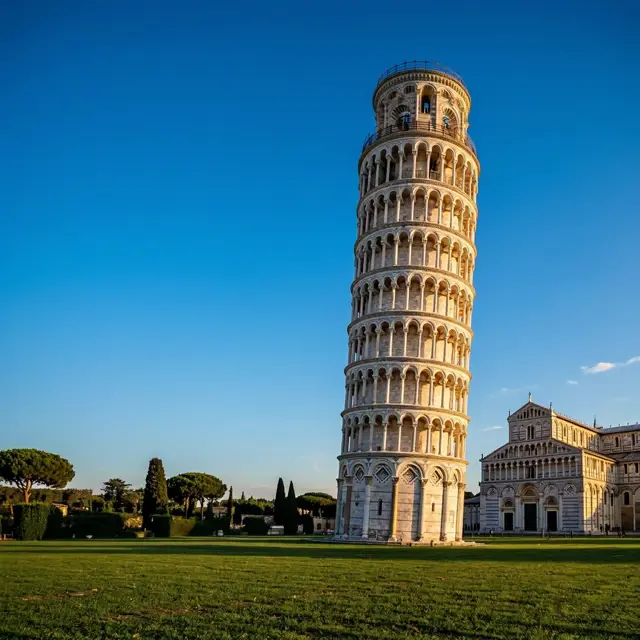
The world's most famous tilting building started leaning long before it was complete. Work began in August 1173. By 1178, with only two floors built, the tower was already sinking.
The problem was underground. The tower stood on a foundation just three metres deep, set in soft, unstable soil that could not hold its weight. The design was flawed from the very start.
Oddly, war saved it. Pisa kept fighting its neighbours, so building stopped for almost a century. That long pause let the soil settle. Without it, experts say the tower would almost certainly have fallen over. In all, construction took 199 years, finishing with the bell chamber in 1372.
Why the Tower Is Actually Curved
When building restarted in 1272, the engineers tried a clever fix. They made the upper floors taller on one side than the other, to make up for the lean.
The result is a tower that is not just tilted, but slightly curved, like a banana. Even the bell chamber on top includes its own small correction for the angle below.
The tower is 55.86 metres tall on the low side and 56.67 metres on the high side, and weighs around 14,500 tonnes. It is the freestanding bell tower, or campanile, of Pisa's cathedral, and holds seven bells, one for each note of the musical scale. Climbing to the top takes 296 steps.
Saving It Without Straightening It
Over the centuries, many attempts to fix the tower failed, and some made the lean worse. By 1990, the tilt had reached 5.5 degrees, and the tower was closed to the public.
Engineers took no chances. They removed the bells to cut the weight, strapped cables around the third level, and moved people out of nearby homes. Then they gently removed soil from under the raised side, 38 cubic metres of it, letting the tower settle back.
But they did not straighten it. The lean was too important to Pisa's tourism. The tilt was reduced to 3.97 degrees, back to where it was in 1838, and the tower reopened in 2001. In 2008, engineers said it had stopped moving for the first time in its history.
Cannonballs, Earthquakes and a Lucky Escape
The tower has a famous place in science. Between 1589 and 1592, Galileo Galilei is said to have dropped two cannonballs of different weights from the top, to show they fall at the same speed. The story comes from a biography written by his pupil.
It has also survived at least four strong earthquakes since 1280. A 2018 study found that the same soft soil that made it lean also protects it. Because of the soil, the tower does not shake in rhythm with the ground, a problem called resonance.
It almost did not survive World War II. An American sergeant sent to check for German soldiers inside was so struck by its beauty that he did not order an artillery strike.