A Boy in His Father's Workshop
Louis Braille was born on 4 January 1809 in Coupvray, a small town about twenty miles east of Paris. His father made leather goods and horse tack, and little Louis loved to play in the workshop. At the age of three, he hurt one eye with an awl, a pointed tool for making holes in leather.
An infection set in and spread to his other eye. By the age of five, he was completely blind. He was so young that at first he did not understand. He often asked why it was always dark.
His parents worked hard to raise him in a normal way, which was rare at the time. His father carved canes for him, and he learned to find his way along the village and country paths. He grew up bright and curious. Local teachers were impressed, and his talent opened the door to more schooling.
A School With Three Books
In February 1819, at the age of ten, Braille left home for Paris. He won a place at the Royal Institute for Blind Youth, one of the first schools for blind children in the world. It was poor and run-down, but there he made lifelong friends.
The children read with a system made by the school's founder, Valentin Haüy. His books used embossing to raise the shapes of ordinary letters on heavy paper. Readers traced each letter with their fingers. It worked, but slowly. The books were huge, heavy, fragile and expensive. When the school first opened, it owned just three of them.
Worse, the children could not write this way. To send letters home, Louis used an alphabet his father cut from thick leather. One author later summed up the problem well. The old system was "talking to the fingers with the language of the eye".
From Twelve Dots to Six
In 1821, a man named Charles Barbier wrote to the school about a code he had invented. It used up to twelve raised dots in two columns, pressed into thick paper, and it could be read entirely by the fingers. Braille saw its promise and decided to improve it.
He cut the maximum of twelve dots down to six and gave each letter a neat, even shape. The big win was size. Each small cell could be felt as a letter with a single touch of a finger. He first showed his work to classmates in 1825, when he was just fifteen. His first version also used dashes, but he dropped them by 1837 because they were hard to read.
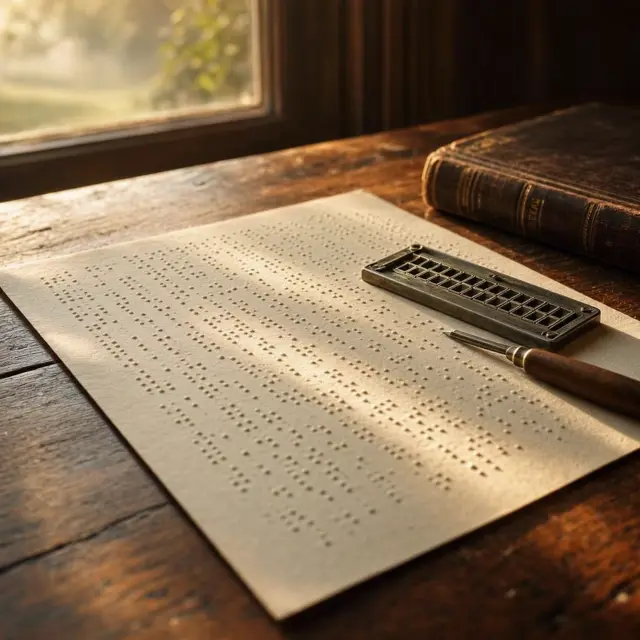
He built it all with Barbier's slate and stylus tools. By adding metal strips across the slate, he kept the lines straight. Braille explained his goal plainly: "We do not need pity". Blind people, he said, "must be treated as equals", and communication was the way.
Music, Maths and a Clever Machine
Braille was a gifted student, and after he finished the school's lessons he stayed on to help teach. By 1833 he was a full professor, teaching history, geometry and algebra. He was also a skilled cellist, and he loved music deeply.
So he extended his code to music. He planned the system with great care, so it would be "flexible enough to meet the unique requirements of any instrument". In 1829 he published his first book about his system. Funnily enough, it was printed with Haüy's old raised letters. A beginner's arithmetic guide followed in 1838.
In 1839, he went further with decapoint. This system let blind people write letters that sighted people could read. He also helped his friend Pierre-François-Victor Foucault, who built the Raphigraphe, a machine for making raised-point letters faster. Foucault's machine was shown at the World's Fair in Paris in 1855.
The Students Who Would Not Give Up
Braille's code did not win easily. A new school head, Pierre-Armand Dufau, opposed teaching it after 1840. Another teacher, Joseph Guadet, backed Braille, and the system came back in 1844. Braille lived with a long lung illness, and he died in 1852, two days after turning 43.
The pupils kept pushing. Because they insisted so strongly, the school finally adopted the system in 1854. It spread across the French-speaking world first. By 1882, one leading supporter reported it was used almost everywhere except in some North American schools. The United States adopted it in 1916, and a single English code came in 1932.
Today braille is used worldwide and is almost unchanged. It now appears on computer terminals, and a special version called Nemeth Braille handles maths and science. An asteroid, 9969 Braille, is named after him. Countries struck coins for his 200th birthday in 2009, and World Braille Day falls on 4 January.