The Letter He Never Sent
In 1802, Beethoven left Vienna for the small Austrian town of Heiligenstadt and stayed from April to October, trying to come to terms with what was happening to his hearing.
While he was there he wrote a letter to his brothers, now known as the Heiligenstadt Testament. In it he set down his thoughts of suicide as his deafness grew, and his decision to keep living for and through his art.
He never sent it. The letter was found among his papers after his death, which is the detail that makes it land: this was not a public statement or a bid for sympathy. It was a private argument he had with himself and won.
He was roughly thirty years old, and the music most people can hum was still ahead of him.
Conversations in Notebooks
The deafness did not arrive all at once. It worsened over decades, and by early 1818 it had deteriorated so far that speech no longer worked for him.
From that point, Beethoven and the people around him had to write to each other in notebooks to hold a conversation. Those conversation books were a practical workaround for a disability, and they accidentally became one of the richest records of any composer's life.
They cover music, business and personal matters, capturing not just what Beethoven said but what people said to him, in their own handwriting.
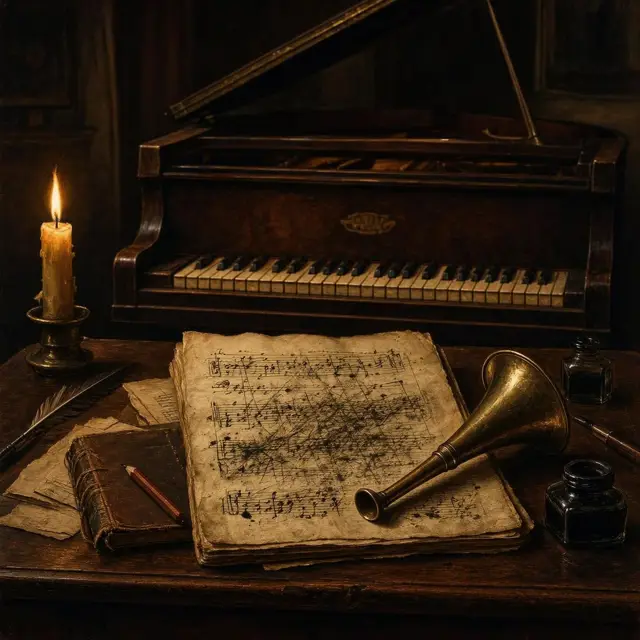
The instruments show the strain too. In 1818 he was given a grand piano by John Broadwood & Sons. He was proud to receive it, but seems to have been dissatisfied with its tone, a dissatisfaction that was perhaps itself a consequence of his increasing deafness, and he tried to have it remodelled.
The Premiere He Could Not Hear
By the 1820s Beethoven was planning to premiere the Missa solemnis and the Ninth Symphony in Berlin. His Viennese admirers heard about it and pleaded with him to perform them locally instead. He gave in.
The first performance took place on 7 May 1824 at the Kärntnertortheater, to great acclaim. And the way it was staged is one of the most quietly devastating scenes in music history.
Beethoven stood beside the conductor, Michael Umlauf, beating time throughout the concert. Umlauf had already warned the singers and the orchestra to ignore him.
So the composer stood in front of his own audience, apparently leading the premiere of what would become one of the most famous pieces of music ever written, while everyone on stage had been instructed to watch someone else. The performance was difficult in other ways too: the chorus struggled with the music and asked for the high notes to be brought down.
Where the Music Went
The late works are the ones people mean when they say Beethoven changed music. This final period produced the Missa solemnis and the Ninth Symphony, both written for very large forces, along with the Diabelli Variations, the last cello and piano sonatas, and the late string quartets including the enormous Große Fuge.
These pieces are marked by intellectual depth, formal invention, and intensely personal expression. String Quartet No. 14 runs seven linked movements. The Ninth Symphony does something no symphony had done before, adding a chorus to the orchestra in its final movement.
The critic Harold C. Schonberg summed up the trajectory: Beethoven "had started as a composer in the classic tradition and had ended as composer beyond time and space".
He was politically alert as well. He drafted the Third Symphony, the Eroica, with Napoleon in mind, then scratched Napoleon's name off the title page in disgust when he declared himself Emperor in 1804.