The Richest Man Nobody Can Put a Number On
Mansa Musa was the ninth *mansa*, or ruler, of the Mali Empire, reigning from the early 1300s until around 1337. Contemporaries described him as inconceivably rich, and modern attempts to price that have mostly given up.
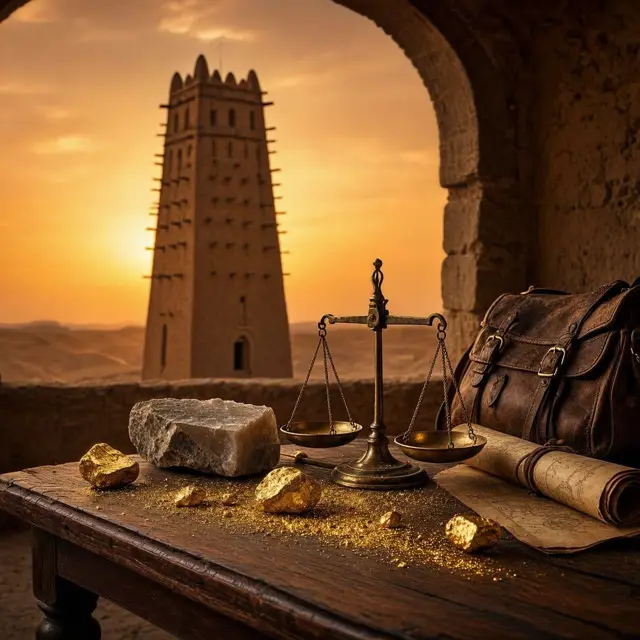
The wealth was real and it had a clear source. Mali's riches came principally from controlling and taxing the trade in salt from the north and gold panned and mined at Bambuk and Bure to the south, built up over a very long period into an enormous reserve. It is estimated that two thirds of the gold circulating in the medieval Mediterranean came from West Africa, accounting for almost half of the Old World's gold supply. Malians near the town of Tadmekka had even invented their own refining process, using melted glass to draw off impurities.
The empire he inherited and expanded covered around 1,300,000 square kilometres, taking in land that is now part of Guinea, Senegal, Mauritania, the Gambia and Mali itself.
The Pilgrimage That Made Him Famous
Musa made his hajj between 1324 and 1325, a journey of some 2,700 miles, leaving his son Muhammad to rule in his absence. It is the single event that put him into the historical record.
The numbers reported for it should be read carefully. Arabic chroniclers writing afterwards give wildly varying figures, and modern historians treat them as rhetorical rather than statistical. By those accounts, his procession included upwards of 12,000 people dressed in brocade and Yemeni silk, with heralds in silks carrying gold staffs, and 80 camels each said to carry between 23 and 136 kg of gold dust. That range itself reflects the absence of any audited count.
What is not disputed is the scale of the spending. Musa provided for the entire company of men and animals, distributed gold to the poor along his route and in the cities he passed through, and is reported to have built a mosque every Friday. His gift-giving in Cairo is said to have noticeably affected the value of gold in Egypt.
Bowing Only to God
Musa and his entourage reached the outskirts of Cairo in July 1324, camped for three days beside the Pyramids of Giza, and crossed the Nile into the city on 19 July.
There he met the Mamluk sultan al-Nasir Muhammad, and the meeting started badly. Al-Nasir expected Musa to prostrate himself before him, and Musa initially refused. When he finally did bow, he said that he was doing so for God alone.
The awkwardness passed. The two rulers got along well and exchanged gifts, and Musa stayed three months, departing on 18 October with the official caravan to Mecca. He lodged in the Qarafa district and befriended its governor, ibn Amir Hajib, who learned a great deal about Mali directly from him. That friendship matters more than it sounds, because it is the source of much of what we know. Ibn Amir Hajib passed the knowledge to historians such as al-Umari, and most surviving detail about Musa comes from Arabic writers like al-Umari and Ibn Khaldun rather than from Mali itself.
How Timbuktu Got Onto European Maps
Musa expanded Mali's borders, notably bringing Gao and Timbuktu into the empire, and then spent on them. He sought closer ties with the wider Muslim world and recruited scholars to travel to Mali, including the Andalusian poet Abu Ishaq al-Sahili.
Timbuktu became a centre of trade, culture and Islamic learning. Markets drew merchants from Hausaland, Egypt and other African kingdoms. A university was founded there, as well as in Djenné and Ségou, and the University of Sankore was restaffed with jurists, astronomers and mathematicians, pulling scholars from across Africa and the Middle East.
Word travelled. News of Mali's city of wealth crossed the Mediterranean to southern Europe, and traders from Venice, Granada and Genoa added Timbuktu to their maps so they could trade manufactured goods for gold. When the kingdom of Mossi took Timbuktu in 1330, Musa quickly regained it, built a rampart and a stone fort, and stationed a standing army there. His palace has since vanished, but the Djinguereber Mosque still stands.
What the Legend Gets Wrong
The popular version of Musa has been sanded smooth, and historians have been quietly correcting it for years.
His reign is commonly called Mali's golden age, but that may partly reflect the fact that it is simply the best documented by Arabic sources rather than that he was necessarily the wealthiest or most powerful mansa. Historians such as Hadrien Collet argue his wealth is impossible to calculate accurately, and that contemporary Arabic writers may have been trying to convey that he had more gold than they thought possible rather than reporting a figure. Musa himself actively promoted the appearance of inexhaustible wealth.
The architecture story has been revised too. A long-standing tradition credited al-Sahili with designing the Djinguereber Mosque, but J. O. Hunwick showed the only project firmly attributable to him in the Arabic sources is a royal audience chamber, and modern scholarship treats the idea of him founding West African mosque architecture as a historiographical myth. Excavations at Djenné-Djenno show complex settlement and craft production in the region by the third century BCE, long predating him. Musa is also less celebrated at home: he features relatively little in Mandé oral tradition, and some *jeliw* criticise him for being unfaithful to tradition and wasting Mali's wealth.