The Bookbinder Who Took Notes
Michael Faraday was born in 1791 in Newington Butts, now part of London. His family was not well off, and he had only the most basic schooling, so he had to teach himself.
At 14 he became an apprentice to a bookbinder and bookseller. Surrounded by books for seven years, he read everything he could. He was especially inspired by Conversations on Chemistry by Jane Marcet, and he grew fascinated by electricity.
In 1812, aged 20, he went to lectures by the famous chemist Humphry Davy. Faraday then sent Davy a 300-page book based on the notes he had taken. Davy replied right away, kindly. The next year, Davy hurt his eyesight in a lab accident and needed help. On 1 March 1813, Faraday became a Chemical Assistant at the Royal Institution. The self-taught apprentice was now inside one of Britain's top labs.
A Wire That Danced Around a Magnet
Faraday's first recorded experiment was wonderfully homemade. He built a voltaic pile from seven British halfpenny coins, seven discs of zinc and six pieces of paper soaked in salt water. With it, he sent a current through a chemical solution and split the compound apart.
In 1821, the Danish scientist Hans Christian Orsted had just shown that electricity and magnetism were linked. Davy and William Hyde Wollaston tried and failed to build an electric motor. Faraday succeeded. In one device, a wire hung into a pool of mercury with a magnet in it. When current flowed, the wire spun around the magnet in a circle. This laid the foundation of electric motor technology.
In his excitement, though, Faraday published without crediting Wollaston or Davy. The row strained his friendship with his mentor and kept him away from electromagnetic research for several years.
Turning Magnets Into Electricity
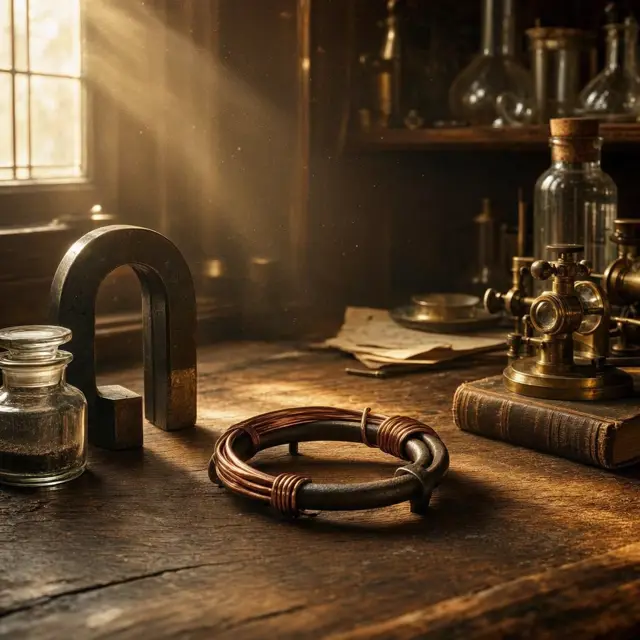
Faraday's big breakthrough came in 1831. He wrapped two coils of insulated wire around an iron ring. When he passed a current through one coil, a brief current appeared in the other. That iron ring is still on display at the Royal Institution.
Next he moved a magnet through a loop of wire, and a current flowed. It also flowed when he moved the loop over a still magnet. He had discovered electromagnetic induction: a changing magnetic field creates electricity. He used it to build the electric dynamo, the ancestor of modern power generators.
Amazingly, his maths never went beyond the simplest algebra. He thought in pictures, not symbols. James Clerk Maxwell later turned his ideas into equations and called him "a mathematician of a very high order". Still, it took nearly 50 years for the technology to catch up, until London's Savoy Theatre became the first public building lit by electricity.
Bending Light and Stepping Into a Cage
In 1845, a special heavy glass Faraday had spent years perfecting paid off. He found that a magnetic field could twist the direction of light passing through the glass, now called the Faraday effect. He wrote in his notebook that he had succeeded "in magnetising a ray of light". That same glass was the first substance found to be pushed away by a magnet, an effect he named diamagnetism.
In 1836, he built a wooden frame about 12 feet square, set it on glass supports, and covered it with paper walls and wire mesh. Then he stepped inside and electrified it, showing that electricity was a force, not a mysterious fluid as people then believed. His ice pail experiment showed that charge sits only on the outside of a conductor and cannot affect what is inside. That shielding effect lives on in the Faraday cage.
In 1857 he noticed that tiny gold particles in a colloid looked different from solid gold. It may be the birth of nanoscience.
Science for Everyone
Faraday loved sharing science with the public. Between 1827 and 1860, he gave nineteen public lectures for young people at the Royal Institution, a series that still runs today. He filled soap bubbles with different gases to test whether they were magnetic. He urged audiences to ask why ice floats on water, then "think of that, and philosophise".
He refused to have his lectures printed, wanting people to repeat the experiments themselves. He told a publisher, "I have always loved science more than money."
He also found time to improve lighthouses, protect ships from corrosion and write to The Times about the filthy River Thames. As a chemist, he discovered benzene and made popular the words anode, cathode, electrode and ion. Today the unit of capacitance, the farad, carries his name, and from 1991 to 2001 his picture appeared on the Bank of England's 20 pound note.