The Tallest Bridge on Earth for Two Decades
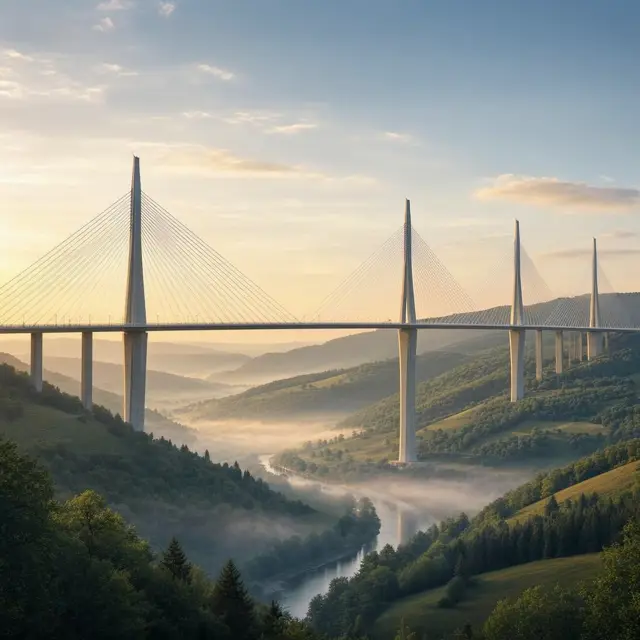
For more than twenty years, the Millau Viaduct in southern France was the tallest bridge in the world. Its structural height reaches 343 metres, and it held the title until late 2025. It carries a motorway across the deep valley of the river Tarn, near the town of Millau.
It is a cable-stayed bridge, built with seven tall masts that hold up the road with steel cables. The design team was led by the French engineer Michel Virlogeux and the English architect Norman Foster. Building it took three years and cost about 394 million euros.
The bridge was officially opened on 14 December 2004 and let traffic on two days later. That was actually ahead of schedule, since the planned opening date was 10 January 2005. It has been ranked again and again as one of the greatest engineering feats of modern times, and it won a major international award for outstanding structures in 2006.
Born From Summer Traffic Jams
The bridge was born from traffic jams. In the 1980s, holiday drivers heading from Paris to Spain had to drop down into the Tarn valley and crawl past Millau. At the start and end of every July and August holiday season, the area choked with cars.
Planners studied four possible routes and picked one west of Millau in 1989, with two versions on the table. A low route would dive into the valley, cross the river on a short bridge and continue into a tunnel. A high route would jump the whole valley on a viaduct about 2.5 kilometres long and more than 200 metres above the river. The low route was dropped because it would cut into the water table, cost more and make the drive longer.
A long design contest followed. In 1996, a jury chose a cable-stayed design with many spans. Some groups argued the toll would keep drivers away, and others doubted the ground could hold such a giant.
Growing Four Metres Every Three Days
Work began in October 2001. Each pylon stands on four concrete shafts, each 15 metres deep and 5 metres wide. Once the pylons rose out of the ground in March 2002, things sped up fast. Each one grew 4 metres every three days. The secret was sliding shuttering, which let workers pour a fresh layer of concrete every 20 minutes.
The road deck was not lifted up from the valley floor. It was built on the high ground at both ends and pushed out sideways across the pylons, a method called bridge launching. Computer-controlled pairs of hydraulic wedges on top of each pylon lifted the deck, nudged it forward, then dropped back, again and again. Each cycle moved the deck 600 millimetres in about four minutes.
The steel masts were driven out along the new deck lying flat. They were joined into one piece and then tilted upright in a single tricky move.
A Road Shaped Like an Upside-Down Wing
The steel road deck looks light, but it weighs about 36,000 tonnes and runs 2,460 metres long. Its cross-section has an inverse airfoil shape. In strong winds, this creates a downward force, pressing the deck down instead of lifting it.
Each mast holds eleven pairs of cables, and every steel strand has triple protection against rust. The outside of each cable is wrapped in a spiral strip. Its job is to stop rainwater from running along the cable in high winds, which could make it vibrate.
The bridge is also packed with sensors for structural health monitoring. Some detect movements as tiny as a micrometre, and some take up to 100 readings per second. Sensors in the road even record the weight of passing vehicles and can tell apart fourteen types. The road surface alone took two years of research, because it must flex with the steel without cracking.
Too Pretty to Just Drive Past
The Millau Viaduct turned out to be almost too beautiful. Soon after it opened, drivers began stopping on the hard shoulder to admire the view. Tourists slowed down to take photos so often that the speed limit was cut from 130 to 110 kilometres per hour.
The bridge is normally closed to people on foot, but there have been rare exceptions. In December 2004, before cars were allowed on, 19,000 walkers and runners crossed part of the deck. In May 2007, 10,496 runners raced across it and back.
It has also become a screen star. It appears in the 2007 film Mr. Bean's Holiday, and the hosts of the British car show Top Gear drove across France just to see it. The builder, Eiffage, paid for the bridge in return for the right to collect tolls until 2080, and it says the bridge will last at least 120 years.