A Sculpture That Ran Out of Money
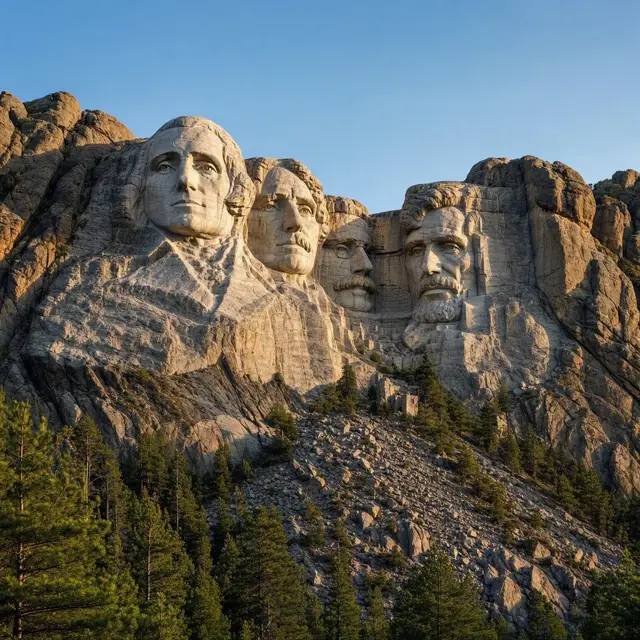
Mount Rushmore looks finished, but it is not. Each of the four presidents was supposed to be carved from head to waist. The money ran out first. Work stopped on 31 October 1941, and only George Washington's figure shows any detail below the chin.
The giant heads of Washington, Thomas Jefferson, Theodore Roosevelt and Abraham Lincoln are each 60 feet (18 metres) tall. Sculptor Gutzon Borglum led the carving from 1927 until he died in March 1941. His son, Lincoln Borglum, then took over and led the project to its end.
Borglum had bigger dreams too. He planned a Hall of Records inside the mountain, a vault behind the heads to protect documents like the Declaration of Independence. Workers cut about 70 feet (21 metres) into the rock before stopping in 1939. In 1998, a time capsule was placed at the mouth of the cave, holding the texts of the documents he had hoped to keep there.
Why Four Presidents and Not Western Heroes
The whole idea came from Doane Robinson, South Dakota's state historian. In 1923, he wanted a huge monument in the Black Hills to bring in tourists. His first plan featured heroes of the American West, such as Lewis and Clark, Sacagawea, and Buffalo Bill Cody.
Borglum disagreed. He argued that the sculpture should speak to the whole nation, not just one region, and convinced the planners to choose four presidents instead. Washington, Jefferson, Roosevelt and Lincoln were picked to stand for the nation's foundation, expansion, development and preservation.
The location changed too. Borglum first wanted to carve tall granite pillars known as the Needles. They were a well-known local landmark, and the plan drew some of the strongest opposition, so it was dropped. It was later noted that the pillars were too small and unstable anyway. In August 1925, Borglum saw Mount Rushmore and reportedly said, "America will march along that skyline."
Dynamite, Drills and Honeycombs
Around 400 workers carved the mountain between 1927 and 1941. They started with dynamite. Then came a method called honeycombing. Workers drilled holes close together, which let small pieces of rock be removed by hand. In total, about 410,000 tonnes of rock were blasted off the mountainside. Remarkably, the project was completed without a single death.
Not everything went to plan. Jefferson was first carved to the left of Washington. When the rock there proved unsuitable, that work was blasted away and a new Jefferson was carved on the right.
The chief carver was Luigi Del Bianco, a stonemason who came from Italy. He was chosen for his skill at showing emotion in carved faces. The faces were dedicated one by one: Washington in 1934, Jefferson in 1936, Lincoln in 1937 and Roosevelt in 1939. The whole project cost US$989,992.32.
A Mountain Picked for Its Rock and Sunlight
Borglum had good reasons to choose this peak. Mount Rushmore is made of smooth, fine-grained granite that wears away only about 1 inch (25 millimetres) every 10,000 years. It also faces southeast, so workers had sunlight for most of the day.
The rock itself is ancient. The granite formed about 1.6 billion years ago, when magma pushed into older rock. Look closely at the presidents' foreheads and you will see light streaks. These come from veins of pegmatite, a paler, coarse-grained rock. Just below Washington's face sits darker material, which is leftover schist.
The mountain's name has a story as well. In 1884 and 1885, a New York lawyer named Charles E. Rushmore visited the area to confirm mining land claims. When he asked his guide the mountain's name, the guide said it had none, but that it would now be named after Rushmore. The Lakota call it Six Grandfathers Mountain, and the land is still the subject of an ongoing Lakota claim.
Keeping Four Giant Faces in Shape
A mountain sculpture needs care. Each year, climbers check the stone and seal its cracks. Borglum's own crack filler, made of linseed oil, granite dust and white lead, did not keep water out well. Today a modern silicone is used instead, disguised with granite dust.
Technology helps as well. In 1998, electronic sensors were installed to track any movement in the sculpture to within 3 millimetres. In 2009, the whole site was recorded using terrestrial laser scanning, creating a detailed digital record to aid its care. In 2005, a German cleaning company washed the monument for free, using water hotter than 93 °C.
All that care pays off. Mount Rushmore is South Dakota's top tourist attraction, and 2,440,449 people visited in 2022. It has also starred on screen, most famously as the setting of the final chase in the 1959 film North by Northwest.