A Lawyer Against a Legal System
Nelson Rolihlahla Mandela (18 July 1918 – 5 December 2013) was a South African anti-apartheid revolutionary, politician and philanthropist who served as President of South Africa from 1994 to 1999 — the country's first black head of state, and the first elected in a fully representative democratic election.
A Xhosa, he was born in Mvezo to the Thembu royal family. He studied law at the University of Fort Hare and the University of the Witwatersrand before working as a lawyer in Johannesburg.
That training matters. He entered politics as someone who understood exactly how the machinery of law could be used to entrench injustice. He became involved in anti-colonial and African nationalist politics, joined the African National Congress in 1943, and co-founded its Youth League in 1944. When the National Party's white-only government established apartheid — a system of racial segregation privileging whites — he and the ANC committed themselves to its overthrow.
From Defiance to Sabotage
Mandela rose to prominence through the 1952 Defiance Campaign and the 1955 Congress of the People, and was appointed President of the ANC's Transvaal branch.
The state responded with prosecutions. He was repeatedly arrested for seditious activities and was unsuccessfully prosecuted in the 1956 Treason Trial. Influenced by Marxism, he secretly joined the South African Communist Party.
Then came the turn that his later reputation often smooths over. Although initially committed to non-violent protest, in 1961 he co-founded the militant Umkhonto we Sizwe and led a sabotage campaign against the government. In 1962 he was arrested for conspiring to overthrow the state, and at the Rivonia Trial he was sentenced to life imprisonment. He was not imprisoned for holding opinions; he was imprisoned for organising armed resistance to a state he had concluded would not yield to anything less.
Twenty-Seven Years
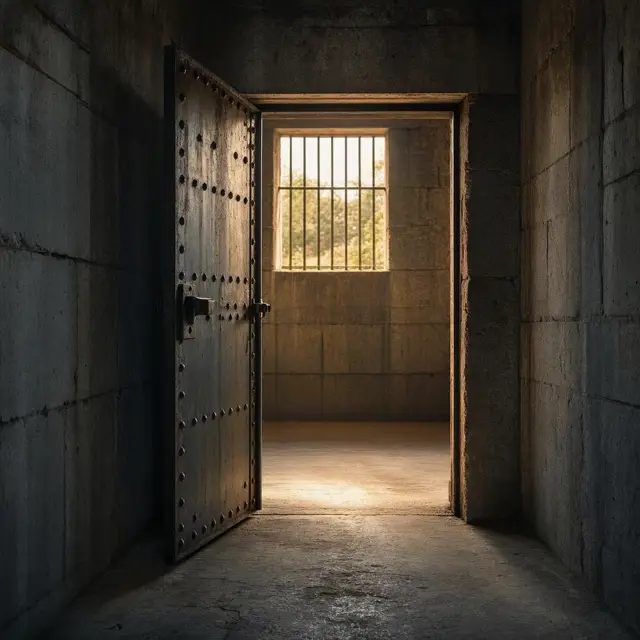
Mandela served 27 years in prison — initially on Robben Island, later at Pollsmoor Prison and Victor Verster Prison.
What eventually opened the door was pressure plus fear. Amid growing domestic and international pressure, and with fears of a racial civil war, President F. W. de Klerk released him in 1990.
What he did next is the part that made him extraordinary rather than merely sympathetic. Mandela and de Klerk — adversaries in the fullest sense — negotiated an end to apartheid together and organised the 1994 multiracial general election, which Mandela led the ANC to win. A man could reasonably have emerged from 27 years of imprisonment seeking retribution. He emerged seeking a settlement with the government that had jailed him.
Reconciliation as Policy
As President, Mandela led a broad coalition government that promulgated a new constitution, and made reconciliation between the country's racial groups the organising principle rather than a slogan.
He created the Truth and Reconciliation Commission to investigate past human rights abuses — a mechanism designed to establish the record publicly rather than to punish comprehensively.
His economics surprised people. Despite his own socialist beliefs, his administration retained its predecessor's liberal framework, while introducing measures to encourage land reform, combat poverty and expand healthcare. Internationally, he mediated in the Pan Am Flight 103 bombing trial and served as Secretary-General of the Non-Aligned Movement from 1998 to 1999. Then he declined a second presidential term, handing over to his deputy Thabo Mbeki in 1999 — a voluntary exit from power that is far rarer among liberation leaders than it should be.
Contested in His Own Time
Mandela was a controversial figure for much of his life, and flattening that does him no favours.
Critics on the right denounced him as a communist terrorist. Those on the radical left considered him too eager to negotiate and reconcile with apartheid's supporters. He was attacked from both directions for the same decisions.
He nonetheless gained international acclaim, and is widely regarded as an icon of moral leadership, democracy and social justice — receiving more than 250 honours, including the Nobel Peace Prize, and becoming the subject of what the record frankly calls a cult of personality. As an elder statesman he focused on combating poverty and HIV/AIDS through the Nelson Mandela Foundation. In South Africa he is held in deep respect and often called by his Xhosa clan name, Madiba, and described as the "Father of the Nation".