A King's Private Dream on Borrowed Money
Neuschwanstein was never meant for visitors. King Ludwig II of Bavaria wanted a private retreat, far from the pressures he felt in Munich. He chose to pay for it from his personal fortune and heavy borrowing, not from Bavarian public funds. Today, more than 1.3 million people visit every year, with up to 6,000 a day in summer.
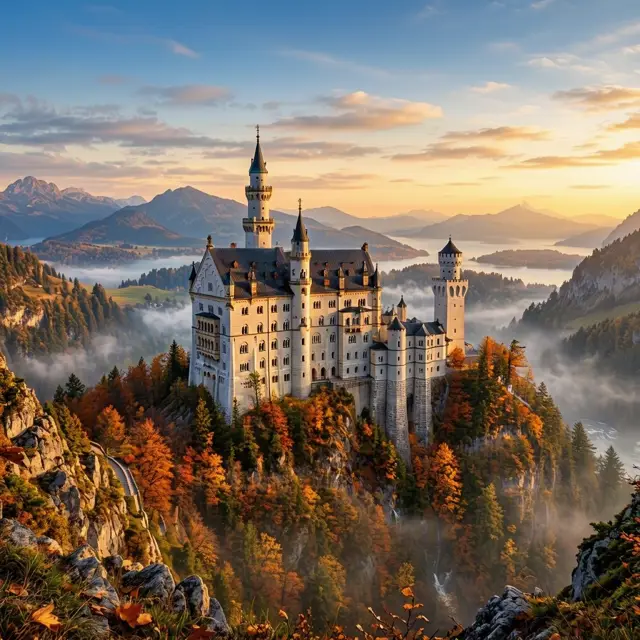
The castle sits on a rugged hill in the foothills of the Alps, in the far south of Germany near the Austrian border. It stands above the narrow gorge of the Pöllat stream, close to two lakes. According to Guinness World Records, it is the tallest castle in the world at 65 metres.
Ludwig grew up nearby. In 1832 his father bought old castle ruins in the area and built Hohenschwangau Castle as the family's summer home. As a young prince, Ludwig knew the ruins on the hill above from his outings. When he became king in 1864, building a new palace there became the first of his palace projects.
Designed Like a Stage Set
Ludwig loved the operas of Richard Wagner, and he built the castle partly in Wagner's honour. Two trips in 1867 shaped his ideas: one to the rebuilt Wartburg castle and one to the Château de Pierrefonds in France. The design was drafted by Christian Jank, a stage designer, and carried out by the architect Eduard Riedel.
That theatre link shows everywhere. Jank drew on his old sketches from his years painting stage scenery. The castle mixes Romanesque shapes, like simple blocks and round arches, with slim Gothic towers and Byzantine decoration. It was planned from the start as a lopsided building, and it left out the real defences that medieval castles needed.
The king controlled every detail and insisted on approving every draft himself. He even sent orders about a painting of the swan knight Lohengrin, asking that the chain from the ship to the swan be made of gold, not roses. Critics of the day mocked the castle as kitsch, but it is now counted among the major works of European historicism.
Marble, Steam Cranes and Modern Comforts
The foundation stone was laid on 5 September 1869. The palace was built of ordinary brick and then covered in stone. White limestone came from a nearby quarry, sandstone came from Württemberg, and marble came from near Salzburg. A steam crane lifted the heavy materials up to the building site.
For about two decades, the site was the main employer in the region. In 1880, around 200 craftsmen worked there. When the king demanded tight deadlines, up to 300 workers a day were reported, sometimes working at night by the light of oil lamps. Records from 1879 and 1880 list 465 tonnes of marble and 400,000 bricks.
Inside, the castle had some of the newest technology of the late 19th century. There was a battery-powered bell system for calling servants, and there were telephone lines. It had running warm water, toilets that flushed automatically and central heating fed by hot air from a kitchen oven. A service lift linked the kitchen to the dining room three floors above.
Unfinished, Unpaid and Suddenly Open
Costs kept climbing as the king's plans grew. During Ludwig's lifetime, Neuschwanstein cost 6.2 million gold marks, almost twice the first estimate of 3.2 million. His private money was not enough, so he kept opening new lines of credit. By 1883, he already owed 7 million marks.
Ludwig moved into the unfinished main building in 1884. He died in 1886, having lived in the palace for a total of only 172 days. The castle was far from complete. Of more than 200 planned rooms, only about 15 rooms and halls were ever finished. A 90-metre keep was never built, and its outline is now marked in the courtyard pavement.
The king never meant to open the castle to the public. Yet no more than six weeks after his death, it was opened to paying visitors. It became a steady source of income for the royal family, and the construction debts were paid off by 1899. By 1939, yearly visitors had reached 200,000.
Wartime Hideout to Fairy-Tale Icon
Its remote location spared it in both World Wars. Until 1944, it was used as a depot to store and catalogue art the Nazis had taken from France. After the war, 39 photo albums recording the seizures were found inside, and they are now kept in the United States National Archives. In April 1945, the SS considered blowing up the castle, but the plan was never carried out.
Today, Neuschwanstein is a global symbol of Romanticism. It inspired Disneyland's Sleeping Beauty Castle and Cinderella Castle. It appeared in films such as Chitty Chitty Bang Bang and The Great Escape. In 2007, it was a finalist in the online vote for the New Seven Wonders of the World, and it was pictured on a 2 euro coin in 2012.
Visits are by guided tour only, lasting 35 minutes, and photography is not allowed inside. A meteorite that fell near the castle on 6 April 2002 was named Neuschwanstein after it. In July 2025, UNESCO named it a World Heritage Site, together with three other palaces of Ludwig II: Linderhof, Schachen and Herrenchiemsee.