One Optical Fact, Endlessly Exploited
Perspective, from the Latin *perspicere* meaning "to see through", is the trick of drawing objects the way an eye actually receives them. It rests on a single optical fact: an object looks N times smaller when it is moved N times further from the eye.
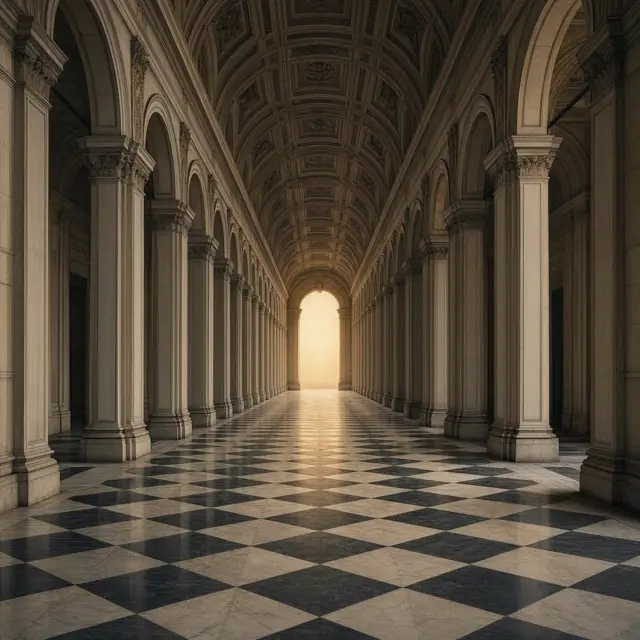
From that one rule everything else follows. Objects shrink as their distance from the viewer grows, and they are subject to foreshortening, meaning the dimensions running away from you appear shorter than the dimensions running across your view. Everything recedes toward points in the distance, usually along the horizon line.
The underlying method is almost mechanical. Imagine a flat pane held up facing the viewer's eye, then draw straight lines from every point on the real object back to that eye. Wherever those lines pierce the pane, you get the image. That intersection is the picture.
When Size Meant Importance, Not Distance
The earliest paintings and drawings did something quite different, and it was a choice rather than a failure. Figures were sized hierarchically, according to their spiritual or thematic importance, not their distance from the viewer.
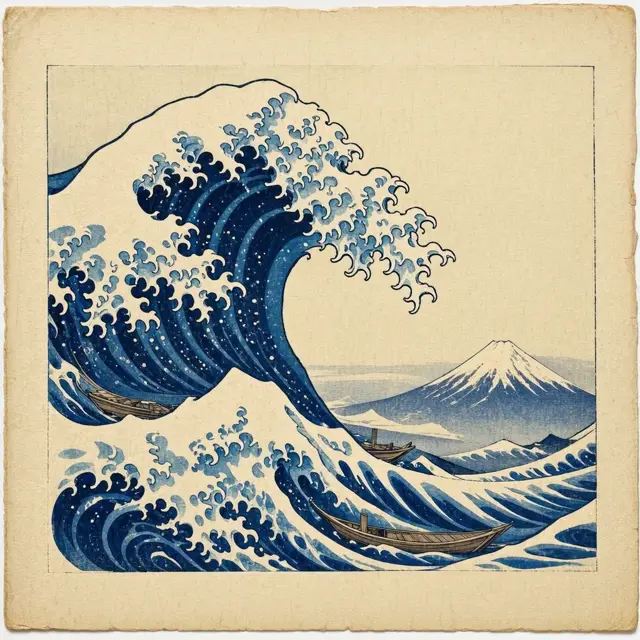
Ancient Egyptian art used what is sometimes called vertical perspective, placing the most important figures highest in the composition, with nearer figures shown below the larger ones. Simple overlapping did the work of indicating distance. Byzantine art was aware of the general principles too, but used reverse perspective for its principal figures.
Attempts at a system did begin early. Around the fifth century BC, Greek interest in illusionism produced *skenographia*, the use of flat painted panels on a stage to fake depth, and the philosophers Anaxagoras and Democritus worked out geometric theories for it. Euclid argued correctly in his *Optics* around 300 BC that perceived size is not related to distance by a simple proportion. Yet no comprehensive system survived, and medieval European artists remained perfectly willing to override distance cues whenever another priority mattered more.
The Florence Experiment
It is generally accepted that Filippo Brunelleschi conducted a series of experiments between 1415 and 1420, making drawings of Florentine buildings in correct perspective.
The famous demonstration, described by Vasari and Antonio Manetti, took place around 1420. Brunelleschi had people look through a hole drilled in the back of his painting of the Florence Baptistery, so they saw the real building. He then raised a mirror between the two, which reflected the painting back to the viewer through the same hole, letting them compare the painted version and the real thing in the same instant.
The story is indicative rather than settled. Brunelleschi's panel is lost, no other perspective painting or drawing by him is known, and Brunelleschi was not actually known to have painted at all. Manetti's account never uses the word "experiment", and the conditions he lists contradict each other, including an eyepiece giving a 15 degree field of view far narrower than the scene described.
The Technique That Rebuilt the Picture
Whatever exactly happened on that Florentine morning, the effect was immediate. Soon after Brunelleschi's demonstrations, nearly every interested artist in Florence and Italy was using geometrical perspective, including Donatello, Masaccio, Lorenzo Ghiberti, Masolino da Panicale, Paolo Uccello and Filippo Lippi.
Crucially, perspective was not only a way of showing depth. It was a new method of building a composition. Visual art could now depict a single unified scene rather than a combination of several, which changed what a picture fundamentally was. Masaccio placed the vanishing point at the viewer's own eye level in his *Holy Trinity* around 1427, and behind the face of Jesus in *The Tribute Money*.
The results were less flawless than the reputation suggests. Material analysis of Renaissance paintings shows that apart from the work of Piero della Francesca, which is a model of the genre, the majority of 15th-century works contain serious errors in their geometric construction, including Masaccio's own *Trinity* fresco.