The Towers That Moved Before They Were Built
When engineers drilled test holes in Kuala Lumpur, they found a nasty surprise. The planned site effectively sat on the edge of a cliff underground. Half the ground was decayed limestone, and the other half was soft rock. Their answer was bold: shift the whole site 61 meters so both towers would sit entirely on the soft rock.
The bedrock was so deep that the towers ended up on the world's deepest foundations. Workers bored 104 concrete piles into the ground, some as deep as 114 meters.
On top sits a huge slab called a raft foundation. For each tower, concrete was poured nonstop for 54 hours. The raft is 4.6 meters thick and weighs 32,500 tonnes. It held the world record for the largest concrete pour until 2007.
World's Tallest, 1998 to 2004
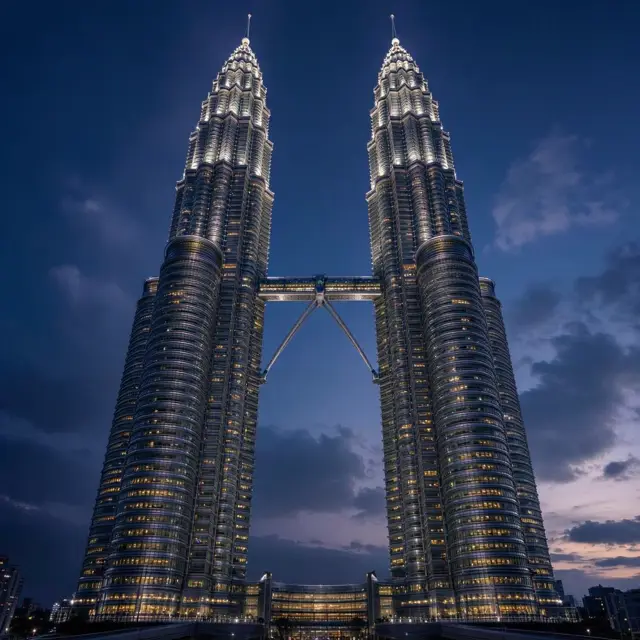
The Petronas Towers are a pair of linked, 88-storey supertall skyscrapers standing 451.9 meters high. From 1998 to 2004 they were the tallest buildings on Earth, until Taipei 101 in Taiwan passed them. They are still the tallest twin skyscrapers in the world, beating the original World Trade Center towers in New York.
The towers were designed by the Argentine-American architect Cesar Pelli in a postmodern style. The goal was a 21st-century icon for the city. Planning began on 1 January 1992 and included careful tests of how wind would push on the design.
They rose on the site of Kuala Lumpur's old race track. Digging began in 1993, and crews hauled away 500 truckloads of earth every night to reach 30 meters below the surface. The towers stayed the tallest in Malaysia until 2019.
Two Teams, One Race
The Malaysian government wanted the towers finished in six years. To hit that deadline, two building groups were hired, one per tower. A Japanese consortium led by Hazama Corporation built Tower 1. A South Korean team led by Samsung C&T built Tower 2, and that tower reached the top first.
Early on, one batch of concrete failed a routine strength test, and all work stopped. Every finished floor was checked. Only one had used the bad batch, and it was torn down. The pause cost 700,000 US dollars a day, so three separate concrete plants were set up on site in case one went wrong again.
Why so much concrete? Importing steel was very expensive. Super high-strength reinforced concrete was cheaper and twice as good at reducing sway, though it made the towers twice as heavy as a similar steel building.
A Bridge 170 Meters Up
The towers are joined by a double-decker sky bridge on the 41st and 42nd floors. It holds the record for the highest two-storey bridge in the world. It hangs 170 meters above the ground, stretches 58.4 meters, and weighs 750 tonnes.
The bridge was built on the ground and then lifted into place over three days in July 1995. It rests on a two-hinged arch whose legs, each 51 meters long, are bolted to the 29th floor of each tower. Engineers studied how the towers would sway in wind and earthquakes so the bridge could cope.
It is also a safety feature. In an emergency in one tower, people can cross to the other. Visitors can walk the 41st floor, but tickets are limited to about 1,000 a day. A second ticket option goes all the way up to level 86.
Split Lifts and Daring Climbs
Even the lifts are clever. The main lifts are double-deckers. The lower deck stops only at even-numbered floors and the upper deck only at odd ones. To reach an odd floor from the ground, you first ride an escalator up to the upper deck.
The towers have drawn daredevils too. In 1999, Felix Baumgartner set a world record for BASE jumping by leaping from a window cleaning crane on the towers. The record has since been broken.
The French climber Alain Robert tried to scale Tower Two with his bare hands. On 20 March 1997, police stopped him at the 60th floor. Exactly ten years later he was stopped on the same floor of the other tower. On 1 September 2009 he finally reached the top in just under two hours. At ground level, the Suria KLCC mall holds about 300 stores and even an aquarium.