The doctor who never was
Roald Amundsen's mother had a plan for him. She wanted him to stay out of the family shipping trade and become a doctor. He kept that promise until she died, when he was 21. Then he quit university at once and went to sea.
The polar bug had bitten him early. At 15 he read Sir John Franklin's stories of Arctic journeys. He later wrote that he read them "with a fervid fascination which has shaped the whole course of my life."
His first big trip came in 1897, when he joined the Belgian Antarctic Expedition as first mate at age 25. Their ship, the Belgica, got locked in the sea ice. It became the first expedition to overwinter in Antarctica, and the crew was poorly prepared. Amundsen believed the ship's doctor, Frederick Cook, saved them from scurvy by hunting animals and feeding everyone fresh meat.
A tiny boat through the Northwest Passage
In 1903, Amundsen set out to do something no one had done. He wanted to sail the Northwest Passage, the icy route through northern Canada between the Atlantic and Pacific. His plan was to go small. He took six men in Gjøa, a 45-ton fishing boat with a 13-horsepower engine, and stayed close to the coast.
They spent two winters at King William Island. There the local Netsilik Inuit taught them how to survive the Arctic. Amundsen learned to use sled dogs to carry goods. He also learned to wear animal skins instead of heavy wool, which could not keep out the cold once it got wet.
In 1905 the ship cleared the Arctic islands. The nearest telegraph was 800 kilometres away, so Amundsen traveled there overland to send the good news. Gjøa now sits in its own building at the Fram Museum in Oslo.
The secret switch to the south
Amundsen's next dream was the North Pole. But in 1909 he heard that two Americans, Frederick Cook and Robert Peary, each claimed to have reached it. So he quietly changed course. He did not tell people where he was really going.
He left Norway on the ship Fram in June 1910. Only when they stopped at Madeira did he tell his crew they were heading to Antarctica. He also sent a short telegram to the British explorer Robert F. Scott, who was planning his own South Pole trip: "Beg to inform you Fram proceeding Antarctic."
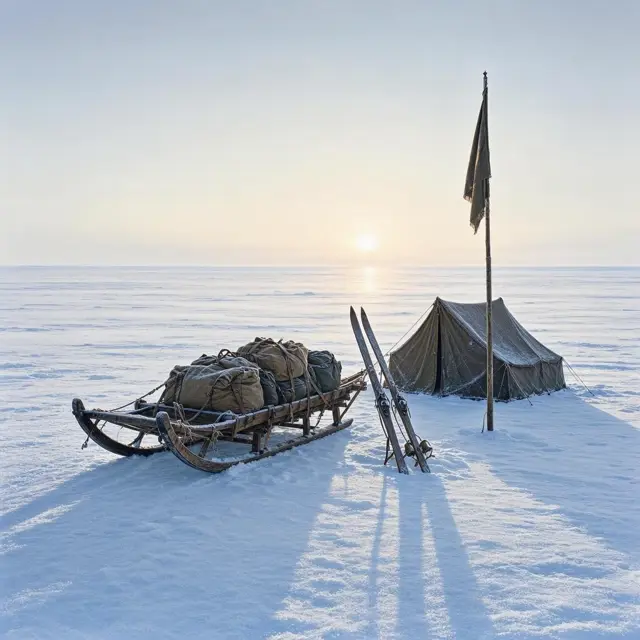
They reached the Bay of Whales on 14 January 1911 and set up a base called Framheim. Using skis and dog sleds, the team laid supply depots at 80, 81 and 82 degrees south. Amundsen also chose Inuit-style fur skins over the heavy wool worn by earlier explorers.
First to the South Pole
The first push toward the pole, in September, had to turn back because of extreme cold. On 19 October 1911, five men tried again. They took four sledges and 52 dogs. The team found a route up the Axel Heiberg Glacier, which no one had known about, and reached the high polar plateau after a four-day climb.
On 14 December 1911, they arrived at the South Pole, about a month before Scott's group. They named their camp Polheim. Before leaving, they set up a small tent with a letter inside stating what they had done, just in case they did not make it back.
They did make it back. Amundsen announced his success from Hobart, Australia, on 7 March 1912. His trip went fairly smoothly thanks to careful planning, good gear, the right clothing, a simple goal, skill with dogs and smart use of skis.
Shovels, flying boats and an airship
Amundsen still wanted the North Pole. From 1918 he tried to freeze his ship Maud into the Arctic ice and drift over the top of the world. The ice got so thick that the plan never worked, though the expedition gathered valuable science.
So he took to the air. In 1925 his team flew two flying boats to 87 degrees 44 minutes north, the farthest north any plane had reached. One plane was damaged. For more than three weeks they shovelled 600 tons of ice to make a runway, living on one pound of food a day. Then all six crammed into one plane and barely lifted off over cracking ice. Everyone back home had thought they were lost forever.
In May 1926, Amundsen and 15 others flew the airship Norge over the North Pole and on to Alaska. He disappeared in June 1928 while flying on an Arctic rescue mission, and his plane was never found. Today a crater on the Moon carries his name.