The Girl Who Did Sums for Fun
Rosalind Franklin was born on 25 July 1920. As a child, her aunt described her as "alarmingly clever". She said Rosalind spent all her time doing arithmetic for pleasure, and always got her sums right. She also loved cricket and hockey.
At 11 she went to a girls' school in west London, one of the few girls' schools in London that taught physics and chemistry. She topped her classes, excelled in science, Latin and sports, learned German and became fluent in French. Her one weak spot was music. The school's music director, the composer Gustav Holst, once asked her mother whether she might have hearing problems.
In 1938 she went to Newnham College, Cambridge, to study chemistry, and she finished in 1941. Her result was accepted as a degree for work purposes. Cambridge only began awarding its BA and MA degrees to women in 1947, and earlier women graduates then received theirs.
From Holes in Coal to X-ray Vision
During World War II, Franklin worked at the British Coal Utilisation Research Association. She studied the tiny pores in coal, using helium to measure its density. Her work helped classify coals and predict how they would perform as fuel and in wartime equipment such as gas masks. It also earned her a PhD from Cambridge in 1945.
After the war she asked a friend about jobs for "a physical chemist who knows very little physical chemistry, but quite a lot about the holes in coal." That led her to Paris in 1947. There, Jacques Mering taught her X-ray crystallography, and she became an expert in it.
Mering used the method on amorphous materials like rayon, instead of neat crystals. Franklin applied it to coal and carbon, studying how the arrangement of atoms changes when carbon turns into graphite. She coined the terms graphitising and non-graphitising carbon, and that work is now part of the mainstream of carbon science.
Photo 51 and the Shape of DNA
In January 1951 Franklin joined King's College London to study DNA fibres. Her clever addition was a camera chamber whose humidity she could control using different salt solutions. With it, she soon produced better X-ray images than those of her colleague Maurice Wilkins.
She quickly found that DNA comes in two forms. Above 75% relative humidity, a DNA fibre became long and thin. When drier, it became short and fat. She named them the B form and the A form. Her lecture notes from November 1951 already suggested a helix, with the phosphate groups near the outside.
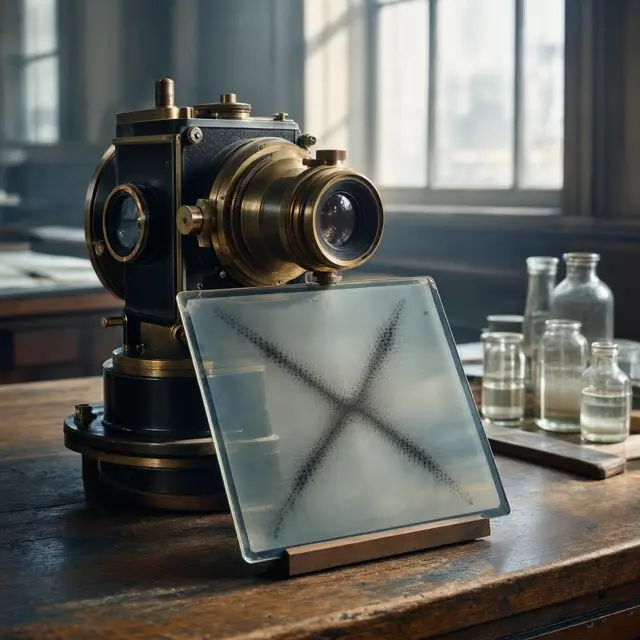
In 1952, her student Raymond Gosling took the famous Photo 51. The scientist John Desmond Bernal later called her images "amongst the most beautiful X-ray photographs of any substance ever taken". Franklin was strictly careful with evidence. "We are not going to speculate," she said, "we are going to wait, we are going to let the spots on this photograph tell us what the structure is."
The Race to the Double Helix
In Cambridge, James Watson and Francis Crick were building models of DNA. Franklin preferred to wait for enough data before building any model. In early 1953, Wilkins showed Watson one of Franklin's DNA X-ray images without her permission. A report containing many of her calculations also reached Crick.
Watson and Crick finished their double helix model on 7 March 1953. Franklin's own draft, dated 17 March, showed she had already worked out much of the structure herself. On 25 April 1953 the journal Nature published the Watson and Crick paper, with papers by Wilkins and by Franklin and Gosling in the same issue.
When Franklin saw their model, she is reported to have said: "It's very pretty, but how are they going to prove it?" In 1962, Crick, Watson and Wilkins shared the Nobel Prize in Physiology or Medicine. Franklin had died in 1958, aged 37, and she was never nominated. Watson later said that ideally she would have received a Nobel Prize in Chemistry.
Viruses, Table Tennis Balls and a Mars Rover
In 1953 Franklin moved to Birkbeck College, calling it "moving from a palace to the slums ... but pleasanter all the same". There she turned to viruses. In 1955 she showed that all tobacco mosaic virus particles are the same length, against the views of a leading expert. Her team then showed that the virus's RNA is wound along the inner surface of its hollow shell.
She also began work on the polio virus. For the 1958 Brussels world's fair, she built a five-foot-high model of the tobacco mosaic virus. Her materials included table tennis balls and plastic bicycle handlebar grips. Her colleague Aaron Klug carried the work forward and won the Nobel Prize in Chemistry in 1982.
Today her name is everywhere. An asteroid discovered in 1997 is called 9241 Rosfranklin. In 2019 the European Space Agency named its ExoMars rover Rosalind Franklin. And in 2020 the UK Royal Mint released a 50p coin showing a stylised version of Photo 51.