The Church That Took a Lifetime
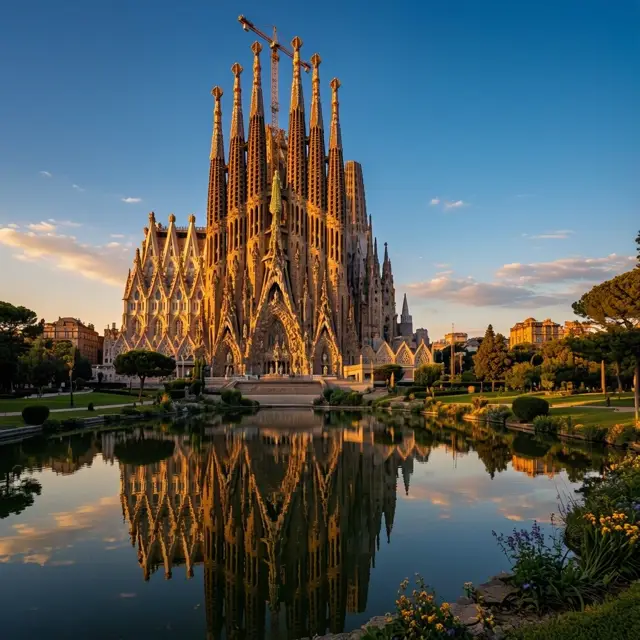
The Sagrada Família is a Catholic church in Barcelona, Spain, and it has been under construction for well over a century. Work began on 19 March 1882, following a plan for a fairly standard church by the architect Francisco de Paula del Villar.
A year later, Villar resigned, and a Catalan architect named Antoni Gaudí took over. He changed the design completely, mixing Gothic architecture with the flowing, curving shapes of Art Nouveau.
Gaudí devoted the rest of his life to it. When asked about how long it was taking, he is said to have replied: my client is not in a hurry. When he died in 1926, only between 15 and 25 percent of the building was finished. He is buried in its crypt.
The project has never received support from any government. It was first paid for by private donors, and today mostly by visitors' ticket money, which helps explain the slow pace.
Plans Lost in the Flames
The Spanish Civil War nearly wiped out Gaudí's vision. In July 1936, a group set fire to the crypt and broke into his workshop, partly destroying his original plans and models.
Work continued afterwards using what could be saved, along with plans rebuilt from published drawings and photographs. Progress came in fits and starts from the 1950s.
Modern technology finally sped things up. From the 1980s, computers were brought into the design process. Stone that was once carved by hand is now shaped off-site by computer-controlled cutting machines. Construction passed the halfway point in 2010, and that year the church was consecrated and declared a basilica.
There were some odd hurdles along the way. In 2018, the church's trustees agreed to pay the city 36 million euros for a building permit, after 136 years of construction without one. And the local stone ran out, so since 2018 the stone has come from a quarry in England.
No Straight Lines
Almost nothing about the building is ordinary. There are no exact right angles anywhere inside or outside it, and very few straight lines.
Its columns are especially clever. They branch like trees to spread their weight, and their shapes change as they rise: a column might start with a square base, become eight-sided, then sixteen-sided, and finally round. Gaudí also made heavy use of the hyperboloid, a strong curved shape that can be built from straight lines.
Each façade tells a story. The Nativity Façade, the first to be completed, is full of scenes from nature. At the base of two columns sit a turtle and a tortoise, one for the land and one for the sea, while chameleons at the sides stand for change.
The Passion Façade is the opposite: plain and harsh, carved with straight lines meant to look like the bones of a skeleton. It even contains a magic square, a grid of numbers in which every row and column adds up to 33.
The World's Tallest Church
Gaudí planned 18 spires in total, with the tallest, the Tower of Jesus Christ, at the centre. He designed it to be slightly shorter than Montjuïc, the hill overlooking Barcelona, believing that his creation should not surpass God's work.
On 30 October 2025, part of the central tower was lifted into place, making the Sagrada Família the tallest church in the world and overtaking Ulm Minster. The tower reached its full height of 172.5 metres on 20 February 2026.
The completed tower was blessed and inaugurated on 10 June 2026, marking 100 years since Gaudí's death.
Even so, the work is not done. Fourteen of the 18 spires were complete as of 2026, and decorative work was expected to continue into the 2030s. Parts of the building have been a UNESCO World Heritage Site since 2005, and one art critic said it is probably impossible to find a church anything like it in the entire history of art.