A Plain Box With No Front Door
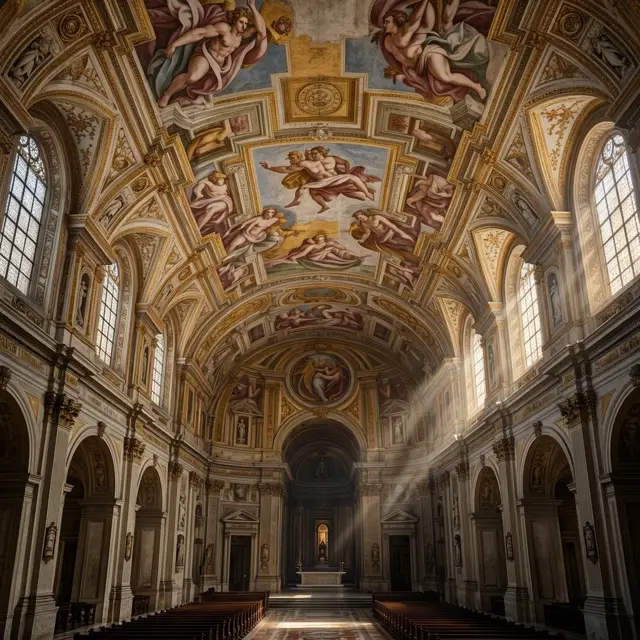
From outside, the most famous painted room in the world is deliberately unremarkable. The chapel has no exterior facade and no outside processional doorway, because you have always entered it from inside the Apostolic Palace. Its exterior carries no architectural or decorative details at all, which was common for Italian churches of the period.
Inside it is about 35 metres long and 14 metres wide, with the ceiling around 20 metres above the floor.
It was built for Pope Sixtus IV between 1473 and 1481, which is where the name comes from, and it replaced an older hall called the Cappella Maggiore that by then was in a ruinous state with its walls leaning. The first mass was celebrated on 15 August 1483. And the ceiling everyone now travels to see was originally something else entirely: brilliant blue, dotted with gold stars.
The Commission Michelangelo Renegotiated
The famous ceiling exists because an artist refused the job he was given.
Pope Julius II commissioned Michelangelo in 1508, and the original brief was modest: paint the twelve apostles on the triangular spandrels supporting the vault. Michelangelo demanded a free hand over the pictorial content instead, and got it.
What he painted between 1508 and 1512 was a nine-part sequence showing the Creation of the World, God's relationship with mankind, and mankind's fall from grace, plus twelve biblical and classical figures who foretold the coming of Christ on the four corner sections, and the Ancestors of Christ around the tops of the windows. The blue-and-gold star ceiling was entirely replaced.
He was not the first major artist in the room. The side walls had been frescoed in 1481 and 1482 by Botticelli, Ghirlandaio, Perugino and Rosselli with the Life of Moses and the Life of Christ.
The Masterpiece That Destroyed Other Masterpieces
Michelangelo returned decades later, in a changed political climate after the Sack of Rome, to paint The Last Judgment on the wall above the altar between 1535 and 1541.
That wall was not empty. Painting it meant obliterating work by the earlier masters: two scenes from the original cycles, the Nativity of Jesus and the Finding of Moses, along with several of the painted Popes and two sets of Ancestors.
Something similar happened to Raphael. In 1515 Pope Leo X commissioned him to design ten tapestries for the lower walls, showing the lives of St Peter and St Paul. They were woven in Brussels over four years. During the Sack of Rome in 1527 they were looted, and either burnt for the precious metal woven into them or scattered across Europe. A set reassembled from later weavings was displayed in the chapel again in 1983.
Smoke Signals and Signal Jammers
The chapel is not a museum piece. It is still the room where a new pope is chosen, and the conclave has produced one of the few pieces of religious ceremony the whole world can read at a glance.
A chimney is installed in the roof, and the ballots are burned. White smoke means a pope has been elected, made by burning the ballots alone. Black smoke means no candidate reached the required two-thirds, made by burning the ballots with wet straw. Chemical additives are now used to sharpen both colours. The first conclave held here was in 1492.
The modern preparations are wonderfully unromantic. Carpenters lay a slightly raised wooden floor to protect the marble, with a ramp for any cardinal who needs a wheelchair. Underneath that floor they install electronic signal jamming equipment, to stop messages passing into or out of the room.