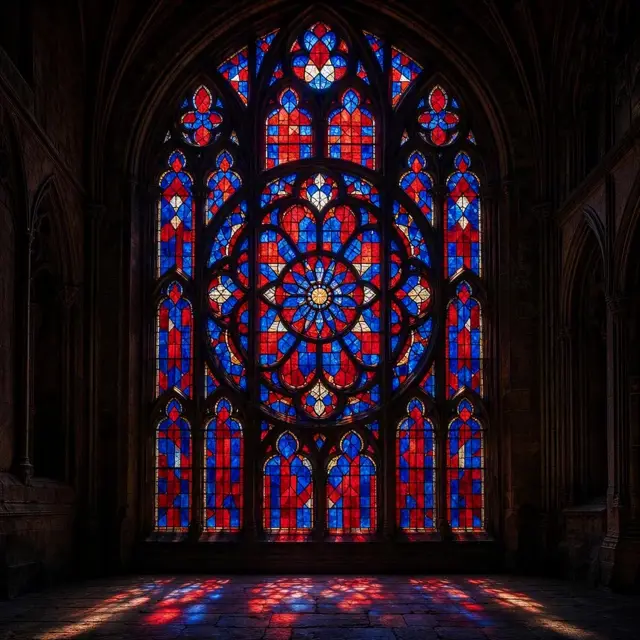
Colour Mixed Into the Glass
Stained glass is glass coloured by adding metallic salts while it is being made. The colour runs through the material rather than sitting on the surface, which is why it does not fade the way paint does.
The chemistry is specific. Medieval blue came from cobalt, at a concentration between 0.025 and 0.1 percent, which produced the brilliant blue of Chartres Cathedral. Copper oxide at 2 to 3 percent gives turquoise. Manganese, one of the oldest additives and in use since early Egyptian times, gives purple.
Red was the expensive one. Metallic gold at around 0.001 percent produces a rich ruby, with the colour depending on the size and spread of the gold particles. Even lower concentrations give the paler tone sold as cranberry glass.
To build a window, small pieces of this coloured glass are arranged into a picture and held together by strips of lead called cames, then supported by a rigid frame. The result has to fit its opening exactly, resist wind and rain, and in large windows carry its own weight.
Where the Stain Comes From
The word stain in stained glass refers to one specific technique, introduced soon after 1300. That technique, silver stain, is a compound of silver, usually silver nitrate, painted onto the surface and then fired in a kiln.
It produces colours from orange-red through to yellow, and on blue glass it makes greens. How the glass is heated and cooled changes the result significantly, and the chemistry is complex and still not well understood. What matters practically is that the silver sinks a little way into the glass rather than sitting on it, so the effect is extremely stable.
By the 15th century it was cheaper than colouring the glass in the pot, and was often used as the only colour on clear glass.
The black lines that define every figure come from a different material, glass paint: powdered glass mixed with iron or rust filings for blackness, clay, and a liquid to make it brushable. It is painted on and fired, burning away everything except a fused layer of coloured glass. Paint went on one face, stain on the other, because the two did not work on top of each other.
How a Window Gets Made
Making a window starts with measurement, not art. The workshop needs an exact template of the opening the glass must fill.
Then comes the subject, chosen to suit the building, a theme, or the wishes of whoever is paying. A small design called a vidimus, Latin for we have seen, is prepared to show the patron, and sometimes a scale model as well. The designer has to work within the structure of the window and the glass actually available.
Next a full-sized drawing, the cartoon, is made for every opening in the window. A small church window might have two of these plus simple tracery above, while the east window of a large cathedral might have seven across three tiers. In medieval workshops the cartoon was drawn straight onto a whitewashed table, which then served as the pattern for cutting, painting and assembling.
The cartoon is divided into a patchwork giving a template for each piece, with the position of every lead line marked, since the lead is part of the picture.
Glass Blown Into Sheets
Before any of this, someone has to make flat coloured glass, and the traditional method starts with a bubble.
In the cylinder or muff process, the glassmaker gathers molten glass on a blowpipe, blows a bubble into it, and works it with metal tools and water-soaked wooden molds until it forms a long cylinder. The bottom is removed, the cooled cylinder is cut open down one side, then reheated in a second oven to flatten it, then cooled slowly in an annealer so the sheet is stable. Alongside crown glass, this was the material of traditional stained-glass windows.
Window design followed architecture. Between about 950 and 1240, windows without stone tracery needed large expanses of glass held by heavy iron frames, as at Chartres and Canterbury. As Gothic building developed, openings grew larger and were divided by stone shafts and tracery, and the circular rose window evolved from simple pierced stone slabs into designs drafted from hundreds of separate points. Chartres was the greatest centre of manufacture, producing glass of unrivalled quality.