A Gift That Came in Crates
The Statue of Liberty was a gift to the United States from the people of France. The idea is linked to Édouard de Laboulaye, a French political thinker and opponent of slavery, and it was designed by the sculptor Frédéric Auguste Bartholdi.
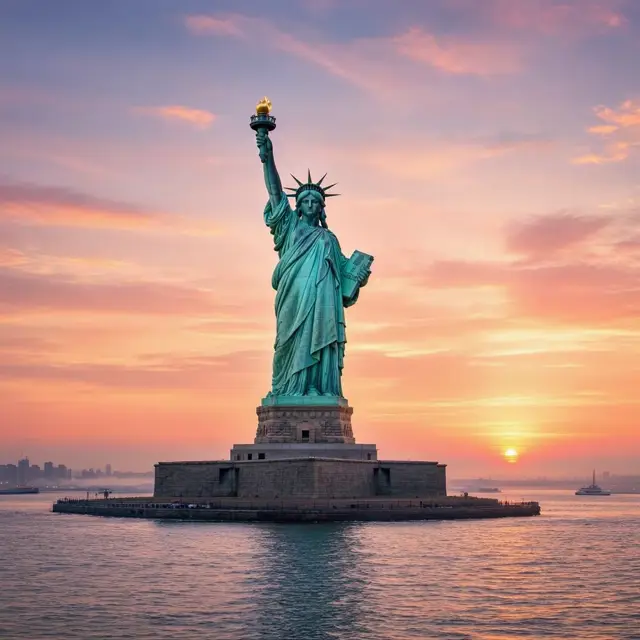
Bartholdi chose a small island in New York Harbor for the site, because every ship arriving in New York had to sail past it. The statue shows a robed woman inspired by Libertas, the Roman goddess of liberty. She holds a torch high, and in her other hand carries a tablet marked with the date of the US Declaration of Independence in Roman numerals.
At her feet lies a broken chain, half-hidden by her robes and hard to see from the ground. It marks the end of slavery after the American Civil War.
The statue was built in France, taken apart, packed into crates and shipped across the Atlantic. When it arrived in June 1885, 200,000 people lined the docks to welcome it.
Eiffel's Hidden Skeleton
The outside of the statue is a thin skin of copper, only 2.4 millimetres thick. Craftsmen shaped it using repoussé, heating copper sheets and beating them into shape with wooden hammers. That kept the statue light for its huge size.
Holding it all up was the job of Gustave Eiffel, the engineer who would later build the Eiffel Tower. His team designed an iron tower to stand inside the statue. He chose not to make it completely stiff. Instead, the copper skin was loosely attached with flexible iron bars, so the statue could sway slightly in the harbour winds and expand on hot days without cracking.
This made it one of the earliest examples of curtain wall construction, where the outer surface carries no weight and an inner frame does all the work.
The first rivet was driven into the statue's big toe. Once the statue was built up to its waist, Bartholdi invited reporters to have lunch on a platform inside it. The finished figure stands just over 46 metres tall.
Pennies From New Yorkers
France paid for the statue, but Americans had to pay for the huge base it would stand on, the pedestal. That turned out to be hard. Newspapers mocked the idea, the governor of New York vetoed a bill to fund it, and Congress said no as well. By 1885, the New York committee had just 3,000 dollars left and stopped work.
The publisher Joseph Pulitzer stepped in. His newspaper, the New York World, launched a drive to raise 100,000 dollars, and he promised to print the name of every donor, however small the gift. The notes poured in. A group of children sent a dollar they had saved to go to the circus. A kindergarten class in Iowa mailed in 1.35 dollars.
In five months the paper raised 102,000 dollars from 120,000 donors, with 80 percent of the money arriving in amounts of less than a dollar.
As part of the fundraising, the poet Emma Lazarus wrote The New Colossus, with its famous lines about the tired and the poor yearning to breathe free.
The Statue That Turned Green
When the statue was dedicated on 28 October 1886, New York celebrated with a parade. As it passed the Stock Exchange, traders threw ticker tape from the windows, starting the city's tradition of the ticker-tape parade.
The torch was a letdown. On the first night it gave only a faint glow, and a newspaper said it looked more like a glowworm than a beacon. The statue was run as a lighthouse, but it proved useless and was handed over to the War Department in 1901.
The biggest change came slowly. The copper started out shiny reddish-brown, but soon after 1900 a green layer called verdigris began to spread, and by 1906 it covered the whole statue. Congress planned to paint it. The public protested, and engineers found the green layer actually protected the copper. In the end, only the inside was painted.
For millions of immigrants arriving by sea, the statue became a sign of welcome. In 1924 it was declared a national monument.