Four huge towers that hold up nothing
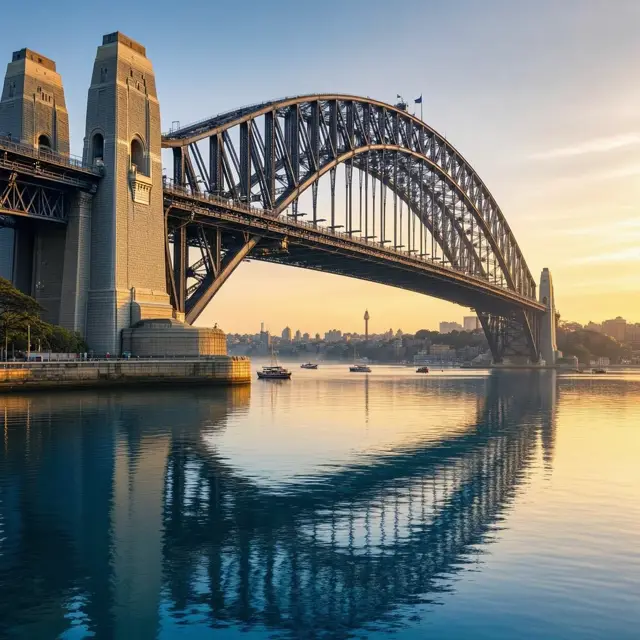
At each end of the Sydney Harbour Bridge stands a pair of pylons, 89 meters tall and faced with granite. They look like they carry the whole bridge. They do not. The real load rests on supports at their base. The pylons were not even in the original design. They were added to ease public worries about the bridge's strength and to give it better visual balance.
Building them was still a huge job. About 250 Australian, Scottish and Italian stonemasons moved with their families to a temporary settlement at Moruya, 300 km south of Sydney. They quarried around 18,000 cubic meters of granite, cut and numbered every block, and sent it north on three ships built just for the task.
Today all four pylons have real jobs. One holds a museum with a lookout, one carries traffic cameras, and the two on the north shore hide vents for the harbour tunnel.
Six million rivets and an arch that grows
The bridge is a steel through arch bridge, nicknamed 'the Coathanger' because of its shape. Its arch spans 504 meters and its top sits 134 meters above the water, making it the world's tallest steel arch bridge. On hot days the steel expands, and the arch can grow 18 cm taller.
The steelwork weighs 52,800 tonnes, and the arch alone weighs 39,000 tonnes. About 79 percent of the steel came pre-shaped from England. Everything is held together by six million hand-driven rivets, made in Melbourne. Each one was heated red-hot, pushed into place, and rounded over with a big air-powered rivet gun. The largest weighed 3.5 kg and was 39.5 cm long.
Why not weld it? At the time, riveting was a proven, well-understood method, while structural welding was not developed enough for a job this size. The last rivet went through the deck on 21 January 1932.
Two halves that met in midair
People proposed a bridge here as early as 1814, but plans kept stalling. A 1916 bill failed because lawmakers felt the money was better spent on the war effort. Finally, in 1924, British firm Dorman Long won the contract with an arch design. It was cheaper than the other options and stiffer under heavy loads.
Arch building began on 26 October 1928. Giant creeper cranes crept out along each half of the arch as it grew. To keep the halves from collapsing before they met, steel cables were passed through tunnels dug into each shore and fixed to the upper sections. On 19 August 1930, the two halves touched for the first time. Once they were riveted together, the arch held itself up and the cables came off.
Before opening, the bridge faced a tough exam. As many as 96 steam locomotives were lined up end to end on its four rail tracks for three weeks of testing.
An opening day with a surprise rider
The bridge opened on 19 March 1932. Just as the state premier was about to cut the ribbon, a man in military uniform rode up on a horse and slashed it with his sword, declaring the bridge open himself. He was arrested, the ribbon was quickly retied, and the official ceremony went ahead. His £5 fine was later reversed on appeal.
The crowds were enormous. Between 300,000 and one million people joined the celebrations, at a time when all of Sydney had about 1,256,000 residents. Schoolchildren carried a message by relay all the way from Tottenham, 515 km away, and it was presented at the ceremony.
Sydney was proud of its new bridge. That year saw a steep rise in babies named Archie and Bridget in its honor. Built during the Great Depression, it kept so many people employed that it earned the nickname 'the Iron Lung'. It cost 6.25 million Australian pounds, which was not fully paid off until 1988.
Cattle at midnight and paint-stripping robots
Here is an odd rule: the main road across the bridge is a stock route, so livestock may legally be herded over it. It can only happen between midnight and dawn, and only after giving notice. The last time was in 1999, for a cattle event.
Looking after the bridge never stops. Its painted steel covers 485,000 square meters, the same as sixty football fields, and each coat needs about 30,000 liters of paint. A special fast-drying paint is used, so drips dry before they reach cars below. Since 2013, two grit-blasting robots nicknamed Rosie and Sandy have helped strip off old paint.
Visitors can get closer than ever. Since 1998, BridgeClimb has let tourists legally climb the southern half of the arch, clipped to a wire lifeline, on a trip lasting three and a half hours. In 2009, the road was even covered in turf for a picnic with 6,000 people.