A Tomb Built From Grief
On 17 June 1631, Mumtaz Mahal died while giving birth to her 14th child. Her husband was Shah Jahan, the fifth emperor of the Mughal dynasty, and his court recorded just how hard he took it.
For a week he stayed away from royal business. For two years he gave up listening to music and wearing fine clothes. Historians of his time wrote that he never showed anyone else the kind of affection he had shown her.
That same year, he ordered a tomb for her. He chose land on the south side of Agra, beside the river Yamuna, and gave its owner a large palace in the centre of the city in exchange. Work began in 1632. The main tomb was finished in 1648, and the whole complex, with its mosque, guest house and gardens, was completed around 1653.
He could not have known it then, but he would one day be buried there beside her.
20,000 Workers and a Road for Elephants
Building it took an army of skill. More than 20,000 artisans, labourers and painters are believed to have worked on it, including sculptors from Bukhara, calligraphers from Syria and Persia, and stone cutters from Baluchistan.
The white marble came from Makrana in Rajasthan. To bring it and other heavy materials to the site, workers built an earth ramp 15 kilometres long, and teams of oxen and elephants hauled specially built wagons along it. Instead of wooden scaffolding, they put up a huge brick scaffold that copied the shape of the tomb.
The decoration came from across the world: jade and crystal from China, turquoise from Tibet, lapis lazuli from Afghanistan and sapphire from Sri Lanka. In total, 28 kinds of precious and semi-precious stone were set into the marble using a technique called pietra dura.
The whole complex cost around 32 million rupees at the time, roughly 827 million US dollars in 2015 money.
Clever Tricks Hidden in the Design
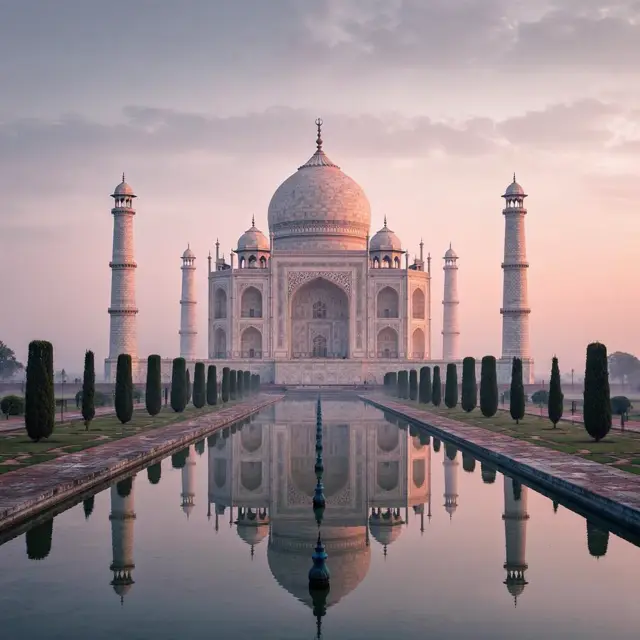
Almost everything about the Taj Mahal is balanced. Its four sides are identical, each built around a huge arched doorway called an iwan, and the building is crowned by a 23-metre marble dome topped with a gilded finial.
At each corner of the platform stands a minaret, a slender tower more than 40 metres tall. All four were built leaning slightly outward on purpose, so that if one ever collapsed, it would fall away from the tomb instead of onto it.
The writing has a trick, too. Verses from the Qur'an run around the arches, and the panels higher up use slightly larger letters, so the text does not look smaller when you read it from the ground.
The tombs you see in the main hall are not the real ones. Each is a cenotaph, a memorial tomb with no one inside. The actual graves of Mumtaz Mahal and Shah Jahan lie in a plain chamber below. And the marble itself shifts with the light, looking pinkish in the morning, milky white during the day and golden under the moon.
A Prisoner With a View
The story has a sad ending for its builder. In 1658, Shah Jahan was removed from power by his own son, Aurangzeb, and kept under house arrest in nearby Agra Fort. From there, he could see the Taj Mahal. When he died in 1666, he was buried inside it, next to his wife.
The building has needed protecting many times since. In 1942, the government covered it in scaffolding to hide it from possible Japanese air attacks. It did the same during the India-Pakistan wars of 1965 and 1971, to confuse bomber pilots.
Pollution is the newer threat. It has turned parts of the white marble yellow-brown, so India created a zone of 10,400 square kilometres around the monument with strict limits on emissions. Restorers have even used mud packs to bring back the white.
Today, around five million people visit every year, and in 2007 it was named one of the New 7 Wonders of the World.