The Great Wave: A Tiny Print That Conquered the World
A struggling 71-year-old artist made it from a woodblock, using a blue pigment that had just arrived from Holland. Today only about 113 originals survive — and one sold for $2.8 million.
3 min read · 8 key facts · 6 terms decoded
Born From Hardship
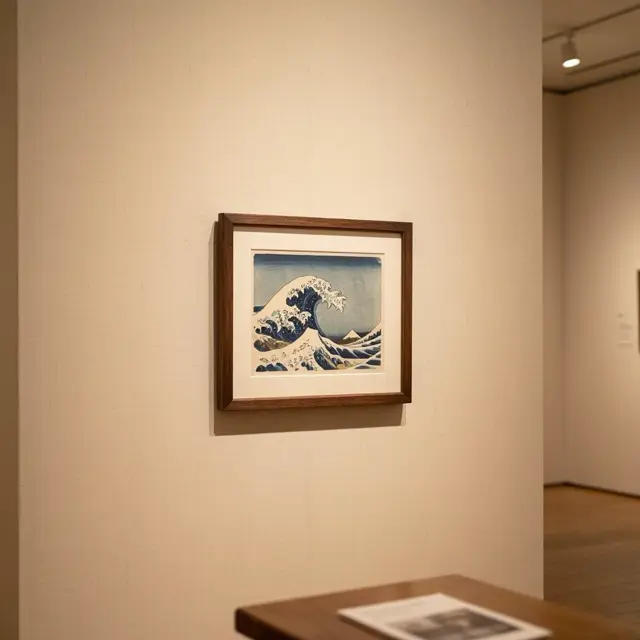
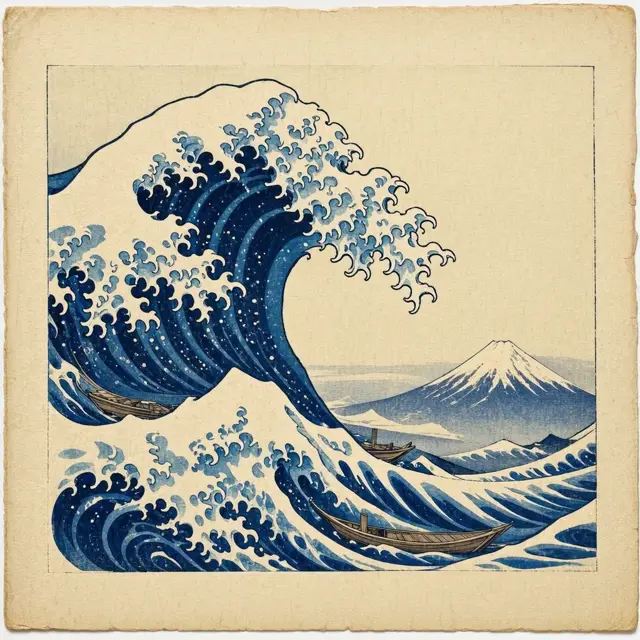
Hokusai created *The Great Wave off Kanagawa* in 1831, at age 71, during severe financial hardship after his wife's death and a grandson's money crisis. It belongs to his series *Thirty-six Views of Mount Fuji*.
The image is deceptively simple: three fishing boats, a towering wave, and tiny Mount Fuji in the distance. The wave stands an estimated 10–12 meters high once you account for Hokusai's roughly 30% vertical compression.
The Blue That Made It Possible
The print's electric color came from Prussian blue, a fade-resistant synthetic pigment imported from Holland that became widely available in Japan in 1829 — just two years before the print was made.
It was made by ukiyo-ewoodblock printing, a craft requiring at least four specialists: the artist, the block carver, the printer, and the publisher who financed it. Hokusai also blended Western single-point perspective with Japanese tradition.
Rare, and Wildly Valuable
Of roughly 8,000 copies originally printed, only about 113 first-edition impressions are known to survive as of 2022 — 35 of them in American museums.
They can be worth fortunes. One print sold for US$2.8 million at Sotheby's in Hong Kong in November 2025. Collectors can date a copy by its wear: the pink and yellow sky areas fade first.
A Wave Everywhere
The image reached far beyond Japan. Composer Claude Debussy kept a copy in his studio and asked for it on the 1905 cover of his orchestral work *La Mer*.
Its cultural pull continues today: Japan's central bank put the print on the redesigned 1,000 yen banknote, which began circulating in 2024.
Key terms, decoded
Claude Debussy
A French composer who featured the print on the 1905 cover of his work La Mer.
Hokusai
The Japanese artist who designed The Great Wave off Kanagawa in 1831.
perspective
A technique for showing depth, here Western single-point perspective blended with Japanese style.
Prussian blue
A fade-resistant synthetic blue pigment that transformed Japanese prints in the 1820s.
ukiyo-e
A Japanese genre of woodblock prints depicting scenes of the 'floating world.'
woodblock printing
A hand method of printing from carved wooden blocks, one for each color.