A Painting on a Dining Room Wall
The Last Supper — *Il Cenacolo* or *L'Ultima Cena* in Italian — is a mural painting by the Italian High Renaissance artist Leonardo da Vinci, dated to c. 1495–1498.
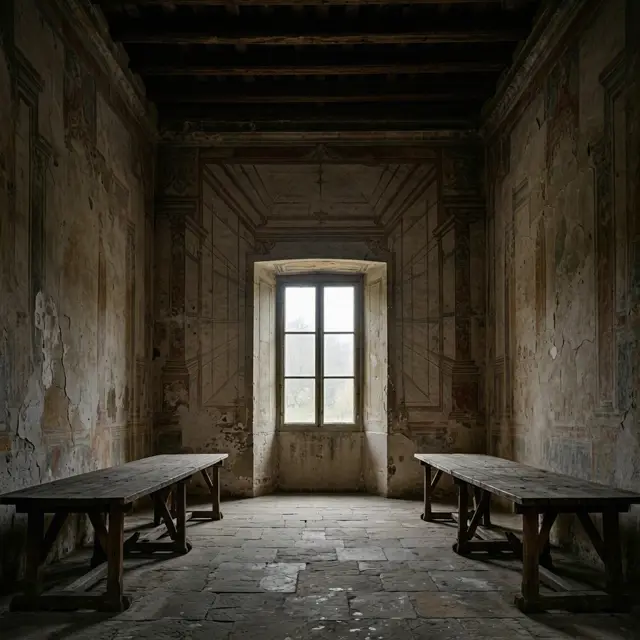
It is not in a gallery and never has been. It is housed in the refectory — the dining hall — of the Convent of Santa Maria delle Grazie in Milan. The monks ate their meals in front of it.
The work depicts the scene of the Last Supper as told in the Gospel of John, and specifically one instant within it: the moment after the announcement that one of those present will betray him. Choosing that particular second is what the painting is built around — it is a picture of a room reacting. Its handling of space, mastery of perspective, treatment of motion and complex display of human emotion have made it one of the Western world's most recognisable paintings.
Commissioned by a Duke
The work was commissioned as part of a plan of renovations to the church and its convent buildings by Leonardo's patron Ludovico Sforza, Duke of Milan.
Some commentators consider it pivotal in inaugurating the transition into what is now termed the High Renaissance — the short period in which Italian art reached the balance, scale and confidence that later centuries treated as a standard.
It is also, aside from the Sala delle Asse, Leonardo's largest work. That combination — his biggest surviving painting, made at a hinge point in the history of European art, executed on a wall in a dining room for the monks of one convent — is a reminder of how much major Renaissance art was produced as architectural decoration for a specific room rather than as a portable object.
The Technique That Doomed It
Here is the decision that determines everything about the painting's condition today.
Leonardo worked slowly, with an inconsistent painting schedule and frequent revisions. Traditional fresco does not permit that: pigment is applied into wet plaster and must be finished before it dries, with no going back.
So he used materials that allowed for regular alterations instead — tempera on gesso, pitch and mastic. It gave him the freedom to keep changing his mind, and it gave the wall no durability whatsoever.
The result was deterioration that began almost immediately. Due to the methods used, a variety of environmental factors, and intentional damage, little of the original painting remains today despite numerous restoration attempts, the last of which was completed in 1999. The most famous mural in the world is largely a record of what was there.
Why It Still Works
Given how little original paint survives, the painting's grip on people needs explaining — and it comes down to structure rather than surface.
The composition organises twelve figures into four groups of three, each reacting differently to the same sentence, so the eye reads a sequence of responses rather than a row of portraits. The room's perspective lines converge on the central figure, meaning the architecture itself directs attention before any detail does.
That design survives damage, restoration and reproduction. It is legible in a faded wall, a printed copy, or a photograph on a phone — which is precisely why the image became inescapable, and why commentators still credit its handling of space and motion as the reason it marked a turning point in Western painting.