A Bridge That Could Not Block the Ships
By the late 1800s, London's East End was booming, and 39% of the city's people lived east of London Bridge. They needed a new river crossing. But a normal low bridge would have cut off sailing ships from the docks and wharfs of the Pool of London.
More than fifty designs were sent in. One from the engineer Joseph Bazalgette was rejected because it did not leave enough headroom. In 1884 a committee proposed a low bridge with an opening section, and recommended a bascule design. Parliament approved it in 1885.
The law was strict. The opening had to be 200 feet wide and 135 feet high when raised. The bridge had to match the architecture of the nearby Tower of London. And it had to open for any ship at any time, no matter how long road traffic had to wait. It was supposed to be finished within four years, but two more acts of Parliament were needed to extend the deadline, and construction took eight years.
Steel Bones in a Stone Coat
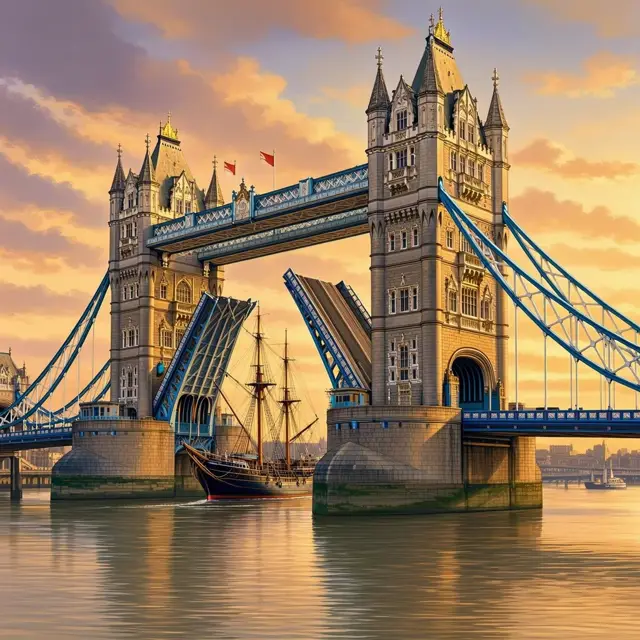
Tower Bridge looks like a castle, but underneath it is a steel machine. More than 11,000 tons of steel form the frame of the towers and walkways. That frame was clad in Cornish granite and Portland stone, both to protect the steel and to fit in with the Tower of London.
Building started in 1886. On average 432 people worked on the site, and at least 1,200 worked on it overall. Two huge piers holding over 70,000 tons of concrete were sunk into the riverbed. The architect Horace Jones died in 1887, and Stevenson, who worked on the architecture, replaced Jones's plain brick front with the fancier Victorian Gothic style that made it such a distinctive landmark.
The bridge is really three bridges in one. The two side spans are a suspension bridge. The middle opens up to let ships pass. The high walkways began as cantilever bridges and became suspension bridges in 1960. One odd detail: a chimney on the bridge is painted to look like a lamppost.
Water Power and Gongs in the Fog
The two halves of the opening road, called bascules or leaves, weigh about 1,070 tons each. They are counterbalanced, so they can swing up in about five minutes, through an arc of 82 degrees.
The original power came from water. Steam engines pumped water at 750 psi into six hydraulic accumulators, which held the pressure until it was needed. Each pier had two pairs of engines for backup, and the machinery was built to twice the official requirements. In 1974 the system was mostly replaced, and oil now does the job water once did. The old steam engines still sit in the Victorian engine rooms.
Ships and the bridge talked through signals. By day there were red semaphore signals. At night, two red lights meant closed and two green meant open. In fog, a gong was sounded. In its first year the bridge opened 6,160 times, about seventeen times a day. Now it opens about a thousand times a year, with 24 hours' notice, and ships pay nothing.
Walkways in the Sky
From the start, the high walkways 143 feet above the river let people keep crossing while the road was raised. But they could only be reached by stairs, so few ordinary walkers used them, and they gained a bad reputation, including for pickpockets. They closed in 1910.
They reopened in 1982 as part of the Tower Bridge Exhibition, which also shows off the original steam engines. In 2014 the walkways got glass floors, so visitors can look straight down at the road and the Thames. In 2019 the attraction drew 889,338 visitors.
Below, the bridge is still a busy road, used by more than 40,000 people a day. To protect it, there is a 20 mph speed limit and an 18-tonne weight limit, checked by cameras and sensors in the road. In 1977 it was painted red, white and blue for Queen Elizabeth II's Silver Jubilee, and a refurbishment starting in 2008 brought back blue and white. Because it is Grade I listed, its new LED lights were attached without drilling any holes.
Buses, Jets and Two Sheep
The bridge has seen some wild moments. In 1912 the stunt pilot Francis McClean flew a floatplane between the bascules and the high walkways and became a celebrity overnight. In 1968 an air force pilot flew a Hawker Hunter jet under the walkway at an estimated 300 miles per hour, without permission.
In December 1952 the safety routine failed while a relief watchman was on duty, and the bridge began to rise with a number 78 double-decker bus on it. The driver, Albert Gunter, made a split-second choice to speed up. He cleared a gap of about 3 feet and dropped 6 feet onto the other bascule, which had not yet started to rise. The City gave him £10 for his bravery.
In 1999 a Freeman of the City of London drove two sheep across the bridge, using an old right that freemen claim. And a popular story says the American who bought the old London Bridge thought he was buying Tower Bridge. He denied it himself.