The Boy Who Drew a Doctor's Horse
Walter Elias Disney was born in Chicago in 1901 and grew up largely in Missouri. On a farm in the small town of Marceline, a retired doctor paid him to draw his horse, and his love of drawing took off. He later described his childhood there as one of the happiest times of his life.
It was not an easy childhood, though. After the family moved to Kansas City, he and his brother Roy woke at 4:30 every morning to deliver newspapers before school, then did another round after school. He often fell asleep in class and got poor grades, but he kept the paper route for more than six years.
In 1918, he tried to join the army to fight in World War I and was turned away for being too young. So he changed the date of birth on his birth certificate and joined the Red Cross as an ambulance driver. He reached France just after the fighting ended, and decorated the side of his ambulance with cartoons.
The Rabbit He Lost
Disney's early businesses kept failing. His Kansas City cartoon studio, Laugh-O-Gram, went bankrupt in 1923. That July, aged 21, he moved to Hollywood, where he and Roy set up the Disney Brothers Studio, the business that would become the Walt Disney Company.
Their big early hit was a character called Oswald the Lucky Rabbit, created with his friend and fellow artist Ub Iwerks. The series was a real success. Then, in February 1928, Disney travelled to New York to ask Charles Mintz, the man who handled the cartoons, for a bigger budget.
It went terribly. Mintz refused, and it turned out he had already persuaded many of Disney's artists to work for him directly. Worse, Disney discovered that Universal Pictures owned the rights to Oswald. Mintz gave him an ultimatum: accept less money, or Mintz would make the series without him.
Disney said no. He lost his rabbit and most of his animation staff. Only Iwerks chose to stay.
A Mouse Almost Named Mortimer
To replace Oswald, Disney and Iwerks came up with a mouse. Disney wanted to call him Mortimer, but his wife Lillian thought the name was too pompous and suggested Mickey instead. Iwerks reworked the design to make him easier to animate, and Disney voiced Mickey himself until 1947. As one employee put it, Ub designed Mickey's physical appearance, but Walt gave him his soul.
The first two Mickey cartoons could not find a distributor. So for the third, Steamboat Willie, Disney added synchronised sound, and Mickey took off.
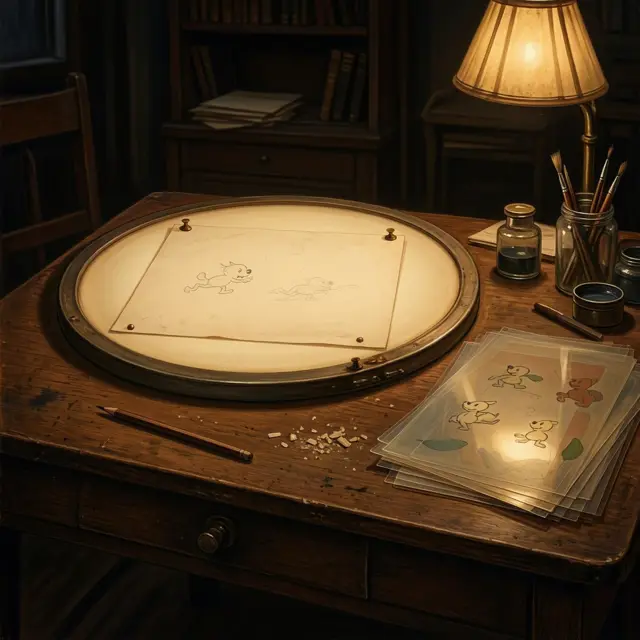
He kept pushing new technology. Flowers and Trees, filmed in full colour, won the very first Academy Award for a cartoon short. Then he bet the studio on a full-length animated film. People in the film industry nicknamed it Disney's Folly and expected it to ruin him. His animators even built a multiplane camera to give scenes a sense of depth. Snow White and the Seven Dwarfs came out in 1937, cost three times its budget, and became the most successful sound film made up to that time.
The Park, and the City He Never Finished
In the 1950s, Disney turned to a new dream. Visiting parks with his daughters, he wished for a clean place where children and parents could have fun together. He studied the Tivoli Gardens in Copenhagen and paid a team of designers, who became known as Imagineers, to plan it. He even sent them to every amusement park in the United States to learn what worked.
Disneyland opened in Anaheim, California, in July 1955. Its Main Street was modelled on his hometown of Marceline. Within a month it was welcoming more than 20,000 visitors a day, and 3.6 million people came in its first year.
Next he planned something bigger in Florida: Disney World, with an experimental city of the future, EPCOT, at its heart. He never saw it. A heavy smoker since World War I, he died of lung cancer in December 1966, aged 65. Disney World opened in 1971, but the city he imagined became a theme park instead.
He still holds the record for the most Academy Awards won by one person: 22, from 59 nominations.