A Fleet the Size of a City
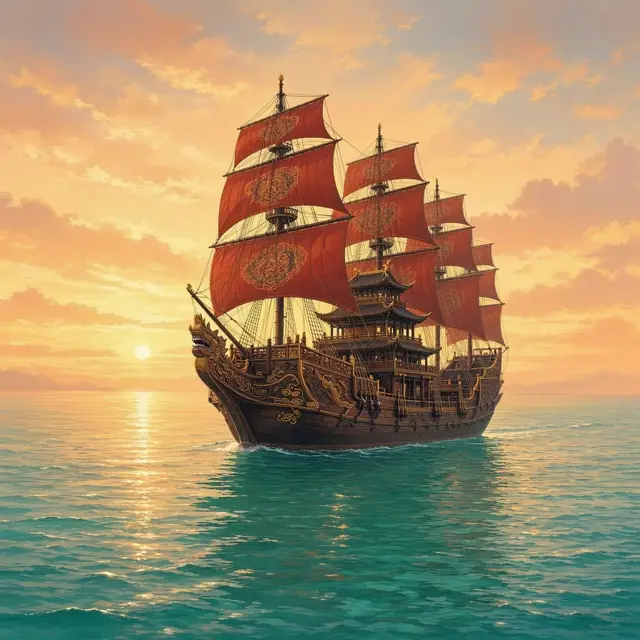
On 11 July 1405, a fleet of 317 ships left Suzhou carrying almost 28,000 crew. In charge was Zheng He, an admiral and diplomat of China's early Ming dynasty. It was the first of seven treasure voyages he would command between 1405 and 1433.
The planning was huge. So many translators were needed that a foreign language institute was set up at Nanjing. On board were navigators, explorers, sailors, doctors, workers and soldiers. A translator named Ma Huan later wrote detailed accounts of the customs and daily lives of people in the ports they visited.
Zheng He himself was hard to miss. Old records describe him as seven chi tall, an old Chinese unit of length, with glaring eyes, teeth as white as shells and a voice as loud as a bell. Born Ma He, he was a trusted adviser to the prince who became the Yongle Emperor. In 1404, the emperor gave him the surname Zheng.
From Java to the Horn of Africa
Zheng He's fleets visited Brunei, Java, Siam, India, the Horn of Africa and Arabia. They handed out and took on goods all along the way. China offered gifts of gold, silver, porcelain and silk. In return, it received novelties such as ostriches, zebras, camels and ivory from the Swahili Coast.
The most famous souvenir was a giraffe, which Zheng He brought back from Malindi. People came too. From his fourth voyage on, he brought envoys from 30 states, who travelled to China to pay their respects at the Ming court.
The routes themselves were not new. The fleet followed old trade routes between China and the Arabian Peninsula that had been used since at least the Han dynasty. When the fleet first reached Malacca, a sizable Chinese community already lived there. Zheng He later wrote that they had crossed more than 100,000 li of water and seen waves like mountains rising into the sky.
Ships Twice the Size of Anything?
Here the story gets wild. A novel published in 1597 claimed that the largest treasure ships had nine masts and were about 127 metres long and 52 metres wide. If true, they would have been nearly twice as long as any other wooden ship recorded until the 20th century.
For comparison, Admiral Nelson's HMS Victory, launched in 1765, was 69.34 metres long. The first ships to reach 126 metres were 19th-century steamers with iron hulls. Some sources go even further and claim treasure ships 183 metres long.
Many scholars doubt these numbers. Historian Edward Dreyer says the novel is poor historical evidence, since it mixes in fantasy. Some experts propose lengths as low as 60 to 75 metres. Part of the problem is an old unit called the zhang, which was not standard in the Ming era. Using one modern estimate of 1.6 metres per zhang, a 44-zhang ship would be about 70 metres long, not 127.
Clues Dug Up From the Shipyard
From 2003 to 2004, they dug up the Treasure Shipyard in northwestern Nanjing, near the Yangtze River, where Zheng He's fleet is believed to have been built. The shipyard once had thirteen basins, and three long ones survive.
The largest basin is 421 metres long, plenty for even the biggest claimed ship. But it is only 41 metres wide at most and just 4 metres deep. That is not wide enough to fit even a ship half the claimed size. The way the wooden frames are grouped suggests the largest ship built there was no more than 75 metres long.
The diggers also found two complete teak rudderposts, each about 10 to 11 metres long. One researcher once used a similar post to argue the ships were enormous. Others point out that traditional wooden junks only 31 metres long also have 11-metre rudderposts, because the post must reach from the water up to the deck.
Why the Voyages Stopped
After the Yongle Emperor died in 1424, his successor halted the voyages. Zheng He made one final voyage under the Xuande Emperor, and then the treasure fleets ended for good. Zheng He probably died during that last voyage and was buried at sea near Calicut, in western India. His tomb in Nanjing is empty.
Money was a big reason the voyages stopped. China faced growing pressure from the Mongols in the north, and the cost of land campaigns there competed directly with the cost of the fleet. Later, the court spent heavily on expanding the Great Wall instead.
Today, his name is everywhere. In China, 11 July is Maritime Day, marking the day his first voyage set out. An underwater mountain in the Arabian Sea is called the Zheng He Seamount. A Chinese training ship named after him sailed around the globe in 2012, and an asteroid mission launched in 2025 was first named after him too.