Faster Than Any Tennis Serve
The fastest tennis stroke on record is Samuel Groth's serve at 263 km/h. The fastest badminton stroke recorded in play is Mads Pieler Kolding's smash at 426 km/h, at a Badminton Premier League match. That is why badminton is often called the fastest racquet sport in the world.
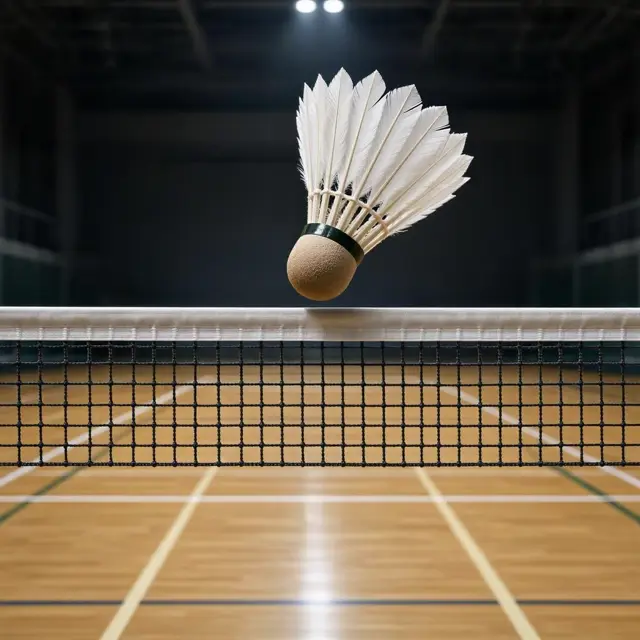
There is a catch. The shuttlecock slows down much faster than a tennis ball. It is traditionally made of sixteen overlapping feathers fixed into a rounded cork base, and those feathers create huge drag. A shuttle weighs about 5 grams, while a tennis ball weighs 57 grams.
All that drag gives the shuttle odd habits. Whichever way it starts, it turns to fly cork-first and stays that way. A high shot falls more steeply than it rises, and a very high serve can drop straight down. The overlapping feathers even give it a slight natural spin, counter-clockwise when seen from above as it drops.
Born Among Officers in British India
The modern game grew up in the mid-19th century among British officers in India, out of an older game called battledore and shuttlecock. Battledore was an old word for a racquet. The name badminton comes from the Duke of Beaufort's Badminton House in Gloucestershire, but nobody knows exactly why or when.
Early on, the game was also called Poona, after the garrison town where it was popular and where the first rules were drawn up in 1873. Outdoor shuttles were sometimes weighted with lead. In Thanjavur, a version called ball badminton was played with a wool ball as early as the 1850s, and the British preferred it in windy or wet weather.
As early as 1860, a London toy dealer published a booklet about the new game, but no copy is known to survive. The Badminton Association of England officially launched the sport in 1893 at a house in Portsmouth. In German, the game is called Federball, meaning feather-ball.
Golden Points and a Shuttle Speed Test
A game runs to 21 points, and you score by winning a rally, no matter who served. At 20 all, play continues until one side leads by two. At 29 all, the next rally is a golden point, and whoever wins it takes the game at 30. A match is the best of three games.
Serving has strict rules. The whole shuttle must be below 1.15 m from the court when it is hit, and the server gets only one attempt, unlike in tennis. To pick who serves first, players can toss the shuttle and see which side it points to.
Even the shuttle gets tested. A player hits a full underhand stroke from the back line, and a shuttle of the right speed must land between 530 mm and 990 mm short of the far back line. Oddly, the rules set no minimum ceiling height, though a hall is unsuitable if a high serve might hit it.
Winning by Fooling the Other Player
Players have to cover a short distance as fast as possible, so trickery is a core skill. Top players prepare different strokes that look identical. They slice the shuttle with an angled racquet face to send it somewhere their arm did not suggest, and slower than their swing implied.
One favourite is the tumbling net shot. Slicing under the shuttle makes it flip over itself several times as it crosses the net. Opponents hate to hit it until it settles, because striking the feathers makes the shot unpredictable. Another trick is double motion, where a player starts moving the racquet one way, pulls back and hits the other way.
Light racquets make all this possible. Elite players develop finger power, tightening their grip at the last moment, and can play a net kill with a swing of less than 10 cm. Some studies even show the wrist plays only a minor role in power. Most of it comes from rotating the upper arm and forearm.
From Back Yards to Olympic Gold
Badminton is often a relaxed game in a yard or on a beach, but at the top it demands stamina, speed, strength and precision. It was a demonstration event at the 1972 and 1988 Olympics and became an official Olympic sport in Barcelona in 1992, with four events. Mixed doubles was added four years later. Olympic gold is now generally the most prized title for individual players.
The sport was first organized in England, and Denmark has long led men's badminton in Europe. Worldwide, Asian nations have become dominant, with China the greatest force in recent years. The men's Thomas Cup was first held in 1948 and 1949, and the mixed Sudirman Cup began in 1989.
The gear is surprisingly light. Top racquets weigh just 70 to 95 grams without grip or strings, and tennis racquets are about four times heavier. Badminton racquets were once made of wood, then light metals, and now carbon fibre.