Invented on a Rainy Winter's Day
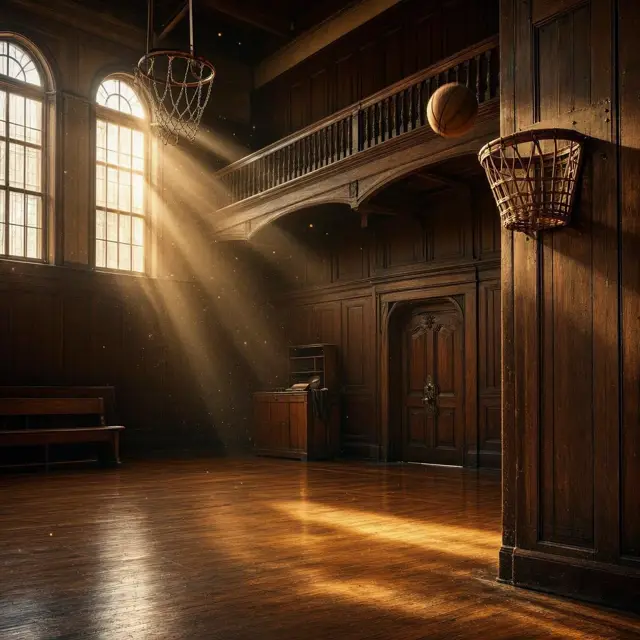
Basketball exists because of bad weather. In December 1891, James Naismith, a Canadian-American physical education instructor at the YMCA training school in Springfield, Massachusetts, needed a way to keep his class active through a rainy New England winter without the injuries of rougher indoor sports. His solution: players would pass a ball and score by tossing it into a basket mounted on the wall.
The first equipment was gloriously improvised, a peach basket nailed to an elevated track. Naismith left the basket's bottom intact, so the ball had to be retrieved by hand after every single score, until he finally removed it and poked balls through with a long dowel.
The first official game was played on 20 January 1892 in Albany, New York, with nine players on a court half the size of today's NBA floor. Final score: 1 to 0, on a shot from 25 feet.
We Have a Basket and a Ball
The sport was nearly named after its inventor. When original player Frank Mahan suggested "Naismith ball", the inventor laughed that such a name would kill any game. Mahan then offered the obvious alternative, and Naismith agreed: "We have a basket and a ball, and it seems to me that would be a good name for it."
The modern game assembled itself piece by piece. Dribbling was not part of the original rules, but it was common by 1896, with rules against double dribbling arriving by 1898. Early soccer balls with laces bounced unpredictably until lace-free construction fixed the problem, and the ball itself stayed brown until the late 1950s, when Tony Hinkle introduced the orange ball for better visibility.
Even the backboard was born of necessity: spectators in balconies kept interfering with shots, and the barrier erected to stop them accidentally created the rebound shot.
From YMCA Gyms to the Olympics
The YMCA network spread basketball across America with missionary speed, and women claimed the game almost immediately. Senda Berenson, a physical education instructor at Smith College, learned the rules from Naismith and adapted them, and on 21 March 1893 Smith's freshmen and sophomores played the first women's collegiate game.
The professional era took longer to organize. The Basketball Association of America formed in 1946, playing its first game between Toronto and New York on 1 November, and its 1949 merger with the National Basketball League created the NBA.
The Olympics embraced the sport in stages: men's basketball debuted at the 1936 Berlin Games, played outdoors, with the United States beating Canada in the final, while women's basketball had to wait for Montreal in 1976. In 1989, FIBA opened the Olympics to professional NBA players, transforming international competition.
The Global Game
The rules Naismith sketched have grown into a precise machine. Two teams of five contest a rectangular court, scoring a field goal worth two points, or three from behind the arc, with fouls punished by free throws worth one point each. Five positions structure the play, from the towering center to the ball-handling point guard, and tied games run to overtime until someone wins.
The skills have names known worldwide: the layup, the jump shot, the dunk, the steal, the block.
And the world took the game. The NBA is the most significant professional league in terms of popularity, salaries, talent, and level of competition, drawing players from all six inhabited continents, while the FIBA Basketball World Cup and the Olympic tournament gather the planet's national teams. Not bad for a game invented to fill a rainy gym class.