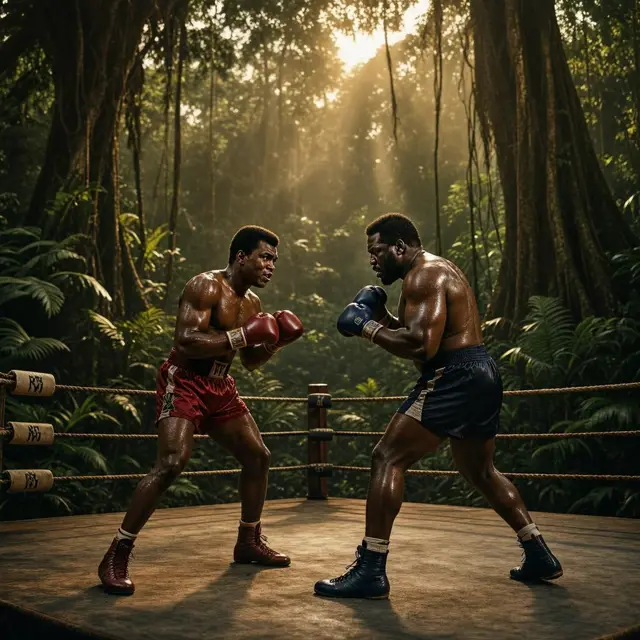
The Fight Everyone Expected Ali to Lose
Muhammad Ali walked into the ring on October 30, 1974, as a massive underdog. Bookmakers had him at 4-1 to lose. His opponent, George Foreman, was 25, undefeated at 40-0, and had knocked out 37 of those men, many of them inside two rounds.
Ali was 32, well past what boxing considered a fighter's prime, and his record already carried two losses. He had spent years fighting for the right to challenge again after being suspended from the sport.
At the 20th of May Stadium in Kinshasa, Zaire, almost nobody expected a real contest. Foreman had steamrolled through the same men who had once beaten Ali, doing it faster and more violently. The fight was billed as a coronation, not a comeback.
A Strategy That Looked Like Surrender
Ali's plan shocked his own corner. Instead of dancing and using his speed, he leaned back against the ropes and let Foreman hit him, arms and gloves covering his head and body. Reporters watching thought Ali had lost his mind before a single big punch even landed.
Foreman threw hundreds of punches that either missed or thudded into Ali's arms instead of his head. Ali talked to him the whole time, taunting him to throw more, wearing him out with every wasted swing. He answered back with sharp counters and tied Foreman up in the clinches.
This approach later earned a name: the rope-a-dope. By the middle rounds, the undefeated champion who had never needed to pace himself was gasping for air, and Ali was still fresh enough to attack.
The Cut That Nearly Cancelled History
The fight almost didn't happen when it did. It had originally been scheduled for September 25, 1974, but eight days before that date, Foreman was cut above the eye during sparring. His sparring partner's elbow opened an 11-stitch gash, and the bout was pushed back five weeks.
The delay left Ali and Foreman training in Zaire far longer than planned, with both camps stuck waiting under the African sun. Promoter Don King had already built an entire spectacle around the original date, and postponing risked the whole event falling apart.
To keep momentum going, organizers staged a three-night concert called Zaire 74 before the rescheduled fight, featuring James Brown, B.B. King, and other major musicians. The delay became part of the story instead of derailing it.
A Billion People Watched Him Fall
When the eighth round finally arrived, Foreman was exhausted from round after round of unanswered effort. Ali unloaded a fast combination, finishing with a hard right hand that sent Foreman toppling to the canvas. The referee waved it off before Foreman could rise, and Ali was champion again.
The scale of the audience matched the moment. An estimated one billion people watched around the world, including roughly 26 million in the United Kingdom alone, nearly half that country's population, tuning in on BBC One. Another 50 million watched on closed-circuit broadcasts in venues across the globe.
Each fighter was paid five million dollars, an enormous purse for 1974, and the event is thought to have generated close to 100 million dollars overall.
The Whisper That Changed the Fight
Foreman later admitted the exact moment he knew something had gone wrong. Around the seventh round, he hit Ali hard on the jaw, expecting him to fold like every opponent before him. Instead Ali held on and quietly asked, "That all you got, George?"
Foreman said that single question told him this fight was nothing like he had prepared for. He had trained to overwhelm Ali with raw power, and instead he was the one running out of answers.
The two men, once framed as bitter rivals, became close friends afterward. Foreman was famously at Ali's side during the 1996 Academy Awards, when the documentary about their fight, *When We Were Kings*, won an Oscar.