A Footrace in Ancient Greece
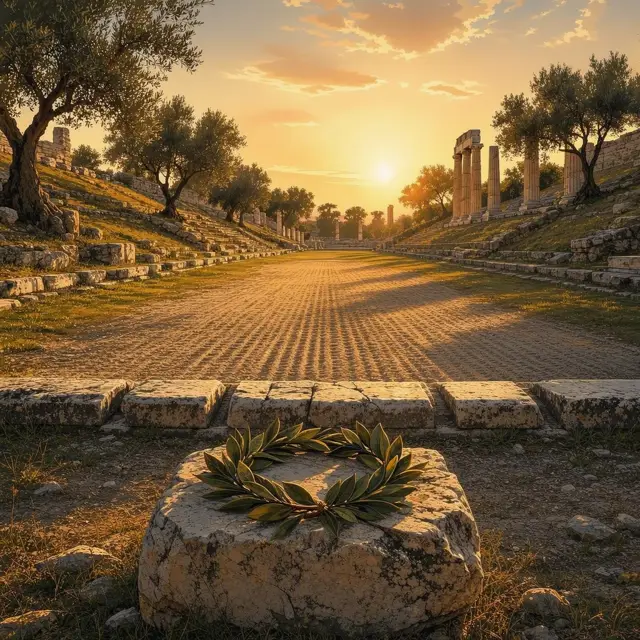
The story begins at Olympia, in Greece, where athletic festivals were held every four years from the 8th century BC. Inscriptions date the games to 776 BC, and at first there was exactly one event: the stadion, a simple footrace.
The program grew into a real spectacle: running events, a pentathlon of jumping, discus, javelin, a foot race and wrestling, plus boxing, the brutal anything-goes combat sport called pankration, and equestrian events.
One famous detail needs correcting. The idea that wars paused for an "Olympic truce" is a modern myth; the Greeks never suspended their wars. The truce protected religious pilgrims traveling to Olympia through warring territories, nothing more. The ancient games survived for over a thousand years before ending around 393 AD, when Emperor Theodosius I moved against the old religious practices they were part of.
One Frenchman's Stubborn Revival
Fifteen centuries later, a French baron decided the world needed the games back. Pierre de Coubertin, inspired in part by England's Wenlock Olympian Games, founded the International Olympic Committee in 1894, and the first modern Olympics opened in Athens in 1896 with 14 nations and 241 athletes competing in 43 events.
The growth since then is almost comical. The 2020 Summer Games alone drew more than 11,300 competitors representing 206 nations, and the 2020 Summer and 2022 Winter Games combined featured over 14,000 athletes across 40 sports and 448 events.
The movement kept sprouting branches: the Winter Olympics debuted at Chamonix in 1924, the Paralympic Games grew from Ludwig Guttmann's 1948 rehabilitation competitions into an official event in Rome in 1960, and the Youth Olympic Games for athletes aged 14 to 18 launched in Singapore in 2010. In 2024, the Paris Games achieved full gender parity on the field of play.
Wars, Boycotts, and a Pandemic
The modern games have absorbed every shock the modern world could throw at them. World Wars I and II cancelled the Olympics of 1916, 1940, and 1944 outright. During the Cold War, large-scale boycotts hollowed out the 1980 and 1984 games. And in 2020, a pandemic did what only world wars had done before, pushing the Tokyo Olympics to 2021.
The calendar itself has been redesigned along the way. Until 1992, the Summer and Winter Games took place in the same year; since 1994 they alternate, two years apart within each four-year cycle.
The athletes changed too. Coubertin's ideal of pure amateurism slowly collapsed, partly because state-sponsored competitors eroded the concept while self-financed athletes played by stricter rules, and the IOC eventually accepted professionals at the games. Winners still collect the same three prizes: gold, silver, and bronze medals.
The Price of Hosting the Planet
Putting on the world's biggest event costs the earth. Beijing 2008 ran to an estimated 40 to 44 billion dollars, the most expensive Summer Games, while Sochi 2014 reached about 51 billion, the most expensive Winter Games ever. Since 1960, cost overruns have averaged 156 percent, meaning hosts pay roughly two and a half times what they budgeted, with Montreal 1976 setting the record at 720 percent over.
The human ledger is heavy too: one housing-rights organization reported that the Olympics displaced more than two million people over two decades, and a 1998 bribery scandal around Salt Lake City's bid saw ten IOC members expelled.
With fewer cities bidding, the IOC took the unusual step of awarding two games at once, giving 2024 to Paris and 2028 to Los Angeles. And in March 2025, Kirsty Coventry became the first woman and the first African elected president of the IOC.