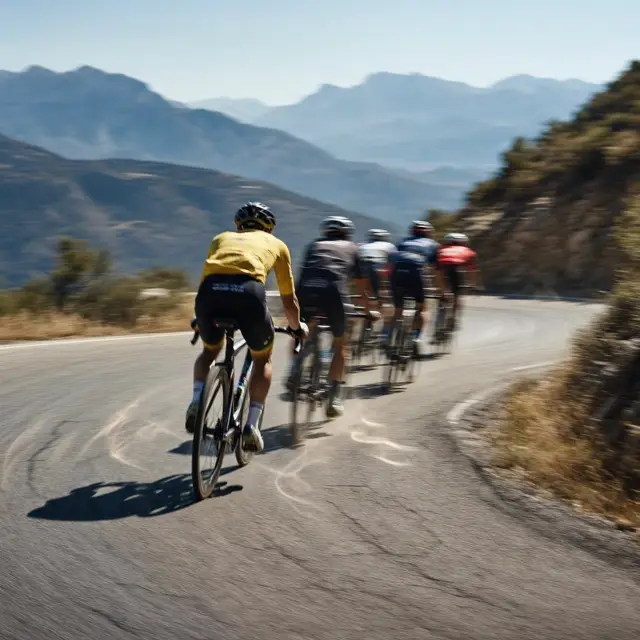
A Race Invented to Win a Newspaper War
The Tour de France did not begin as a sporting idea. It began as a marketing weapon.
The newspaper *L'Auto* was losing a circulation battle against its rival *Le Vélo*, and its editor Henri Desgrange needed something dramatic. At a crisis meeting on 20 November 1902, a 26-year-old cycling journalist named Géo Lefèvre floated an idea: a six-day race of the kind already popular on indoor tracks, except staged all the way around France.
It was an absurd proposal. Six-day track racing happened in a stadium where riders could be watched, fed and counted. Lefèvre was suggesting the same endurance ordeal spread across an entire country's roads, most of them unpaved. Desgrange took the gamble anyway. The race was first organised in 1903, and it has run annually ever since apart from 1915 to 1918 and 1940 to 1946, when the two World Wars stopped it.
Twelve Thousand Francs and Twenty-Four Survivors
The first Tour set off on 1 July 1903 and was won by Maurice Garin. Getting riders to the start line at all took some persuading.
Desgrange halved the entry fee from 20 francs to 10 francs and dangled a first prize of 12,000 francs — around six times what most workers earned in a year. Even so, the field numbered only 60 to 80 entrants.
The attrition was savage. By stage four, only 24 riders were still in the race. That pattern of brutal selection became the Tour's identity rather than an embarrassment: the route deliberately drags the field through the Pyrenees and the Alps, and since 1975 has almost always finished on the Champs-Élysées in Paris. Each year the race alternates between clockwise and counterclockwise loops of the country, so no rider gets to specialise in one direction forever.
Why the Leader Wears Yellow
The most famous garment in cycling owes its colour to a printing decision. The yellow jersey was adopted in 1919 for a wholly practical reason: *L'Auto* was printed on yellow paper, so the leader became a moving advertisement for the sponsoring newspaper.
The other jerseys arrived much later, each carving out a separate contest inside the same race:
- Green — the points classification, prized by sprinters, introduced in 1953
- Polka-dot — the mountains classification for the best climbers, added in 1975
- White — the young rider classification for riders under 26, also added in 1975
There is also a team classification, based on the first three finishers from each team on every stage. And a single stage win carries real prestige of its own, usually claimed by a team's sprint specialist or by a rider who escapes in a breakaway.
Three Weeks, Eight Riders, One Clock
The modern format is remarkably fixed even though the route changes every year. The Tour runs 21 day-long stages over a 23- or 24-day period, covering roughly 3,500 kilometres — about 2,200 miles. Between 20 and 23 teams of eight riders each take part.
The scoring is unforgiving in its simplicity. Every stage is timed to the finish, and each rider's times are added to all their previous stages. Lowest cumulative time leads the race and wears yellow. There is no hiding a bad day.
Winning it five times places a rider in a very small club: Jacques Anquetil, Eddy Merckx, Bernard Hinault and Miguel Induráin, joined by Tadej Pogačar with his 2024 victory. As a UCI World Tour event, the field is mostly made up of UCI WorldTeams, plus whichever squads the organisers choose to invite.
The Chapters Nobody Frames
A race built on suffering has repeatedly tipped into something darker, and the Tour's history carries that honestly.
Tom Simpson died during the 1967 Tour, a loss that pushed riders to strike over doping concerns. Three decades later the 1998 Festina affair exposed doping organised at team level rather than by lone individuals; a French government investigation later reported that close to 90% of the riders had tested positive for EPO during that Tour.
Then came the biggest erasure in the sport's history. Lance Armstrong's seven consecutive wins from 1999 to 2005 were revoked after he admitted doping — a stretch of the record book simply left blank.
The women's side of the race has its own uneven story. A women's Tour ran under various names from 1984 to 2009. After criticism from campaigners and the professional women's peloton, a one- or two-day race, La Course, filled the gap from 2014 to 2021, and the first full Tour de France Femmes was finally held in 2022.