A Berry From a Giant Herb
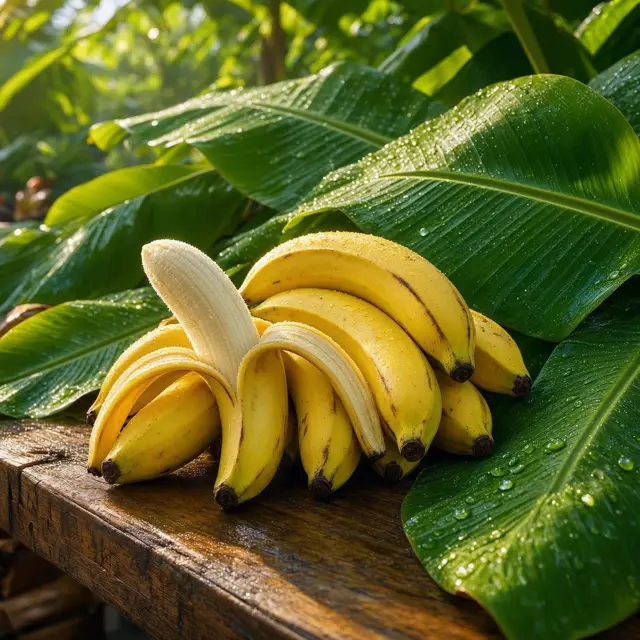
Almost everything casual about the banana is botanically wrong. The banana is not growing on a tree: the banana plant is a giant herbaceous flowering plant, in fact the largest herbaceous flowering plant in the world, a towering herb wearing a tree costume. And the fruit itself is, botanically speaking, a berry.
The bananas we eat come from the genus Musa, and almost all modern edible varieties descend from just two wild species, Musa acuminata and Musa balbisiana, or their hybrids.
Their most useful trick is also their greatest weakness. Cultivated bananas are seedless thanks to parthenocarpy, the ability to produce fruit without fertilization, which means new plants cannot be grown from seed. Instead, every plant is propagated by cloning offshoots, making commercial bananas genetically identical copies of each other.
Domesticated Before the Pyramids
Bananas are one of humanity's oldest agricultural projects. The plants are native to tropical Indomalaya and Australia, and they were probably domesticated in New Guinea, where microscopic plant remains at the Kuk Swamp archaeological site date banana cultivation to around 10,000 to 6,500 years before the present.
Even the name has traveled continents. The word "banana" is thought to be of West African origin, possibly from the Wolof word banaana, while the genus name Musa may derive from the Arabic word mauz.
Today the crop is a global staple grown in some 135 countries. Combined production of bananas and plantains reached 179.3 million tonnes in 2022, and the two biggest producers, India with 34.5 million tonnes and China with 11.8 million, together account for roughly 26 percent of the world total.
The Banana That Vanished
Your great-grandparents ate a different banana. The Gros Michel variety once dominated world trade, until Panama disease, a wilt caused by a Fusarium fungus, tore through the plantations. The industry survived by switching to the Cavendish, the main banana eaten in the Western world today.
History is now threatening a rerun. A new strain of Panama disease known as Tropical Race 4, along with the leaf disease black sigatoka, threatens Cavendish production in turn. Because every Cavendish is a clone, a disease that kills one plant can kill them all.
Breeding a replacement is maddeningly hard for the same reason the fruit is convenient: commercial varieties are seedless, leaving breeders little to work with. As insurance, banana genetic material is conserved in gene banks around the world, a library of diversity for rebuilding the crop.
Picked Green, Ripened by Gas
The banana in your kitchen made its journey asleep. Export bananas are picked green and shipped in refrigerated vessels held at 13 degrees Celsius, a chill that keeps them unripe for three to four weeks in transit.
At the destination, ripening is switched on like a light. The fruit goes into airtight rooms filled with ethylene gas, the same compound bananas naturally produce, which stimulates the formation of amylase, an enzyme that converts starch into sugar, while triggering pectinase production that softens the flesh. Sweetness, on schedule.
How you eat them depends on where you live. English splits the family into dessert bananas and cooking plantains, but Southeast Asian languages draw no such line: in Malaysia and Indonesia they are all pisang, in Thailand kluai, in Vietnam chuoi, feeding recipes from curries to chips, fritters, and preserves.