A Thousand Flowers per Mouthful
Honey begins as nectar, a sugary plant secretion that is 70 to 80 percent water. A foraging bee sips it into a special second stomach called the honey crop, and filling that crop with roughly 40 milligrams of nectar takes visits to more than one thousand flowers.
Back at the hive, the real factory work begins. Bees pass the nectar mouth to mouth, forming bubbles between their mandibles to speed the process, while enzymes from their glands split complex sugars into the simple sugars glucose and fructose.
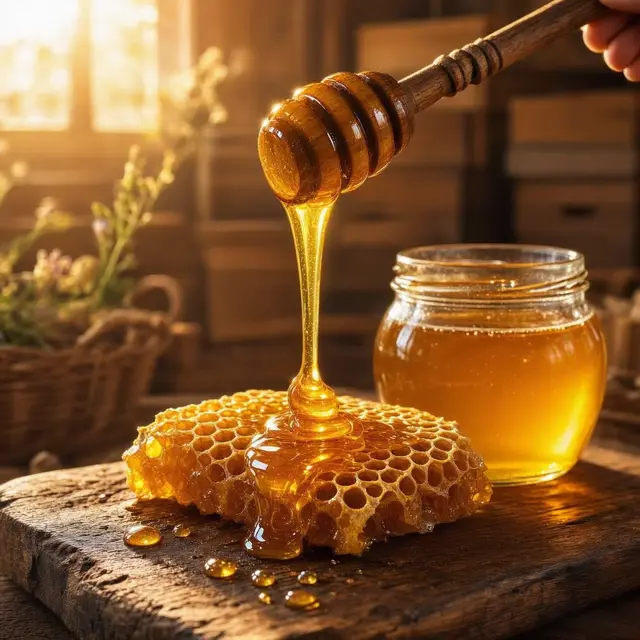
Then comes the drying room. The hive is kept at around 35 degrees Celsius in the storage areas, and workers beat their wings in coordination to evaporate water until the honey thickens to between 15.5 and 18 percent water. Only then do the bees seal each hexagonal wax cell of the honeycomb, capping their finished product against contamination.
The Food That Never Spoils
Honey has a property almost nothing else in your kitchen can claim: stored properly, it does not spoil. Samples of honey discovered in archaeological digs have proven edible even after millennia.
The secret is chemistry hostile to microbes. Honey's sugar concentration is so high that there is simply not enough free water left for microorganisms to grow, and its average pH of 3.9 makes it distinctly acidic.
The bees add a bonus weapon. During processing they mix in an enzyme called glucose oxidase, which slowly produces gluconic acid and hydrogen peroxide, both of which help suppress bacterial growth. As long as the water content stays below roughly 18 percent, honey effectively has an indefinite shelf life, a pantry item with no expiry date, engineered by insects.
Eight Thousand Years of Sweet Tooth
Humans have been raiding hives since before written history. Cave paintings in the Cuevas de la Arana in Spain show people foraging for honey at least 8,000 years ago, scaling cliffs for the prize.
Keeping the bees ourselves came next. The husbandry of honey bees is known as apiculture, while in the Americas the Maya practiced large-scale meliponiculture, the keeping of New World stingless bees that store honey in little pots of wax and resin, since pre-Columbian times.
Today the ancient craft is a global industry. World production of honey reached 1.9 million tonnes in 2023, with China alone producing 24 percent of the total, followed by Turkey, Ethiopia, and Iran. A single managed hive typically yields about 29 kilograms of honey per year, the pooled output of millions of flower visits.
Sweetness With Fine Print
Nutritionally, honey is concentrated energy: about 82 grams of carbohydrate per 100 grams, dominated by 41 grams of fructose and 36 grams of glucose, with a standard tablespoon providing around 43 kilocalories. Its overall sweetness is about the same as table sugar.
What sugar cannot match is character. Each honey carries over 100 volatile aroma compounds that shape its flavor, which is why clover, orange blossom, buckwheat, lavender, and manuka honeys taste like different foods entirely, each a portrait of the flowers it came from.
Medicine keeps a cautious interest in it too, with research pointing to promise for wounds, burns, and coughs. But there is one firm rule: honey is unsuitable for infants because of the risk of botulism, and some rare honeys made from the wrong flowers can even be toxic to adults.