A Book Nobody Can Read
Somewhere in a locked vault at Yale sits a book that has defeated every codebreaker who has ever opened it. The Voynich manuscript is packed with roughly 38,000 words in an unknown alphabet, and after more than a century of trying, nobody has cracked a single sentence.
The script, nicknamed Voynichese, uses only 20 to 25 basic characters and has no obvious punctuation. Yet the handwriting flows smoothly across the page, like someone who had written the same words a thousand times before.
That fluency is part of what makes the mystery so maddening. Analysts have found the text follows real linguistic patterns, like Zipf's law, but its letter-level randomness, called entropy, is lower than any known human language.
Carbon Dating Solves One Mystery, Not the Big One
In 2009, scientists at the University of Arizona ran radiocarbon dating on the manuscript's vellum, calfskin parchment, and got a strikingly narrow window: 1404 to 1438. Every sample tested came back consistent, which is rare for old parchment.
That single result quietly killed one popular theory: that book dealer Wilfrid Voynich, who first showed the manuscript to the world in 1912, had faked it himself. Forging fourteen or fifteen matching calfskins from the early 1400s would have been nearly impossible for a 20th-century con artist.
The paint used for the illustrations also checked out as ordinary, inexpensive material typical of 15th-century Europe. So the book is genuinely medieval. What nobody has explained is why someone spent all that time writing something no one since has been able to read.
From an Emperor's Court to a Cardboard Box
The manuscript's paper trail starts around 1599, when Holy Roman Emperor Rudolf II reportedly paid 600 ducats for it, about 67.5 troy ounces of gold. From there it passed to a Prague alchemist named Georg Baresch, the first owner anyone can actually confirm.
In 1665, university rector Jan Marek Marci mailed it to the Jesuit scholar Athanasius Kircher, insisting in his cover letter that Kircher was the only man alive who could read it. Kircher couldn't. The book then sat in a Jesuit college library in Rome for two centuries.
It resurfaced in 1912, when a Polish book dealer named Wilfrid Voynich bought it from that same collection and spent seven years trying to publicize it. After passing through his widow's estate and a dealer who never found a buyer, it finally landed at Yale University in 1969, where it remains today as manuscript MS 408.
Plants That Don't Exist and Women in Strange Baths
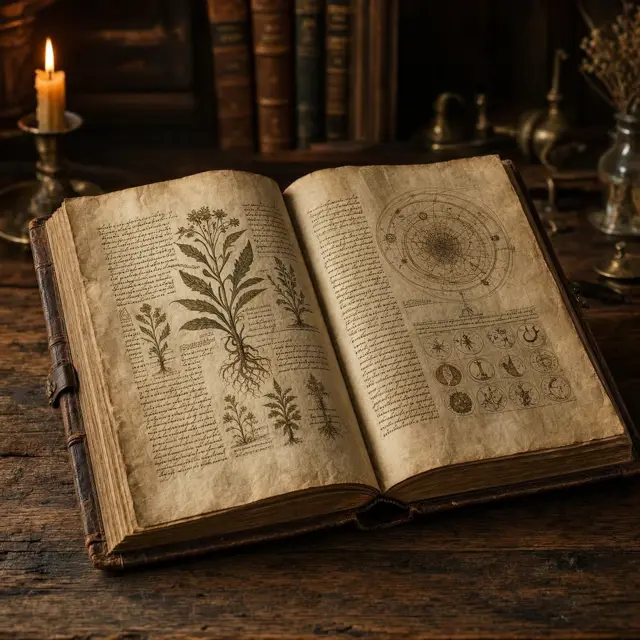
More than half the manuscript, about 126 pages, is devoted to a herbal section full of plant drawings. The strange part is that almost none of the plants match anything real. Some appear to be composites, with the roots of one species fastened to the leaves of another and the flowers of a third.
Then things get stranger. A 20-page section shows women bathing in pools connected by an odd network of pipes and tubs. Another section, nicknamed the "rosettes folio," unfolds into six pages of interlocking circular diagrams that look like castles and islands seen from above.
There's also an astronomical section with zodiac-style diagrams and star-crowned female figures, plus pages of recipes broken into paragraphs marked with little stars. None of it lines up cleanly with any known medieval manuscript tradition, which is exactly why botanists and historians still argue about what any of it is supposed to depict.
The Codebreakers Who Struck Out
During and after World War II, the United States government's own top cryptographers took a swing at the manuscript. William F. Friedman, who had helped break Japanese military codes, led an NSA team through the 1950s and got nowhere. His wife, Elizebeth Smith Friedman, a codebreaker who had personally dismantled real spy rings, called statistical approaches to the manuscript "doomed to utter frustration."
Every decade since has produced a new claimed solution: Ukrainian, Turkish, an invented universal language, even a lost dialect connected to Aztec Mexico. Every one of them has collapsed under scrutiny, often because the proposed dates or languages don't match the radiocarbon evidence.
The most convincing recent finding isn't a translation at all. Medievalist Lisa Fagin Davis studied the handwriting and found telltale differences, in loop size and crossbar shape, that point to five different scribes. That suggests a whole community made this book together, not a single hoaxer working alone.