A Ship Sailing Itself
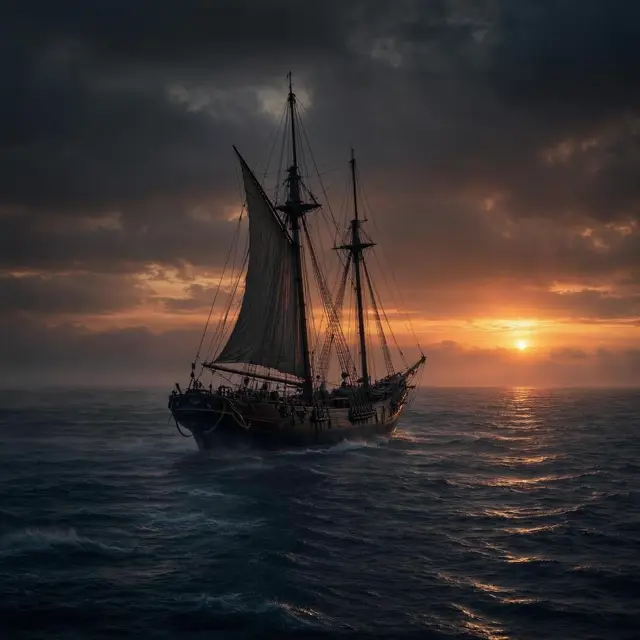
On December 4, 1872, the crew of a Canadian brigantine called the Dei Gratia spotted something strange in the Atlantic, between the Azores and the coast of Portugal. A ship was sailing along on its own, with no one steering it and its sails only partly set. When First Mate Oliver Deveau climbed aboard, he found nobody. Not the captain, not his wife and baby daughter, not one of the seven crew members. The ship was the Mary Celeste, and it had left New York a month earlier bound for Genoa, Italy, carrying 1,701 barrels of alcohol.
Deveau expected a wreck. Instead he found a ship that was still afloat and still seaworthy, with about three and a half feet of water sitting in its hold, nowhere near enough to sink it. Whatever had happened, it had happened fast, and it had happened to everyone at once.
Everything Was Left Behind
What made the Mary Celeste so eerie wasn't what was missing. It was what wasn't. Captain Benjamin Briggs's sword lay sheathed under his bed. His crew's belongings sat undisturbed in their quarters. Below deck, someone found a vial of sewing machine oil standing perfectly upright, the kind of small detail that doesn't survive a struggle, a storm, or a fire.
The only things gone were the ship's lifeboat, most of the navigation instruments, and the ship's papers. The cargo of alcohol, worth a considerable sum, sat untouched in the hold. Whoever left the Mary Celeste didn't do so in a panic of theft or violence. They left in a hurry, but in an orderly way, taking only what they needed to survive, and they never came back for the rest.
An Inquiry That Cleared Everyone
The salvage hearings in Gibraltar ran from December 1872 to April 1873, and the men running them were suspicious from the start. Attorney Frederick Solly-Flood suspected foul play: mutiny, piracy, even murder. Investigators pointed to cuts on the ship's bow and reddish stains on the captain's sword as proof of violence.
Then the science came back. The stains weren't blood. A US Navy captain concluded the bow marks were natural wear, not weapon damage. There was no fire, no explosion, no sign of a struggle anywhere on board. In the end, the court awarded the Dei Gratia's crew a salvage payment of £1,700 for recovering the ship, but no charges were ever filed. Nobody could prove a crime had happened, because the evidence said none had.
So What Actually Happened?
With no evidence of a crime, investigators turned to accidents. One theory blamed a waterspout that could have flooded the hold just enough to frighten the crew without truly endangering the ship. Another blamed a seaquake near the Azores, shaking everyone into a panic they didn't need to feel.
The theory that has aged best involves the cargo itself. The 1,701 barrels held industrial alcohol, and some of them may have leaked vapor into the hold. A 2006 experiment recreated the effect and produced a dramatic wave of flame that left the surrounding air barely warm. A 2026 University of Manchester study reached a similar conclusion: a fast, low-damage vapor explosion could have convinced Briggs his ship was about to blow up, prompting him to load everyone into the lifeboat and abandon ship, only for something to go wrong afterward.
A Fraud Finally Sinks Her
The Mary Celeste never lived down her reputation. Sailors considered her cursed, and she passed from owner to owner at a loss, once described as rotting on wharves where nobody wanted her.
Her end came in 1885, and it wasn't a mystery at all. Captain Gilman Parker loaded her with cargo deliberately misrepresented as valuable, insured it for $30,000, and steered the ship onto a coral reef near Haiti on purpose. He then sold whatever survived for a fraction of that sum. A Boston jury deadlocked on the conspiracy charge, but the scheme still destroyed everyone involved: Parker died in poverty three months later, one conspirator went mad, and another died by suicide.
Hunting for the Wreck
More than a century later, people still wanted to find her. In August 2001, an expedition led by novelist and shipwreck hunter Clive Cussler located wreckage on the same coral reef where Parker had scuttled the ship, and early wood analysis seemed to match timber from the New York shipyard that built her in 1872.
The excitement didn't last. Researcher Scott St George used dendrochronology on samples from the wreck. The growth rings showed the trees were still alive and growing in Georgia as late as 1894, nine years after the Mary Celeste went down. The wreck Cussler found couldn't be her after all, and to this day no confirmed remains of the actual ship have ever been identified.