The Game With No Clock
Almost every major sport ends when time runs out. Baseball does not. The sport has no game clock, though some competitions now use pace-of-play rules such as a pitch clock to keep games from stretching too long.
A game is usually nine innings, one turn batting and one turn fielding for each team. Most games finish after the ninth. If the scores are level at that point, extra innings are normally played until somebody comes out ahead.
The basic shape is simple: two teams of nine players take turns batting and fielding, and the team with more runs at the end wins. Amateur and youth versions vary it freely, with six innings at Little League level and seven at high school level.
How a Run Actually Happens
Each play begins with the pitcher on the fielding team throwing the ball toward the batter, who tries to hit it with a bat. The batting team wants the ball struck into the field of play, away from fielders, so its players can run the bases.
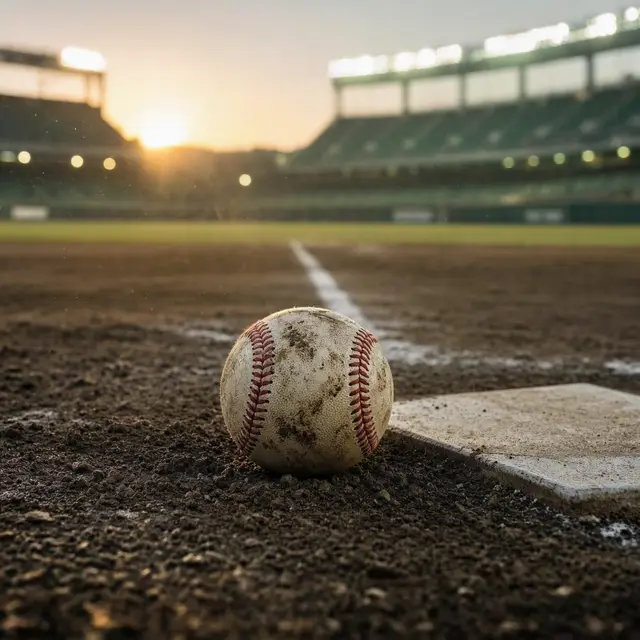
Those bases sit at the corners of a square. A runner advances counter-clockwise from first to second to third and back to home plate, and touching home plate is what scores a run. The batting team's first job is simply getting someone safely to first base.
The fielding team works to record outs. A pitcher can retire a batter with three pitches that count as strikes. Fielders can catch a batted ball before it touches the ground, or tag a runner with the ball while that runner is off a base. Three outs and the teams swap roles.
An English Game That Became America's Pastime
Baseball was not invented in the United States. It evolved from older bat-and-ball games already being played in England by the mid-18th century, carried across the Atlantic by immigrants, and it was in North America that the modern version took shape.
Its American identity was forged partly through hard times. The sport built a reputation as a source of escapism during troubled stretches of American history, including the Civil War and the Great Depression, which earned it the nickname "America's Pastime".
It has been unofficially recognised as the national sport of the United States since the late 19th century, although in modern times it is considered less popular there than American football. The field itself has a distinctive geometry: foul lines extend from home plate at 45-degree angles, marking out 90 degrees of fair territory and 270 degrees of foul territory.
Where the Game Is Biggest Now
Baseball spread far past its adopted homeland. It travelled through the rest of the Americas and the Asia-Pacific during the 19th and 20th centuries, and is now considered the most popular sport in parts of Central and South America, the Caribbean and East Asia, particularly Japan, South Korea and Taiwan.
The top level in the United States and Canada is Major League Baseball, split into the National League and the American League, each with East, West and Central divisions. The champion is decided by playoffs culminating in the World Series. Japan splits its top level between the Central and Pacific Leagues, and Cuba between the West and East Leagues.
Internationally, the World Baseball Classic, organised by the World Baseball Softball Confederation, draws the top national teams. The sport was played at the Olympic Games from 1992 to 2008 and was reinstated on a one-off basis in 2020.