Bored Tourists and Runaway Sleds
Bobsleigh started with a hotel owner who was tired of empty winters. Caspar Badrutt ran a hotel in the spa town of St. Moritz, Switzerland, that was only busy in summer. He talked some wealthy English guests into staying all winter, and kept them happy with food, drink and activities. Soon, wintering in St. Moritz became very fashionable in Victorian Britain.
More guests meant more boredom. In the early 1870s, some adventurous Englishmen began racing boys' delivery sleds through the icy lanes and roads of the town. When they started crashing into people on foot, they added steering. The first bobsleds were two small sleds joined by a board, with a steering device at the front.
Steering meant longer runs and higher speeds, and the locals complained louder and louder. To keep the peace, Badrutt built a natural ice run outside town in the late 1870s. And the sport's odd name? It comes from early riders, who bobbed back and forth inside their sleds to go faster.
From the Cresta Run to the Olympics
Formal races began in 1884 on the Cresta Run, a natural ice track built each year by guests and locals together. It is still in use, and it has no artificial cooling, which makes it one of the few natural tracks in the world. The first club formed in 1897, and the first track built just for bobsleds opened near St. Moritz in 1902.
The sport spread fast. Its world governing body was founded in 1923, and the four-man race was part of the very first Winter Olympics in 1924. The two-man event followed in 1932. The only Winter Games without bobsleigh were in 1960 in California, when organizers chose not to build a track to save money.
Women joined later. The first women's races were held in Lake Placid, New York, in 1983, and two-woman bobsleigh reached the Olympics in 2002. Germany and Switzerland are the most successful bobsleigh nations, and since the 1990s Germans have won more medals than anyone else.
Ice Chutes Built for Speed
Modern tracks are made of concrete coated with ice. Each one must have at least one straight section and at least one labyrinth. Ideally, a track is 1,200 to 1,300 metres long, with at least fifteen curves. The earliest tracks were straight runs, but over the years they grew more and more twisting.
The speeds are wild. Bobsleds can reach 150 km/h, and the reported world record is 157.06 km/h, set on March 3, 2019, at the World Championships in Whistler, Canada. On some curves, the crew can feel forces as strong as 5 g.
You do not have to be an Olympian to feel it. Several tracks offer bobsleigh rides to tourists, including ones in Sigulda in Latvia, Innsbruck-Igls in Austria, Whistler in Canada, Lillehammer in Norway, Lake Placid and Salt Lake City in the United States, and La Plagne in France. Some tracks are also shared with the sliding sports of luge and skeleton.
Sleds, Weights and Crews
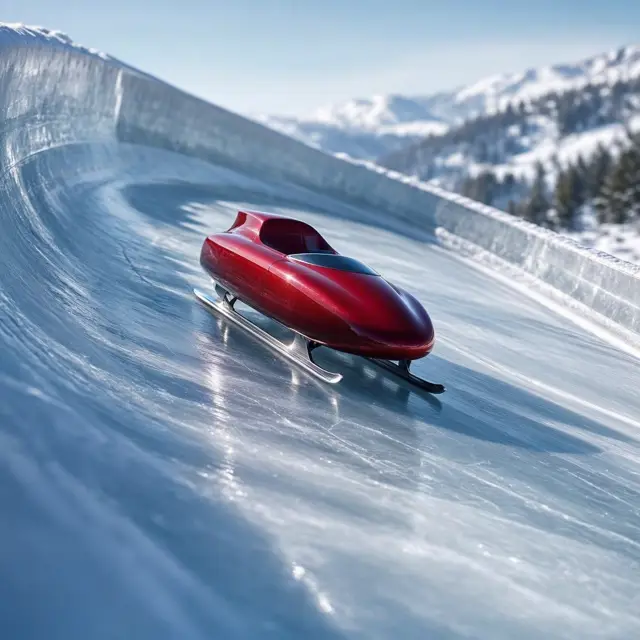
A modern bobsled is built from light metals, steel runners and a smooth aerodynamic body. A four-person sled can be no longer than 3.8 metres, and a two-person sled no longer than 2.7 metres. Before a weight limit came in 1952, crews were often very heavy, because extra weight meant extra speed. Now there are maximums, such as 630 kilograms for a four-man sled with its crew. Lighter teams can add metal weights to reach the limit.
Sleds once carried five or six people, but in the 1930s crews were cut to two or four. A four-person crew has a pilot, a brakeman and two pushers. The pushers need speed and strength to get the sled moving fast at the start. Since 2014, women have also been allowed to race in four-person events.
Steering is surprisingly gentle. The pilot pulls on two metal rings linked to pulleys that turn the front runners. Pull the left ring, and the sled goes left. Only tiny moves are needed, because at speeds up to 130 km/h, anything bigger could cause a crash.
Monobobs and Races Won by Hundredths
A one-person bobsled is called a monobob. Single sleds were first used for adaptive bobsleigh, for athletes who can drive a sled but not push it, and for young athletes not yet strong enough to push a big sled. Women's monobob joined the Olympics in 2022, so that women and men would have the same number of bobsleigh events.
Since the 2020-21 season, every monobob in major races must come from a single official builder. The sled must weigh at least 162 kilograms on its own, and no more than 247 kilograms with the athlete on board. That means the athlete can weigh no more than 85 kilograms.
Each run, called a heat, starts with the crew pushing the sled for up to 50 metres before jumping in. Grooves in the ice keep it on line at first. Times are recorded in hundredths of a second, so even tiny mistakes show up in the results. At the Olympics and World Championships, every race is decided over four heats.