Sixty-Four Squares, One Target
Chess is a board game for two players, played on a square board of 64 squares in an 8×8 grid. The players, White and Black, each control sixteen pieces: one king, one queen, two rooks, two bishops, two knights and eight pawns.
Each piece type moves in its own pattern, and an enemy piece is captured — removed from the board — by moving your own piece onto its square.
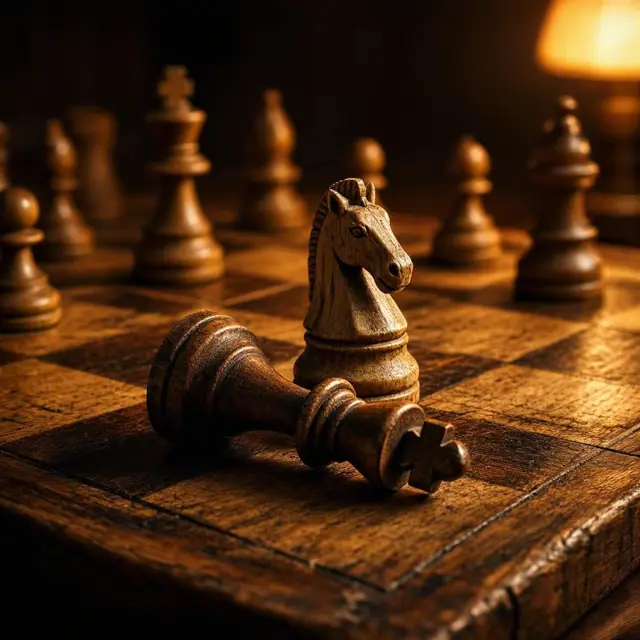
The objective is narrower than it first appears. You are not trying to take the most pieces or control the most ground. You are trying to checkmate the enemy king: to threaten it with capture it cannot escape. Everything else on the board exists to serve or obstruct that one aim. There are also several ways a game can end in a draw, which is why chess so often ends with neither player winning at all.
From Chaturanga to Europe
The recorded history of chess starts with the emergence of chaturanga in 7th-century India.
That single ancestor branched widely. Chaturanga is also thought to be the ancestor of related games including janggi in Korea, xiangqi in China and shogi in Japan — meaning the board games of half the world share one family tree.
The western branch travelled by trade and conquest: introduced to Persia, spreading to the Arab world, then to Europe. The modern rules emerged in Europe at the end of the 15th century — this is when the queen became the powerful piece we know — and became standardised with universal acceptance only by the end of the 19th century. So the game is roughly 1,400 years old, but the version you would recognise is about 500, and the agreed rulebook barely 130.
Champions and Federations
Organised chess arose in the 19th century, and international competition today is governed by FIDE, the Fédération Internationale des Échecs.
The first universally recognised World Chess Champion was Wilhelm Steinitz, who claimed the title in 1886. The current World Champion is Gukesh Dommaraju, who won the title in 2024.
Around the competitive game has grown an enormous body of chess theory — accumulated analysis of openings, middlegames and endgames that any serious player is expected to know. Chess also spills well outside its own board: aspects of art appear in chess composition, the game has influenced Western culture and the arts, and it has genuine relevance to mathematics, computer science and psychology. Today it is one of the world's most popular games, with millions of players worldwide.
The Machine That Won, and the Game That Didn't End
One of the goals of early computer scientists was to build a chess-playing machine — chess was treated as a benchmark for machine intelligence itself.
That benchmark fell in 1997, when Deep Blue became the first computer to win a match against a reigning World Champion, defeating Garry Kasparov.
The aftermath is more interesting than the headline. Modern chess engines are now significantly stronger than any human player, and rather than killing the game they have greatly influenced the development of chess theory — humans now study what the machines find. And the final twist: despite all of it, chess is not a solved game. Nobody has computed a perfect strategy from the opening position. The machines beat us comfortably, and still nobody knows what the game's true result should be.