Two Sticks Balanced on Three Stumps
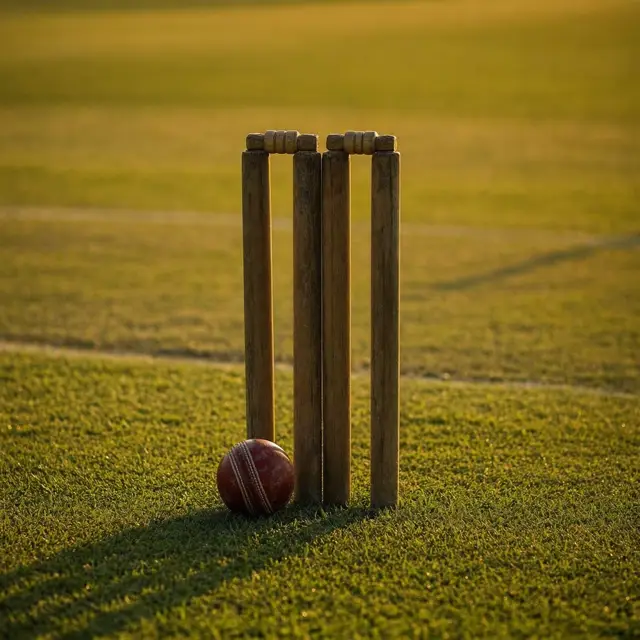
Cricket is a bat-and-ball game played between two teams of eleven, on a field with a 22-yard pitch at its centre. At each end of that pitch stands a wicket: two bails — small sticks — balanced on three stumps.
That fragile arrangement is the whole target of the game. Two players from the batting team, the striker and the nonstriker, stand in front of either wicket with bats. One player from the fielding team, the bowler, bowls the ball toward the striker's wicket from the opposite end.
The striker's goal is to hit the ball and then swap places with the nonstriker — each swap scores one run. Runs also come when the ball reaches the boundary of the field, or when the ball is bowled illegally. Everything else in cricket is elaboration on: hit ball, run, do not let those two little sticks fall.
Ten Ways Out and Then You Swap
The fielding team's job is to stop runs by dismissing batters — getting them "out". There are several ways to do it:
- Bowled, when the ball hits the striker's wicket and dislodges the bails
- Caught, when a fielder catches the ball after the bat hits it but before it touches the ground
- Run out, when a fielder hits a wicket with the ball before a batter can cross the crease line
When ten batters have been dismissed, the innings ends and the teams swap roles. Ten, not eleven — because batting requires two players at the crease, so once ten are out the last one has nobody to bat with.
The ball itself is a serious object: a hard, solid spheroid of compressed leather with a slightly raised sewn seam, enclosing a cork core layered with tightly wound string. Players wear protective gear precisely because of it.
Five Days, or Three Hours
Almost no other sport stretches across such wildly different lengths while remaining the same game.
At one end sit traditional Test matches, played over five days. At the other is Twenty20 — T20 — where each team bats a single innings of 20 overs, an over being a set of six fair opportunities to score, and the whole match lasts three to four hours.
The clothing follows the format. Traditionally cricketers play in all-white kit; in limited overs cricket they wear club or team colours. The change is a useful signal — white flannels mean the long game, colours mean the short one. Five days and three hours, same bat, same ball, same 22 yards.
A Private Club Still Writes the Rules
The earliest definite reference to cricket has it being played in South East England in the mid-16th century. It spread globally with the expansion of the British Empire, and the first international matches came in the second half of the 19th century.
Governance splits in an unusual way. The International Cricket Council (ICC) is the game's governing body, with over 100 members, twelve of them full members who play Test matches. But the Laws of Cricket themselves are maintained by the Marylebone Cricket Club (MCC) in London — a private members' club, still the custodian of the rulebook for a sport played by hundreds of millions.
The game is now played primarily in India, Pakistan, Bangladesh, Sri Lanka, Afghanistan, Australia, New Zealand, England and Wales, South Africa and the West Indies. Australia is the most successful international side, with eight One Day International trophies including six World Cups, and more time as top-rated Test side than anyone else. Women's cricket, long overshadowed, has grown significantly in the 21st century.