Older Than Almost Everything Else on Ice
Curling began in late medieval Scotland, and the physical evidence is startlingly old. A stone inscribed with the date 1511 was found at Dunblane, alongside another dated 1551. The first written record of a competition comes from Paisley Abbey in February 1541.
That makes curling older than most organised sport of any kind, and it was being played on frozen Scottish ponds centuries before anyone thought to codify it.
Formal rules arrived with the Royal Caledonian Curling Club, founded in 1838, which produced the first official ruleset. The Olympic path was slower and stranger: curling was an Olympic medal event in 1924, though that was only recognised retroactively in 2006, and it gained permanent Olympic status in 1998. Mixed doubles joined the programme in 2018.
Bowls, but Sliding, on Ice
Strip away the ice and curling is a cousin of bowls, boules and shuffleboard — get your object closest to the target, and knock your opponent's away.
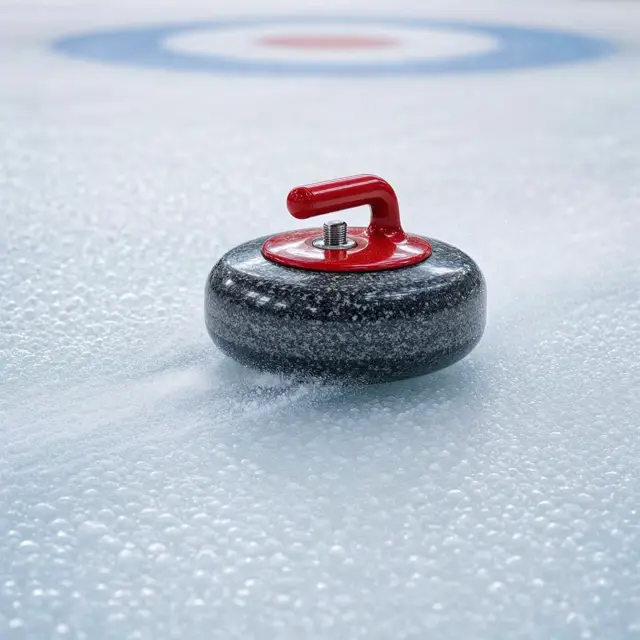
Two teams of four take turns sliding heavy polished granite stones, also called rocks, down a curling sheet toward the house, a circular target marked on the ice. Each team has eight stones, each player throwing two. Points go to the stones resting closest to the centre of the house at the end of each end, which is complete once both teams have thrown all their stones. A game is usually eight or ten ends.
The equipment is unusually specific. Stones weigh between 17.24 and 19.96 kilograms — up to 44 pounds — and the granite comes from just two places: the Scottish island of Ailsa Craig and Trefor Quarry in Wales. The sheet runs 146 to 150 feet long and 14.5 to 16.5 feet wide, with the house marked in concentric rings of 4, 8 and 12 feet.
The Ice Is Bumpy on Purpose
Here is the detail that surprises people who assume ice sports want ice as smooth as possible. Curling ice is deliberately not flat.
Before play, the surface is pebbled — sprayed with water droplets that freeze into small raised bumps. The result "resembles an orange peel, and the stone moves on top of the pebbled ice." Riding on the tips of those bumps rather than the full flat surface reduces friction and is what enables the stone's characteristic curved path.
It also names the sport. Curling is known as the roaring game because of the sound the stones make travelling over the pebble. A smooth sheet would be quieter, slower, and would not curl properly — the imperfection is the entire point.
Why Grown Adults Sweep the Floor
The sweeping looks comic to newcomers and is in fact the most technical part of the game.
The thrower creates a curved trajectory — the curl — by gently rotating the stone as they release it. From there, two sweepers move alongside with brooms or brushes, sweeping the ice in its path. Sweeping reduces friction, which makes the stone travel farther and in a straighter line, with less curl. The explanation given is the Thin Film Model, where the friction created makes a smoother path for the rock to travel down.
That trade-off is what turns curling into a strategy game rather than a throwing contest. Because sweeping simultaneously extends distance and reduces curve, a team is constantly choosing between reaching a spot and bending around a guard. Add the hammer — the last-stone advantage in an end — and the sport becomes closer to chess played at walking pace, where the throw sets the plan and four people spend the next twenty seconds negotiating with physics.