Why Fencers Wear White
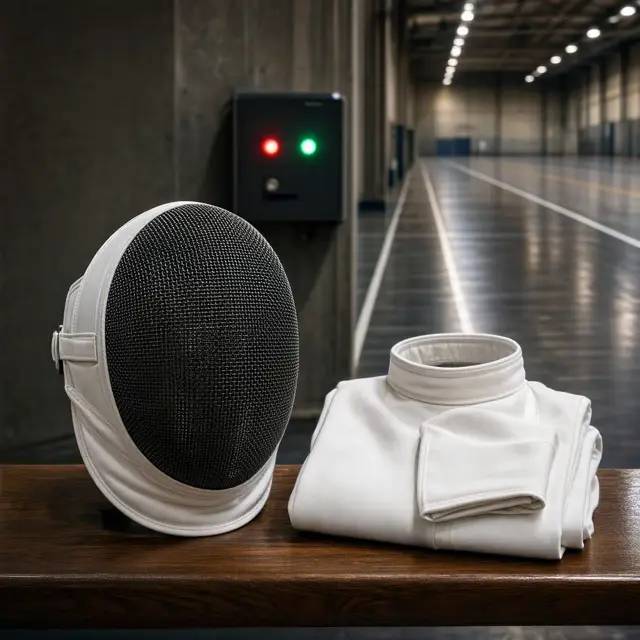
Fencing touches can be very fast and very light. Before electronics, the tip of a weapon was sometimes covered in dye, soot or coloured chalk. A hit left a mark, and the referee could see where it landed. That may be why the fencer's uniform is traditionally white, while an instructor's is black.
At the first organised fencing competition, held in London in 1880, the foils were tipped with black to help the judges. Each bout was fought to five hits.
Then came electricity. Starting with épée in 1933, side judges were replaced by an electric scoring box, with a sound and a red or green light for each touch. Foil followed in 1956 and sabre in 1988. Fencers now wear a lamé, a jacket that conducts electricity, and a body cord runs up the sleeve to the box. The plug's pins are spaced unevenly, so it cannot go in the wrong way.
One Sport, Three Rulebooks
Fencing has three disciplines, each with its own weapon and rules. The foil is light, at most 500 grams, and only the torso counts as a target. Hits must land with the tip. If both fencers hit within 300 milliseconds, the referee uses right of way to decide who gets the point.
The épée is heavier, up to 775 grams, and the whole body is a target, from head to toe. There is no right of way at all. If both fencers hit at the same time, they both score. A large bell-shaped guard protects the hand and wrist.
The sabre is the newest weapon. It can cut as well as thrust, and it targets everything above the waist. Hits with the whole blade count, not just the tip. In sabre, a touch off the target does not even stop the action, so the fencing simply keeps going. Most top fencers specialise in just one of the three.
From Old Manuals to High-Speed Chess
Fencing grew out of swordsmanship for duels and self-defence. The oldest surviving Western fencing manual, known as the Tower manuscript, was written around 1300 in what is now Germany. In the 1500s, a school in Bologna took the lead. Its founder, Filippo Dardi, was also a professor of geometry at the University of Bologna.
The shift to sport came in 1763. Domenico Angelo opened a fencing academy in Soho, London, and taught the rich the fashionable art of the sword. His family ran it for three generations. He set the rules of posture and footwork that still guide modern fencing. He was also the first master to stress its health and sporting benefits.
Today fencing is called "high-speed chess". Each bout begins and ends with a salute, and good sportsmanship is stressed at every level. In the 1880s, the French master Camille Prévost wrote down its basic conventions, and fencing clubs and national groups soon spread around the world.
An Olympic Original
Fencing was one of the first Olympic sports. Along with athletics, cycling, swimming and gymnastics, it has been part of every modern Olympics. The 1904 Games even had a fourth discipline, singlestick, but it was dropped after that year.
Women's individual foil arrived at the 1924 Paris Games. For a time, women were kept out of épée and sabre, which were seen as too dangerous. Women's épée joined the Olympics in 1996 and women's sabre in 2004. The 2020 Olympics were the first to include every fencing event.
The sport is run by the FIE, based in Lausanne, Switzerland, with 155 national federations. In early pool rounds, a bout lasts until 5 hits or 3 minutes. In knockout rounds, fencers race to 15 hits within three 3-minute periods. Team matches work like a relay. Three fencers each face all three rivals, and the first team to 45 hits wins.
Lunges, Flèches and Lightsabers
Fencing has a whole language of moves. The lunge is the classic attack, a fast step forward with the front leg while the back leg pushes. A feint is a fake attack to trick a reaction. To defend, a fencer uses a parry to knock the blade away, then strikes back with a riposte.
Some moves look like stunts. In the flèche, the fencer leans past the point of balance, crosses their feet and runs right past the opponent after the hit. Crossing the feet is illegal in sabre, so sabre fencers use the "flunge", a flying lunge. The flick bends the blade like a whip to hit hidden spots.
The kit is tough. Tournament fabric must resist a force of 800 newtons, and masks must hold 25 kilograms on the mesh. There are fun variants too. In chair fencing, rivals fence while seated. A version with toy lightsabers even appeared on the sports channel ESPN2 in 2018.