Banned by Royal Decree, Then Not
The first written record of golf in Scotland is not a celebration. It is a prohibition.
In 1457, James II banned the game outright, because it was pulling people away from practising archery, which the kingdom actually needed. That is the earliest documentary evidence we have that golf existed at all: a complaint that too many people were playing it.
The ban held until 1502, when James IV lifted it, having become a golfer himself. The royal accounts settle the matter beautifully. In 1503 and 1504 there is a payment recorded "for golf clubbes and balles to the King that he playit with".
So the sport's entry into the historical record runs: banned for being too popular, then unbanned by a monarch who had tried it and liked it. Scotland is now generally called the home of golf, and the modern game did originate there in the 15th century.
The Eighteen Holes Were an Edit
Almost nothing about a golf course is a natural constant, including the number everyone treats as sacred.
The standard 18-hole round was created at the Old Course at St Andrews in 1764, when members modified the course from 22 holes down to 18. There is no deeper logic to the number. Someone shortened a course and the world copied it.
The rest of the furniture was standardised gradually too. The oldest surviving rules of golf were compiled in March 1744 for the Company of Gentlemen Golfers, who played at Leith. Musselburgh Links is certified by Guinness World Records as the world's oldest golf course, documented in play as early as 2 March 1672.
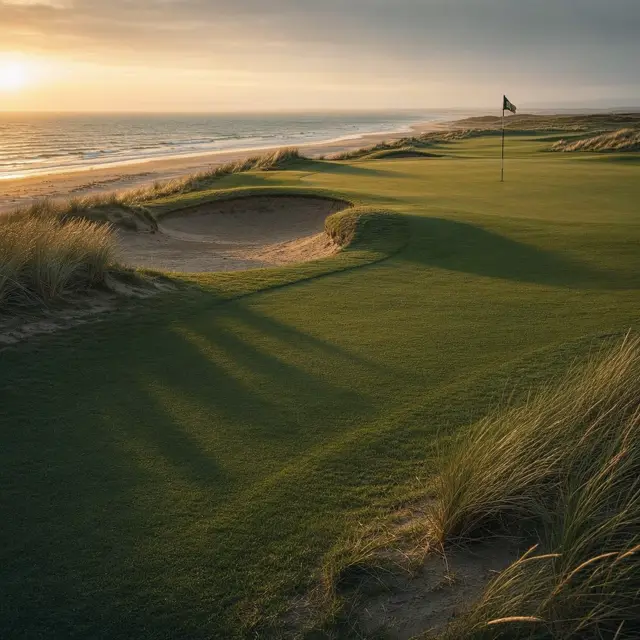
Golf is also unusual among ball games in having no standardised playing area at all. Coping with wildly different terrain is part of the sport, which is why a course beside the sea is a links, and why holes bend into what players call a dogleg.
Everyone Wants to Claim It
Where golf ultimately comes from is genuinely unsettled, and several countries have a reasonable case.
Some historians trace it to the Roman game of paganica, played with a bent stick and a stuffed leather ball, which may have spread across Europe with Roman conquest and slowly turned into something recognisable.
Others point to chuiwan, a Chinese game played between the eighth and fourteenth centuries whose name combines striking and small ball. A Ming Dynasty scroll from 1368 called The Autumn Banquet shows a member of the imperial court swinging what looks very much like a golf club at a small ball, aiming to sink it in a hole.
There are European contenders too: cambuca in England, chambot in France, the more polo-like Persian game chowkan, and kolven in the Netherlands, played annually at Loenen from 1297 onward to mark the capture of an assassin the year before.
From Prestwick to an Orchard in Yonkers
Golf's first major, and the oldest tournament still running anywhere in the sport, is The Open Championship. It was first played on 17 October 1860 at Prestwick Golf Club in Ayrshire, and Scottish golfers won the earliest majors.
Today The Open is one of four men's majors, with the other three all played in the United States: The Masters, the U.S. Open and the PGA Championship.
The American side of the story starts far more modestly than that lineup suggests. In 1888 two Scotsmen from Dunfermline, John Reid and Robert Lockhart, demonstrated golf in the United States by setting up a hole in an orchard. Reid founded America's first golf club the same year, Saint Andrew's Golf Club in Yonkers, New York.
Most play still comes down to two formats: stroke play, counting total shots, which dominates at elite level, and match play, won by taking the most individual holes.