From Ancient Greece to Berlin
Gymnastics grew out of exercises in ancient Greece, including skills for getting on and off a horse. The word comes from the Greek verb gymnazo, meaning "to train" or "to exercise". In Athens, physical training was combined with the education of the mind. One ancient writer even compared gymnastics to philosophy, poetry, music, geometry and astronomy as a form of wisdom.
The modern sport took shape in Germany. In 1811 Friedrich Ludwig Jahn started the German gymnastics movement in Berlin. It led to the invention of the parallel bars, the rings, the horizontal bar, the pommel horse and the vault horse. Those names still fill the men's program today.
The idea spread fast. Charles Beck opened the first gymnasium in the United States in 1825. The international federation was founded in Liege in 1881, and men's gymnastics was part of the first modern Olympic Games in 1896. Women's Olympic gymnastics began in 1928 in Amsterdam, with a limited program of synchronized calisthenics.
Six Events for Men, Four for Women
Artistic gymnastics is the most common competitive form. Men compete on six events: floor, pommel horse, still rings, vault, parallel bars and horizontal bar. Women compete on four: vault, uneven bars, balance beam and floor.
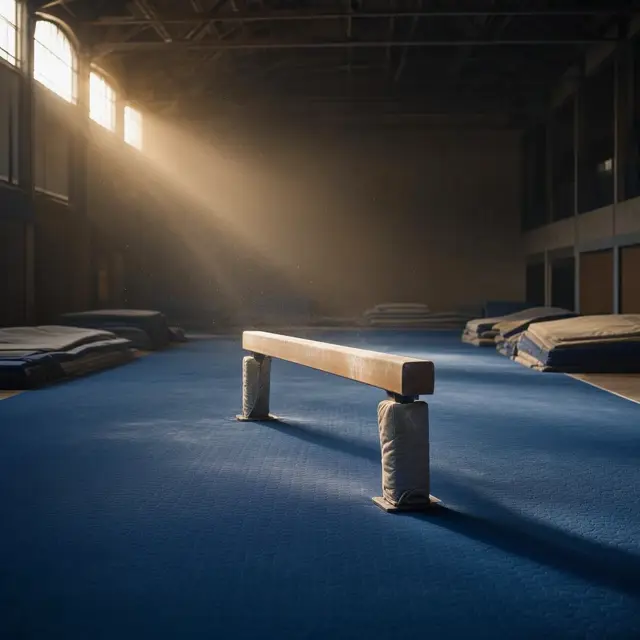
The numbers are wild. The balance beam is 5 metres long, just 10.16 centimetres wide and 125 centimetres off the ground. The still rings hang from a point 5.75 metres above the floor, and the gymnast must stop them from swinging. On the horizontal bar, a steel bar 2.8 centimetres thick, gymnasts swing full circles called giants, then let go for dismounts like a triple-back salto.
Even the floor has its own rules. It is a carpeted 12 by 12 metre square on springs, called a spring floor. Women perform to music without words. Men perform without music and must touch every corner of the floor at least once. In 2001 the old vaulting horse was replaced by a wider, more stable vaulting table, and gymnasts began attempting harder vaults.
Goodbye to the Perfect 10
For decades, a gymnast's score was taken off a maximum of 10. That changed in 2006. Now the final score adds two parts together. The E score judges execution. It starts at 10 and drops with every mistake. The D score measures difficulty, and it is open-ended.
Because the D score has no theoretical cap, neither does the total. This is called "open-end" scoring, although in practice there is still a limit. The harder the skills a gymnast performs and links together, the higher they can climb. But if they skip a skill, or fail to connect two moves that were meant to be joined, their difficulty score drops.
The rule book, called the Code of Points, is revised a little for each four-year cycle ending in an Olympic year. Not everyone has switched, though. US women's college gymnastics still uses the old 10.0 system. And back in 1954, the newly standardized Olympic events used a point system from 1 to 15.
Ribbons, Trampolines and Freerunning
Rhythmic gymnastics mixes ballet, dance and gymnastics with handheld apparatus: ball, hoop, clubs and ribbon. The ribbon is six metres of satin, so it tangles easily, and any knots must be undone or the gymnast is penalized. In a move called a boomerang, the gymnast tosses the handle, then pulls it back by the end of the ribbon and catches it.
Trampolining has been part of the Olympic Games since 2000. A routine is ten bounces in a row without a pause, each with an aerial skill. The time taken to finish those ten skills counts too, because it shows how high the jumps were. In tumbling, athletes power through a pass of eight flips and twists down a 25-metre sprung track.
The family keeps growing. Parkour, also known as freerunning, got the go-ahead as a FIG sport in 2018. Its first world championships took place in Tokyo in October 2022. Para-gymnastics, for disabled athletes, became a new FIG discipline in October 2024.
Rope Races, Pole Tricks and a Giant Wheel
Some events have vanished. Competitors once raced up a rope 6 or 8 metres long, starting from a seated position and using only their hands and arms. Club swinging, also called Indian clubs, was part of the 1904 and 1932 Olympic Games. Flying rings, a swinging version of the still rings, was a US college event until the early 1960s.
Other forms live outside the main federation. In wheel gymnastics, athletes perform inside a large wheel known as the Rhönrad or German wheel, and its first world championships were held in 1995. In India, mallakhamba has gymnasts perform feats and poses on a vertical wooden pole or rope. Its name can be translated as "pole gymnastics", and in 2013 the state of Madhya Pradesh made it its state sport.
One common misconception is worth clearing up. Gymnasts do tend to be short, but it is unlikely that the sport affects their growth. Their parents also tend to be shorter than average.