A Sport With a Birthday
Handball has an actual birthday. On 29 October 1917, Max Heiser, Karl Schelenz and Erich Konigh published the modern rules in Berlin, and that date is seen as the sport's date of birth. The first official match followed on 2 December 1917.
The idea is much older, though. Ancient Greek pots and stone carvings show people throwing balls to each other. Roman women played a version called expulsim ludere. There are records of handball-like games in medieval France and among the Inuit of Greenland.
The first written rules for team handball came in 1906 from Holger Nielsen, a Danish gym teacher who was also an Olympic medalist. The International Handball Federation was founded in 1946, and as of 2016 it had 197 member federations.
Seven Players, Three Steps
A handball team has seven players on court: six outfield players and one goalkeeper. They pass the ball with their hands and try to throw it into the other team's goal. A match has two halves of 30 minutes. It is fast and high-scoring, and professional teams now usually score between 20 and 35 goals each.
The ball rules are strict. Players can hold the ball for only three seconds and take only three steps. After that they must pass, shoot or dribble. Only the goalkeeper may touch the ball with the feet, and only inside the goal area.
Defenders are allowed body contact to stop attackers. Yet no protective gear is required. The ball is sized to be handled with one hand, and it must not have a shiny or slippery surface.
Flying Into the Forbidden Zone
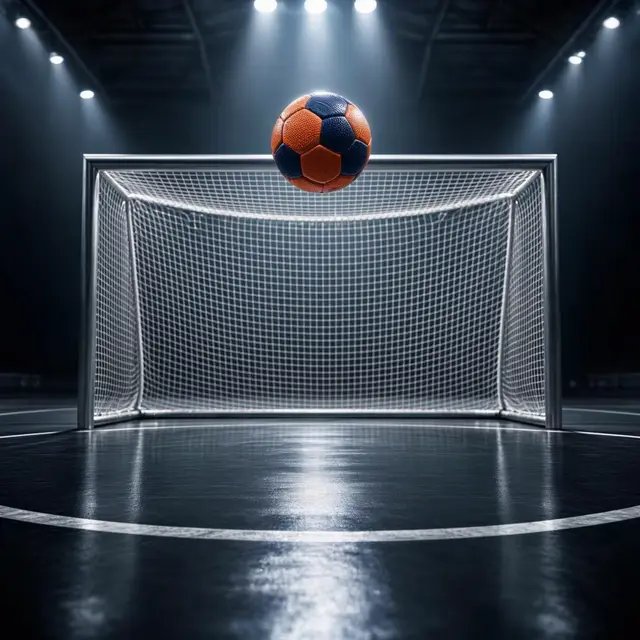
Around each goal is a line six metres out. Inside it lies the crease, a zone where only the defending goalkeeper may stand. The goal itself is two metres high and three metres wide.
Here is the fun part. Attackers cannot touch the floor inside the crease, but they can fly over it. A player can jump from outside the line, catch a pass in mid-air, and shoot before landing. Landing inside is fine, as long as the ball is already gone. When a diving player passes to another diving teammate, it is called doubling.
The quirky rules keep coming. If the ball touches the ceiling, the other team gets a throw-in. If a goalkeeper knocks the ball out over the goal line, their own team keeps it. And since a 2015 rule change, any player can replace the goalkeeper as an extra attacker, which led to many more goals scored into empty nets.
Yellow, Red and Even Blue Cards
A handball match has two equal referees, not one boss and one helper. If they disagree on a punishment, the stricter one wins. They even swap places on court about every ten minutes. Together they use 18 official hand signals.
Punishments climb step by step. A yellow card is a warning. Next comes a two-minute suspension, when the player sits out and the team plays one short. Three of those bring a red card. A blue card may follow a red one when the referees will file a report.
The rules also protect the goalkeeper. On a penalty throw, hitting a goalkeeper who is standing still in the head means an instant red card. And teams cannot stall forever. Since 1995, a referee raises one hand to warn of passive play, meaning the attackers must shoot soon or lose the ball.
Olympic Stages and Record Crowds
Men's handball first appeared at the 1936 Olympics in Berlin, played outdoors. It vanished for decades and came back indoors at the 1972 Munich Games. Women's handball joined the Olympics in 1976.
Europe rules the sport. Since 1938, European countries have won every medal but one at the men's world championships. On the women's side, only two non-European countries have ever won the world title: South Korea and Brazil. The game is also popular in East Asia, North Africa and parts of South America.
The crowds can be enormous. On 10 January 2024, the opening matches of the European Men's Championship in Düsseldorf drew 53,586 spectators, a world record for the sport. Handball has even landed on money. A Greek €10 coin from 2003 shows a modern player beside an ancient one, and Britain made a 50 pence coin for the 2012 London Olympics.