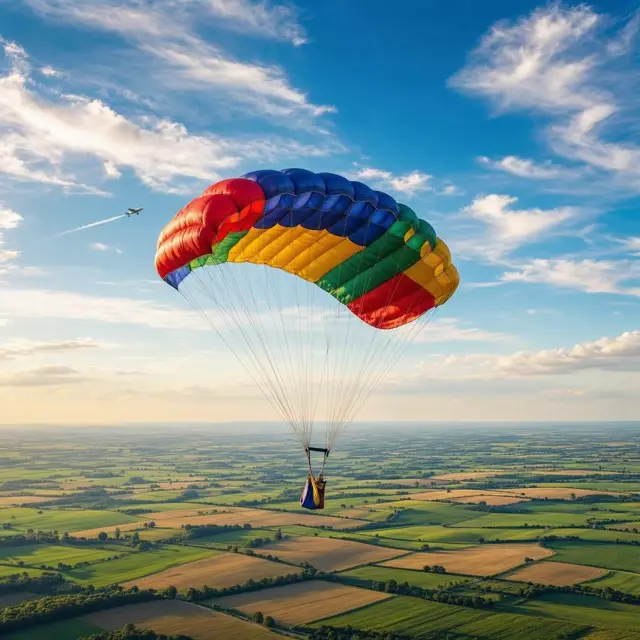
A Silk Leap Over Paris
On 22 October 1797, a French balloonist named André-Jacques Garnerin rose over Paris, cut his basket loose from the balloon, and dropped. His silk canopy opened at about 910 metres. It was the first well-documented parachute descent. Early jumps like his were mostly public shows or emergency experiments.
In 1914, Tiny Broadwick had a problem. Her static line got tangled with the aircraft, so she opened her parachute by hand instead. The Smithsonian calls it the first planned freefall descent. In 1919, after the manual ripcord was developed, Leslie Irvin made an intentional freefall jump from an aeroplane.
The sport took off after the Second World War. The first World Parachuting Championships were held at Bled in 1951, and they focused on landing accuracy. Today, parachutes are also used by firefighters called smokejumpers, who drop in to reach remote wildfires.
How a Jump Actually Works
A sport jump starts with stepping out of the plane. Falling belly-down, a skydiver soon reaches terminal velocity, about 200 km/h. Diving head-down in a streamlined shape makes you fall even faster.
To open the main parachute, the jumper releases a pilot chute, a small parachute that drags the big one out. Opening happens in three stages: activation, deployment and inflation. Most modern sport parachutes are a ram-air canopy. Air rushes into openings at the front and puffs the fabric into a wing shape that glides.
Steering is simple. Pull one toggle to turn, or pull both to slow down. Just before touching down, the jumper pulls both toggles down, which cuts forward speed and descent. A 2023 review of more than 62 million civilian jumps found an injury rate of 0.044%, with most injuries happening during landing.
Learning to Fall With Style
Beginners have several paths. In a tandem jump, a student is strapped to an instructor who handles everything, from the exit to the landing. In static-line training, a line tied to the aircraft opens the student's parachute automatically. In accelerated freefall, instructors hold on to the student's harness during freefall at first.
You can also learn without leaving the ground. Vertical wind tunnels let people practise body flight, and indoor skydiving has grown into its own competitive sport.
A modern setup includes a main parachute and a backup reserve. Many rigs also carry an automatic activation device, which opens the reserve by itself in certain conditions. Before group jumps, teams often rehearse their moves on the ground, walking through the exit and each formation. This practice has a fun name: a dirt dive. Jumps take place over a drop zone, a set landing area.
Sports Played in Mid-Air
Skydiving is not one sport but many. In formation skydiving, teams of four or eight link up in freefall to build shapes, earning one point for each correct formation. A camera flyer films every jump for the judges.
Other events get even stranger. In canopy formation, jumpers link their open parachutes together, stacking them into shapes. In freeflying, people fall sitting, standing or head-down. Skysurfers once rode boards in freefall, until that event was dropped from FAI competition in 2009. Wingsuit flyers wear suits with fabric between the arms and legs, which slows their fall and speeds them forward. You need at least 200 previous skydives to try one in the United States.
Old-school skills still count. In accuracy landing, competitors aim to touch down on the exact centre of a target. And paraski combines accuracy landing with giant slalom skiing.
Jumping From the Edge of Space
Some jumps sound almost impossible. In 1960, US Air Force officer Joseph Kittinger stepped off from 31,333 metres. He fell for 4 minutes and 37 seconds and passed 965 km/h before opening his main parachute.
In 1962, Soviet parachutist Yevgeny Andreyev jumped from a balloon near Saratov and fell 24,500 metres before opening his canopy. In 2012, Felix Baumgartner jumped from 38,969.4 metres above New Mexico and reached 1,357.6 km/h. Two years later, Alan Eustace raised the height record to 41,422 metres.
Group records are just as wild. The largest official freefall formation had 400 skydivers linked together over Udon Thani, Thailand, on 8 February 2006. In 2025, 174 skydivers built a head-down formation over Illinois. As of July 2026, that one was still listed as a preliminary record claim.